Historic elevator
Lacerda Elevator Audio Guide (Elevador Lacerda)
Seventy-two metres of Art Deco concrete stitch together Salvador's port and its square of power: an elevator that covers, in about twenty seconds, the cliff that splits the city in two, and that had to knock down a courthouse to be born.
- 25 min of audio
- Art Deco and engineering
Since its founding in 1549, Salvador has lived on two levels: the Falha de Salvador, a tectonic fault, separates the Cidade Alta of government from the Cidade Baixa of the port with a drop of about 85 metres. The Elevador Hidráulico da Conceição opened on 8 December 1873 to overcome that escarpment, and the 1930 renovation added a second reinforced-concrete tower that raised it from 63 to 72 metres and gave it the Art Deco profile that now dominates the bay.
Its story is full of twists: the excavations cracked the old Tribunal da Relação, which ended up demolished; the family that promoted the project went bankrupt a few years later; in the hydraulic era every passenger was weighed before boarding, and locals called it “the Screw”. Today its cabins are still driven by Otis motors built exclusively for it.
Highlights
- 1930 Art Deco tower: reinforced concrete that raises the structure from 63 to 72 metres above Praça Cairu
- 2019 plaque recalling the Tribunal da Relação, demolished from 1871 onwards because of the elevator works
- Otis 74D motors built exclusively for the elevator, installed in 1930 and 1961
- Viewpoint over All Saints Bay and Forte de São Marcelo from Praça Tomé de Sousa
- 1930 “Lacerda” sign, restored and lit in the renovation that reopened in 2025
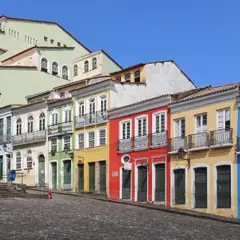
Few cities carry their social order as plainly written into the terrain as Salvador. When Tomé de Sousa founded it in 1549, the Falha de Salvador, an escarpment of tectonic origin, had already split it into two levels about 85 metres apart: above, the Cidade Alta, with the palaces and power; below, the Cidade Baixa, with the port and trade. For more than three centuries, everything that went up or down that drop did so by pulley cranes or on the backs of human beings.
The story of the Lacerda Elevator begins on 17 October 1869, when work started on an elevator that many in the province dismissed as a “utopia”. It opened on 8 December 1873, the feast day of Nossa Senhora da Conceição da Praia, as the Elevador Hidráulico da Conceição, and the local press and the Prefeitura now present it as the first urban elevator in the world, although other sources prefer to call it one of the first. The 1930 renovation gave it its present architecture: an outer reinforced-concrete tower, four cabins and a 72-metre Art Deco silhouette that has become the emblem of the port.
What to see at the Lacerda Elevator goes well beyond a twenty-second ride. The audio guide starts at the viewpoint on Praça Tomé de Sousa, passes the plaque of a vanished courthouse, accompanies the trip in the cabin and ends at the foot of the tower, with documented narration that keeps its most revealing episodes for the place itself.
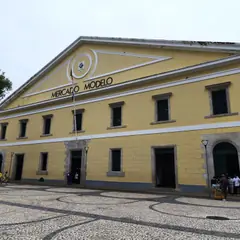
Below, the cabin opens onto the Mercado Modelo, in the old port customs house; above, a few minutes on foot through the Cidade Alta, the Largo do Pelourinho awaits, and following the bay to the south you reach the Solar do Unhão.
The escarpment that separates power from the port
Praça Tomé de Sousa
Summary of this stop
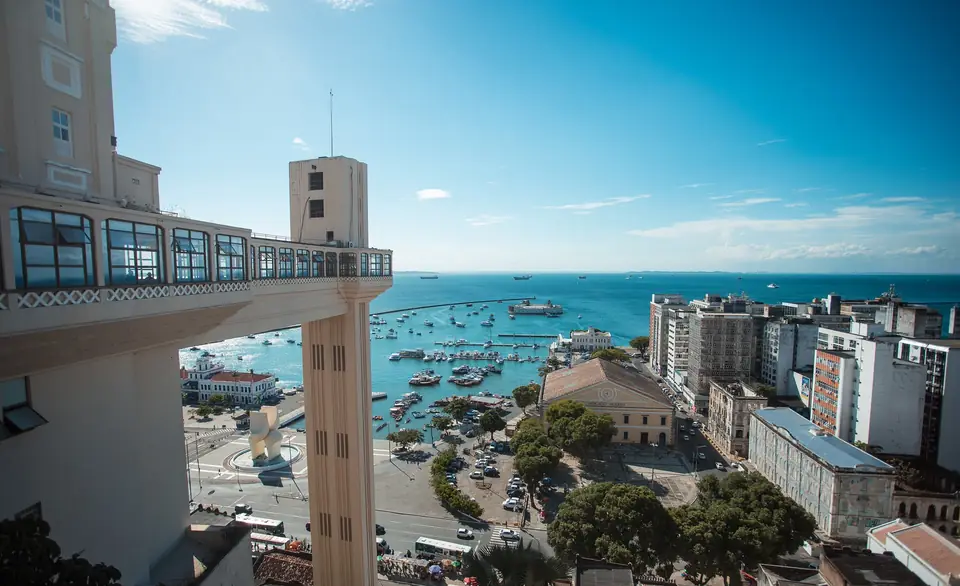
On the balustrade of Praça Tomé de Sousa the scale of the cliff becomes clear at once. Below stretch the port, the Mercado Modelo and, over the waters of All Saints Bay, the round silhouette of Forte de São Marcelo. From here it is easy to see why a city with government above and goods below sooner or later needed a machine.
Before the elevator there were the guindastes, pulley cranes that hoisted loads up the escarpment. The oldest, the Guindaste da Alfândega, owned by the government, stood in the middle of today’s Praça Municipal, right beside where the elevator now begins. But people did not ride the crane: until the mid-19th century they passed from one city to the other on the backs of enslaved men or in cadeirinhas, sedan chairs carried by two Black porters, who also hauled the port’s cargo up the ladeiras. In 1860, Prince Maximilian of Austria noted that this means of getting around owed its existence to slavery.
That past makes the viewpoint more than a postcard. Why one of the city’s slopes bears, according to a popular explanation, a name born of the complaints of those who carried the loads is one of the details revealed when you listen to the narration on the spot.
A courthouse brought down by a dream
Tribunal da Relação plaque
Summary of this stop
On one of the pillars leading to the upper platform, a plaque placed on 7 March 2019 recalls something almost nobody suspects when walking by: on this very ground stood the first own seat of the Tribunal da Relação, Bahia’s court of justice since the 17th century. It was a sobrado built on clay at the edge of the escarpment, next to the Government Palace, and in 1808 it had housed Carlota Joaquina.
The excavations of 1869 and 1870 to house the cabins inside the rock opened cracks in the building. After the rains of June 1870 the courthouse was evacuated, and from July 1871 the sobrado was demolished. Antônio de Lacerda, who promoted the project with his brother Augusto Frederico, wrote that his tower and his tunnel in living rock surpassed those of the European lifts, and that even so he ran into the distrust of a province where many did not want to put up capital.
The distrust had some economic basis. Around 1877, four years after the opening, the elevator did not earn enough to pay back the investment and the Grupo Lacerda went bankrupt. The surname came later: at the end of the 19th century, in 1896 according to the most cited date, the elevator was officially renamed Elevador Lacerda. The name that shines today at the top of the façade thus hides a story of ruin, and the narration tells at this point how the family’s fall was lived.
The scale, the water and the Screw
Lacerda Elevator cabins
Summary of this stop
The tunnel that enters the rock of the escarpment leads to the cabins, and the ride becomes a story in itself. In hydraulic times the elevator had a maximum load and every passenger was weighed before boarding: on 16 March 1889 the Barão de Jeremoabo noted in his diary his 61 kilos and those of other authorities, between 54 and 115. Antônio de Lacerda himself, who died in 1885 having seen nothing but his hydraulic elevator, paid his fare like any other user and demanded the same of his family.
The system depended on the city’s water, and that had consequences. In 1910 the elevator stood idle for several days for lack of supply, and in December 1912 a cabin fell from a height of 12 metres. Sources do not agree on exactly when electric traction arrived, but they do agree on what moves the cabins today: Otis model 74D motors built exclusively for this elevator, two installed in 1930 and two more in 1961, when the elevator already belonged to the Prefeitura and the capacity of each cabin went from 16 to 32 people.
For Bahians, that first machine was soon the “Parafuso”, the Screw. In 1884 a British traveller described the tower seen from the sea, bought his ticket and stepped into what he called a kind of lion’s cage. Who shared the ride with him and what smelled of smoke inside the cabin is told during the descent itself.
Looking up from Praça Cairu
Praça Cairu
Summary of this stop
At the foot of the escarpment, facing the Mercado Modelo, the lower station opens onto Praça Cairu with three metal-grille doors lettered “Entrada”, “Lacerda” and “Saída”. From here the 1930 tower is seen whole: that year’s renovation added this second reinforced-concrete tower, with vertical pilasters, which descends to the Cidade Baixa, raised the structure from 63 to 72 metres, doubled the number of cabins from two to four and fixed its Art Deco look.
The elevator is also recent news. On 25 February 2025 it reopened after ten months of works, with air-conditioned cabins, the sign restored and lit, and the verandas of the upper station open again as balconies. The fare rose from 0.15 to 1 real, and Salvador Card users ride free. A modest price for something Salvador has repeated for generations: that stepping into the Lacerda is the quickest way to “go up in life”.
This gesture of raising your eyes to the tower also has a soundtrack. In 1963 the Trio Nordestino made its record debut with “Retrato da Bahia”, a samba by Riachão that starts exactly here. What the song’s protagonist sees when he looks up, and why that is enough to portray all of Bahia, is the finale the audio guide saves for the end of the route.