Afro-Brazilian sanctuary
Bonfim Church Audio Guide (Basílica Santuário Senhor do Bonfim)
The vow of a slave-ship captain raised this sanctuary on the hill of Itapagipe, but it was Bahia's Black people who made it their own: they wash it, sing to it and surround it with ribbons even when its doors are shut.
- 45 min of audio
- Faith and candomblé
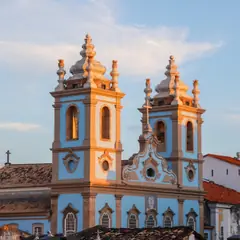
Bonfim Church was born of a storm at sea. Captain Theodósio Rodrigues de Faria vowed to bring to Salvador a replica of the Senhor do Bonfim venerated in Setúbal, and the image, a little over a metre tall, arrived in 1745. It waited almost a decade in the Igreja da Penha until, in 1754, it entered in procession the temple raised by the Devoção do Senhor do Bonfim; the towers were not finished until 1772. Outside, a Rococo pediment, Portuguese azulejos of 1873 and two bulbous 19th-century tops; inside, 28 azulejo panels painted in Lisbon and a neoclassical baldachin altarpiece.
The founder of the cult owned three ships and trafficked enslaved people, and his gravestone is still in the central aisle, beneath a ceiling that paints his ship in the storm. Yet the festival that made the temple famous is Afro-Brazilian: every January some 200 baianas dressed in white pour perfumed water over the steps for Oxalá, with the doors closed ever since an archbishop banned the washing in 1889.
Highlights
- Lavagem staircase: every January some 200 baianas sprinkle it with perfumed water after walking 8 km, a festival recognised by IPHAN in 2014
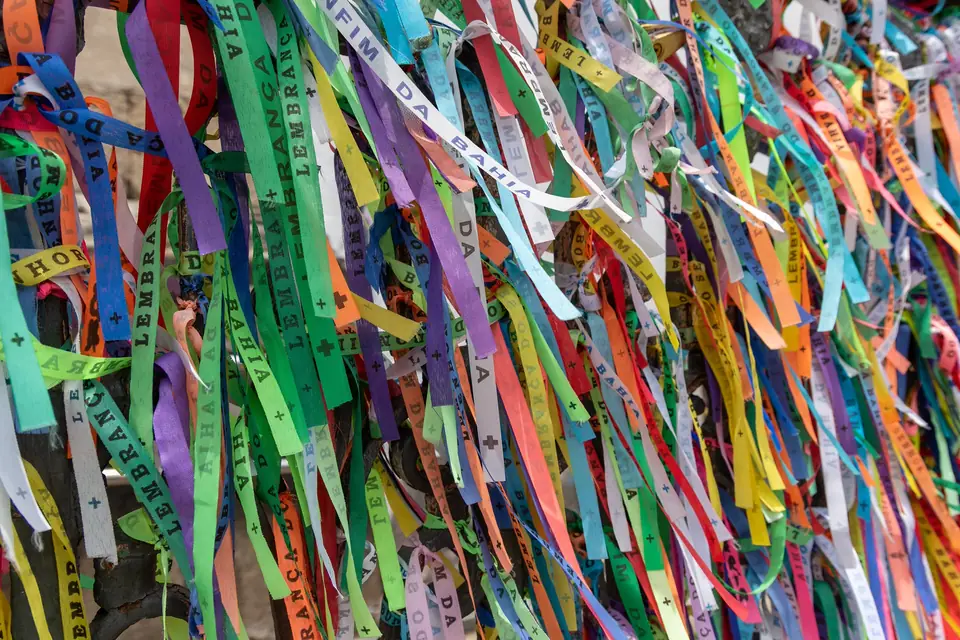
- Railings covered in fitinhas, heirs of a 47 cm measure that reproduced the length of the image's arm
- Gravestone of the founder, a trafficker of enslaved people, under Franco Velasco's ceiling (1818-1820) showing his ship in the storm
- 28 azulejo panels of the life of Christ painted in Lisbon in 1855 and a neoclassical altarpiece of 1813-1814
- Room of Miracles with wooden and silver ex-votos and a coin dented by a bullet
At the top of the Sacred Hill of Itapagipe stands the most popular temple in Bahia. The story of Bonfim Church begins at sea: Captain Theodósio Rodrigues de Faria, caught in a tempest, vowed to bring to Salvador a replica of the Senhor do Bonfim venerated in Setúbal. The image landed on 18 April 1745, Easter Sunday, although another version moves the arrival and the start of the works back to 1740. What is not disputed is the wait: the Christ spent almost ten years kept in the Igreja da Penha.
In 1754, with the interior finished, the image of the crucified Christ and that of Nossa Senhora da Guia went up in festive procession to the new church, the work of the Devoção do Senhor do Bonfim, founded in 1746. The most cited date is 24 June, although some push it to July. The towers still took until 1772, and the façade kept changing throughout the 19th century.
What is fascinating about this sanctuary is the distance between the one who founded it and those who fill it. The vow of a trafficker of enslaved people raised it and the Black devotees of Salvador, who identify the Senhor do Bonfim with Oxalá, made it their own. The audio guide covers the largo, the staircase, the railings and the interior, with documented narration checked against historical sources that keeps its most surprising episodes for the place itself.
In the Historic Centre, the Rosário dos Pretos Church tells the faith of the brotherhood of enslaved and freed people who built it, and the São Francisco Church the golden Baroque of the friars: the other two great temples of Salvador.
Bulb-topped towers for a sailor’s vow
Largo do Bonfim
Summary of this stop
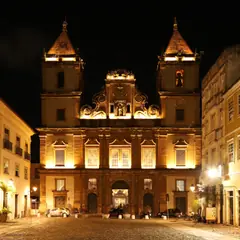
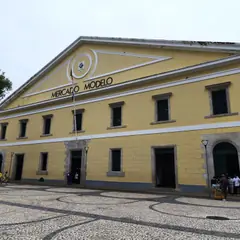
The route begins in the Largo do Bonfim, facing the façade. From here the architecture of Bonfim Church can be read at a glance: a Rococo pediment with volutes, a lower part clad in 1873 with yellowish-white industrial Portuguese azulejos and two towers topped with bulbs. Those tops are also from the 19th century: a drawing of 1836-1839 and a canvas attributed to Abram-Louis Buvelot still show the original pinnacles.
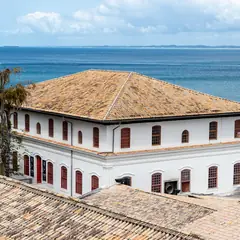
Around the square line up low houses that the Irmandade built in the 19th century to lodge pilgrims. The whole complex is, at bottom, the culmination of a vow made in the middle of a storm and of a wait of almost a decade between the arrival of the image and its entry into the temple. What happened on that crossing, and why the Christ took so long to get a home, is what the narration tells in front of the façade.
The steps washed with the doors closed
Basilica staircase
Summary of this stop
At the foot of the staircase you understand the festival that made the temple famous. The lavagem was born from a cleaning before the January feast: between the end of the 18th century and the beginning of the 19th, the lay members of the Devoção forced enslaved people to wash and adorn the church. When the first one was held nobody knows for certain, and several versions of its origin circulate. In 1889 Archbishop Dom Antônio Luís dos Santos banned the washing of churches on feast days, with police support; since then the baianas no longer enter, the water is poured on the staircase and the churchyard and the doors stay closed. Later, Archbishop Augusto Álvaro da Silva went so far as to veto even the washing of the steps between 1929 and 1936, in 1943 and from 1948 to 1952.
The festival survived everything. Every January, on the Thursday before the second Sunday after Epiphany, some 200 baianas dressed in white walk 8 km from Conceição da Praia and pour perfumed water from their quartinhas over the steps. In 2014 the IPHAN issued the title recognising it as Cultural Heritage of Brazil, although not all scholars accept that it is a candomblé rite in the strict sense.
The rest of the year, in the same largo, priests and ialorixás from some nine terreiros offer daily baths of leaves and of Oxalá’s white corn to open paths. That coexistence a few steps from the Catholic door has not always been calm, and how a dispute over it ended in an official office is part of what you hear right there.
An arm of Christ turned into a ribbon
Fitinha railings
Summary of this stop
The side railings of the churchyard disappear under thousands of coloured fitinhas, Bahia’s most famous amulet. Its ancestor was very different: a measure of white cotton embroidered with gold thread, 6 to 7 cm wide and 47 cm long, the length of the image’s right arm, worn around the neck. Its creation, in 1809, is attributed to the Devoção’s treasurer, Manoel Antônio da Silva Serva, although a 1804 document from the brotherhood itself already mentions the measurements. That ribbon disappeared around 1940, and today’s thin, colourful version arose with tourism from the 1950s.
The basilica does not sell fitinhas, and every three or four months it removes all those that cover the railings and burns them in a ceremony to make room for new ones. According to popular belief, the three wishes come true only if the ribbon breaks by itself; a ritual that many attribute to 20th-century tourist promotion rather than to colonial times. How long you must wait for a wish to come true even has a scientific answer, and the narration reveals it beside the railings.
The captain’s slab beneath his painted ship
Gravestone of Theodósio Rodrigues de Faria
Summary of this stop
Now in the nave, the central aisle leading to the altar passes over a gravestone: that of Theodósio Rodrigues de Faria, buried here in 1757. The founder of the cult owned three ships and was a trafficker of enslaved people, and his tomb presides over the most popular temple of Black Bahia. Right above, the wooden ceiling painted by Franco Velasco between 1818 and 1820 shows some sailors handing the angels a picture of the ship in the storm.
On both sides, the walls display 28 large blue-and-white azulejo panels with the life of Christ, painted in Lisbon in 1855 by Tomáz do Carmo. At the far end awaits the neoclassical high altarpiece, in the form of a baldachin, which Antônio Joaquim dos Santos carved in 1813-1814. How the memory of the captain fits into a sanctuary venerated above all by the descendants of the enslaved is one of the questions the audio guide raises beneath that ceiling.
The Christ who almost never goes out
High altarpiece and Sala dos Milagres
Summary of this stop
In the main niche of the altarpiece, protected by glass, is the crucified Christ that arrived in 1745. The original image has left the church only thirteen times: the first in 1823 and others for the drought of 1842, the cholera of 1855 or the peace of 1942. Today, in processions, a replica of the same size takes its place.
One of those outings, in 1923, during the centenary of Bahia’s independence, became an episode the city still remembers. To the right of the high altar, the Sala dos Milagres holds the material proof of that trust: feet, legs, hands and heads carved in wood or silver for cures attributed to the Senhor do Bonfim, and a coin dented by a revolver bullet that saved its bearer’s life. What the crowd did with the Christ that night in 1923 is the ending the narration reserves for the altar.