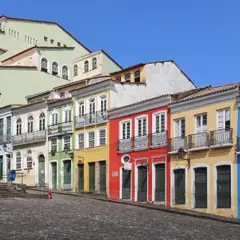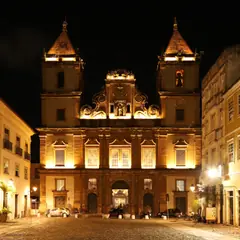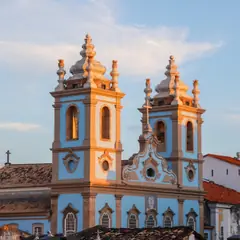
Historic market
Mercado Modelo Audio Guide
A neoclassical customs house of 1861 that fire turned into a market: beneath its arcades survive the cooks, the capoeiristas and the saveiros of another Mercado Modelo that burned and no longer exists.
- 45 min of audio
- Neoclassical architecture
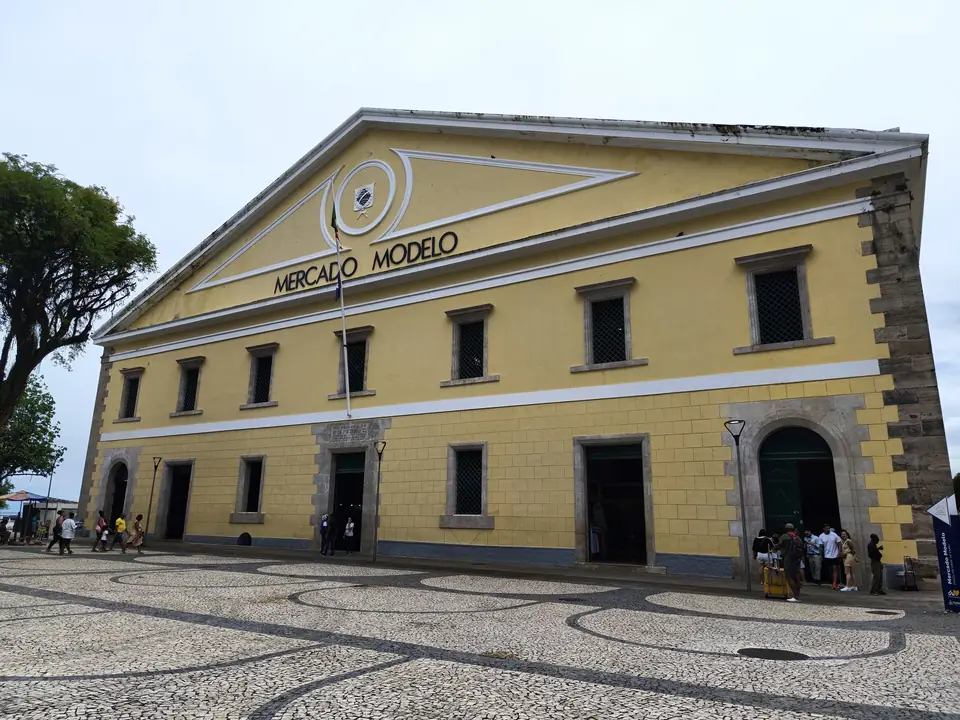
The first Mercado Modelo opened in 1912 next to Praça Cayru, supplied by the ramp where the saveiros of All Saints Bay unloaded vegetables, animals, cachaças and goods for candomblé. After several fires, that of August 1969 destroyed it completely, and on 2 February 1971, Iemanjá's day, the market traders moved to the city's third Alfândega, a neoclassical customs building of 1861 protected by the IPHAN that the move ended up saving.
Its basement drags along a persistent myth: that newly arrived slaves were locked up there and that their cries can still be heard. The dates dismantle it, because the slave trade had been abolished since 1850, and today those stone arcades are a gallery where heads carved from burnt wood keep the building's true scar.
Highlights
- Former third Alfândega of 1861: yellow neoclassical façade facing the bay, protected by the IPHAN
- Fonte da Rampa do Mercado: a 16-metre sculpture-fountain by Mário Cravo Júnior shaped like saveiro sails
- 20 paintings in false windows of the Lavagem do Bonfim, the Yemanjá festival and capoeira
- Galeria Mercado: basement of stone arcades with heads carved from the wood of the 1980s fire
- Restaurants Maria de São Pedro and Camafeu de Oxóssi, with a varanda over All Saints Bay
The story of the Mercado Modelo is a story of fires. The first market opened in 1912 on a Marina plot next to Praça Cayru: a shed of about 2,400 m², with a metal façade and zinc roof, which so displeased Bahians that in 1915 it was rebuilt with an eclectic façade. In the early hours of 7 January 1922 fire left it reduced to its underground “caverns”; once renovated, it swapped yellow and red for green and the city renamed it Tartaruga Verde. On 1 August 1969 came the most violent fire of all, and what remained standing was demolished for safety.
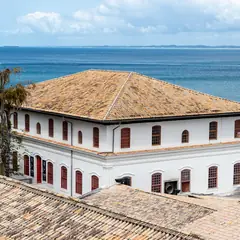
The market that greets visitors today has lived since 1971 in another building: Salvador’s third Alfândega, a neoclassical customs house of 1861 facing All Saints Bay. Inside await craft stalls, a central corridor with an image of Nossa Senhora da Conceição that survived the 1984 fire, a capoeira roda at the back that, according to several sources, is one of the oldest street rodas in existence, and a first floor with restaurants that come from the lost market. The catastrophe of 1969 even ended up in samba: Riachão dedicated “Incêndio no Mercado Modelo” to it, and Vanusa recorded in 1973 the song “Mercado Modelo”, which mourns the original building.
The audio guide covers the square where the old market stood, the customs house façades, the basement of arcades and the first-floor hall, with documented narration checked against historical sources that keeps its most surprising episodes for the place itself.
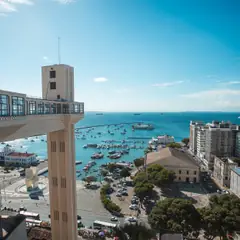
Right opposite, the Lacerda Elevator rises in about twenty seconds to the Cidade Alta, and following the bay shore to the south you reach the Solar do Unhão, another port building that changed its life.
An empty square that was a market
Fonte da Rampa do Mercado
Summary of this stop
The route begins in front of a gap. The square opened beside the Rampa do Mercado is the site of the old Mercado Modelo, the one supplied by the saveiros arriving from the Recôncavo laden with vegetables, grain, animals, cigars, cachaças and goods for candomblé. After the 1969 fire the plot stayed empty, and in 1970 the Monumento à Cidade do Salvador was raised there, better known as the Fonte da Rampa do Mercado.
The work is by Mário Cravo Júnior: a 16-metre sculpture-fountain whose curved forms recall the sails of the saveiros that docked a few steps away. Its own history rhymes with the market’s: in 2019 it burned too, and it was rebuilt with fireproof resin.
What the square does not tell is who walked this vanished ground a few months before the fire. Documented tradition recalls a November morning in 1968 with sisal mats strewn with flowers over the cement, guests in jacket and tie and a capoeirista improvising verses for a very unusual visitor. Who she was and what she took away as a gift is revealed when you listen to the narration on the spot.
The customs house the traders saved
False-window paintings
Summary of this stop
The second stop pauses at the side façade facing the Rampa. On 2 February 1971, Iemanjá’s day, the market traders who had lost everything moved to the old Alfândega, a neoclassical building of 1861 protected by the IPHAN. That move had an unexpected effect: use as a market ended up saving the old customs house.
On its side façades, the blind openings became canvases. In the year 2000, 20 acrylic paintings were commissioned from Bahian artists, ten on the ground floor and ten on the first floor, placed in “false windows” up to 2.70 metres high: the Lavagem do Bonfim, the Yemanjá festival, the Lacerda Elevator, the orixás, the puxada de rede and the capoeira roda. They were restored in 2023 and form a sort of painted chronicle of the bay.
Beside them, the ramp recalls another custom. On the eve of the feast of Conceição da Praia, the saveiros arrived at dawn from the Recôncavo with names carved as slogans, “Deus te guie” or “Deixe eu viver”, and holds full of fruit for the festival. Which tattooed skipper was smoking on one of them in 1937, and which writer said he had heard his stories there, is part of the account at this stop.
Stone arcades against a myth
Galeria Mercado
Summary of this stop
Beneath the market opens a basement of cool half-light and stone arcades that has fed a myth for decades: an international travel guide claims the customs house lodged newly arrived slaves, and some traders say they hear screams. The historians Francisco Senna and Murilo Mello deny it with dates: the building dates from 1861, the law of 1850 had already abolished the slave trade, and the basement was a porão to isolate from damp the customs floor by the sea, which did not open until 1971.
Closed for about 15 years, the lower level reopened in January 2024 as the Galeria Mercado. Among its restored arcades are shown Rubem Valentim’s Templos de Oxalá, a lamp installation by Vinicius S.A and a timeline of 16 photographs of the market.
The most eloquent piece is the series Cabeças de Tempo, by Mário Cravo Jr. Those heads are carved from the wood of the fire the market suffered in the 1980s, already inside the customs house; after the 1984 fire, the restoration was a project of the architect Paulo Ormindo de Azevedo. Why that burnt wood is the true trace of the building’s pain is the idea that closes this stop.
The table that survived the fire
Restaurant hall
Summary of this stop
The route goes up to the first floor, where two restaurants share a hall and a varanda facing All Saints Bay. Maria de São Pedro was born in 1925 at the Feira do Sete, moved to the old Mercado Modelo around the mid-1940s, lost everything in 1969 and since 1972 has shared space with the restaurant of Camafeu de Oxóssi, a capoeira mestre and candomblé figure born in 1915.
Jorge Amado was a customer of Maria de São Pedro for 30 years, and in “Bahia de Todos os Santos” he evoked her old restaurant as a party facing the Rampa do Mercado that the fire devoured. Sartre, Neruda, Orson Welles and Pierre Verger, who photographed the cook, also passed through that table.
Documented tradition also keeps an episode from 1954: a count travelled from São Paulo to hire her for a banquet, and she flew with her helpers and a tonne of ingredients, dendê, dried shrimp and clay alguidares included. What ultimatum she issued in that kitchen, and who had to pack their bags, is the finale of the route.