UNESCO heritage
Largo do Pelourinho Audio Guide
Salvador's happiest postcard bears the name of a whipping post that is no longer there: a sloping square of ice-cream-coloured mansions, Olodum drums and absences that weigh more than the façades.
- 40 min of audio
- Colonial historic centre
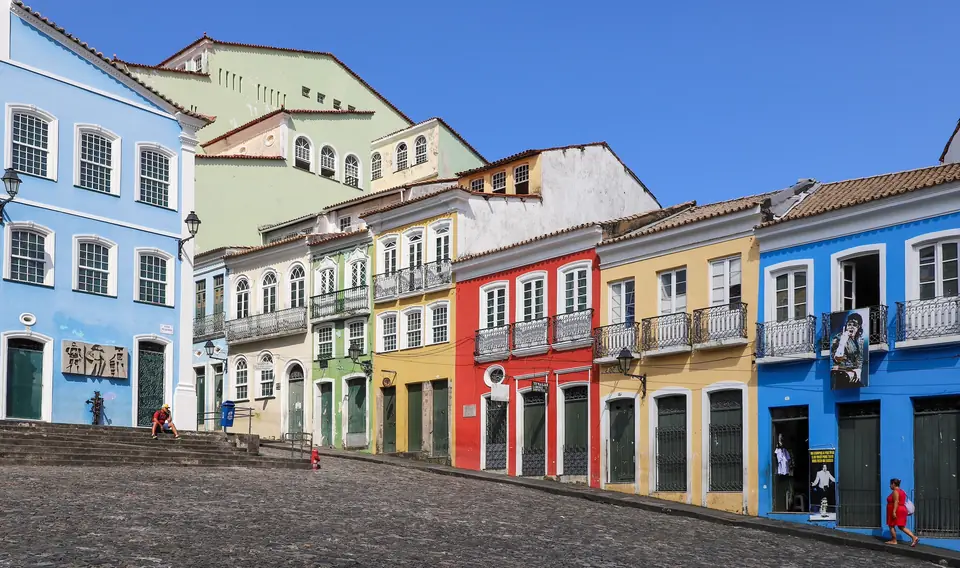
The Largo do Pelourinho was born of a demolition: in 1790 the Porta do Carmo, one of the northern gates of the walled city, fell, and the gap became a square. In 1807 the city's market arrived here and, with it, the pelourinho, the whipping post that stayed until 1835 and ended up giving its name to the whole neighbourhood. Today this cobbled triangle, surrounded by colonial mansions and presided over by Jorge Amado's blue house, is the heart of Salvador's Historic Centre, a UNESCO World Heritage Site since 1985.
Its pastel colours are recent: in the 18th and 19th centuries the buildings were ochre, grey and lime white, and the restoration begun in 1991 turned homes into bars and shops while the area's residents fell from 9,853 to 3,235. In 1996 Spike Lee covered the sky over the largo with a white cloth so that Michael Jackson could record among some 200 Olodum drummers, and at number 19 a 17th-century wall shares a doorway with the story of a capoeira school that never came back.
Highlights
- The empty spot of the pelourinho, the whipping post that stood in the square from 1807 to 1835 and gives the neighbourhood its name
- Blue house of the Fundação Casa de Jorge Amado, guarded by an iron Exu by Tati Moreno
- Pastel façades that Lina Bo Bardi compared to an ice-cream parlour, the result of the 1990s restoration
- Setting of the They Don't Care About Us video, shot by Michael Jackson with Olodum in 1996
- Stretch of 17th-century city wall at number 19, free to visit at the Museu da Gastronomia Baiana
The story of the Largo do Pelourinho begins with a city wall coming down. At this point the second Porta de Santa Catarina was first opened, around 1591-1635, and then the Porta do Carmo; its demolition in 1790 left free the space of a sloping triangular square that descends toward the Baixa dos Sapateiros. After that demolition and the Opening of the Ports to Friendly Nations in 1808, the mansions grew in size and the area held the best homes in the city until the early 20th century. From the 1950s the money moved to other neighbourhoods: the surroundings became working-class housing and Black territory, and by the 1980s it was a ruinous area.
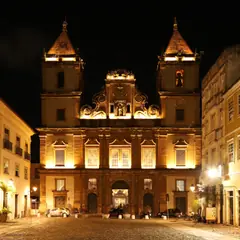
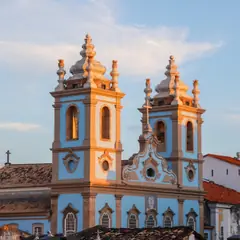
In that forgotten neighbourhood the bloco afro Olodum was born on 25 April 1979, and from here its drums went around the world: first with Paul Simon’s video for The Obvious Child, shot in the Pelourinho in 1990, and later with Michael Jackson. The IPHAN protected Salvador’s Historic Centre in 1984 and UNESCO declared it a World Heritage Site in 1985; the Largo do Pelourinho is its main postcard, with the Museu da Cidade next to Jorge Amado’s house and, at the far end, the azulejo-bulb towers of the Rosário dos Pretos Church, raised by the Black brotherhood of the Rosário from 1704.
On Tuesdays, moreover, the square keeps the “bênção”, a street party born in 1983 from the bread distribution that the São Francisco church held every Tuesday. The audio guide walks the largo downhill, from the blue house to the doorway of number 19, with documented narration checked against historical sources that puts in the foreground what the postcard does not show: what is missing from it.
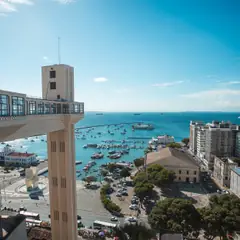
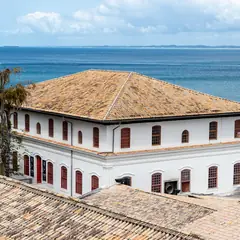
At the foot of the slope, the blue façade of the Rosário dos Pretos Church closes the square; a few minutes on foot away, the São Francisco Church holds the friars’ golden Baroque, and the Lacerda Elevator descends from the Cidade Alta to the port.
A blue house and a novel of 116 rooms
Fundação Casa de Jorge Amado
Summary of this stop
At the top of the slope, the blue mansion at numbers 47, 49 and 51 dominates the square. It is the Fundação Casa de Jorge Amado, inaugurated on 7 March 1987 with a party of more than 20,000 people, with a permanent exhibition on the writer and the Zélia Gattai café. At its doors an iron Exu by Tati Moreno stands guard, installed by Mãe Stella de Oxóssi, beneath a motto warning that whoever comes in peace may enter.
From this point the largo reads like a great courtyard of mansions, the same ones that grew taller when the wall fell and that for more than a century housed Salvador’s best-off families. That setting changed over time, and Jorge Amado knew it first-hand: as a young man he lived a little over a year in the Pelourinho, in a casarão on Rua Alfredo de Britto that is now part of his foundation.
In his novel Suor (1934), begun at the age of 16, a sobrado on the Ladeira do Pelourinho becomes an anthill of four floors, 116 rooms and more than 600 tenants, where only the rats did not pay rent. What coincidence links that fictional building to the writer’s real house is something revealed when you listen to the narration on the spot.
The whipping post that named the neighbourhood
Spot of the pelourinho
Summary of this stop
In the centre of the square there is nothing, and that emptiness is the main piece of the largo. Here stood, between 1807 and 1835, the pelourinho, the whipping post that arrived with the city’s market and gave its name to the whole neighbourhood, the Pelourinho or Pelô. The dominant version places public whippings of enslaved Africans there, although the historian Cid Teixeira argued that in Salvador it was above all a symbol of municipal power. Nor does 1835 mark the end of slavery, which in Brazil came much later: it is the date when the post disappeared from the square, for reasons no source fully clarifies.
Before arriving here, the pelourinho travelled around the city. It was raised in 1549 in the old Praça da Feira, today Praça Municipal; in the 17th century it moved to the Terreiro de Jesus and from there it was shifted to today’s Praça Castro Alves, on the argument that the cries of the whipped disturbed the services in the Jesuits’ church. And the square holds another paradox: its official name is Praça José de Alencar, in honour of the novelist of O Guarani and Iracema, who was a minister of justice and a defender of slavery.
Salvador never raised its pelourinho again, not even a replica. In the 1980s, at the spot where it supposedly stood, a sculpture by Mestre Didi was placed for a time in praise of the orixás and the eguns, the ancestors. Today neither the post nor its answer remains, and where the only work that recalls it can be found is part of the route.
Ice-cream colours over an emptied neighbourhood
Pastel mansion façades
Summary of this stop
Uphill, the pistachio, lemon and pineapple façades make up Salvador’s most photographed image. But those tones are a recent invention: in the 18th and 19th centuries the buildings were ochre, grey, brown and lime white. Lina Bo Bardi, author of the first rehabilitation project (1986-1989), said the result looked like an ice-cream parlour.
Behind the colours lies a deeper change. Since 1991 the restoration led by the government of Bahia through the IPAC turned mansions into bars, shops and cultural centres: by 1999 there were 1,350 restored buildings, and the area’s residents went from 9,853 in 1980 to 3,235 in 2000. For its critics, that project put tourism first, against Bo Bardi’s proposal to keep the residents, and pushed out a good part of the neighbourhood’s Black and poor population; the balance is still under debate.
On 10 February 1996, this same setting became a film set. Michael Jackson recorded They Don’t Care About Us here with some 200 Olodum musicians and about 5,000 people around, and Spike Lee covered a good part of the sky over the square with a white cloth to soften the light. The varanda from which the singer leaned out was for almost 17 years a small shrine with his life-size figure, until a court order closed it in 2026. Which mansion it was and how that empty balcony looks today is pointed out on the spot.
Number 19: a wall and a capoeira school
Museu da Gastronomia Baiana
Summary of this stop
The route ends at the doorway of number 19, which holds two layers of history. Underground, the excavations for the renovation of the largo brought to light a stretch of monumental wall attributed to the 17th-century Santa Catarina walls. It can be visited free at the Museu da Gastronomia Baiana and recalls that this square was, before anything else, a gate of the city.
Upstairs, the same casarão housed from 1941 the Centro Esportivo de Capoeira Angola of Mestre Pastinha, the “school of masters” that João Grande, João Pequeno and Curió passed through and that Jorge Amado, Mário Cravo and Carybé frequented. In 1971 he was asked to leave the building for renovations and the space was never returned to him. Pastinha went on teaching in another street of the neighbourhood and died blind and forgotten in a nursing home on 13 November 1981, aged 92.
Where his berimbaus once sounded, Bahian food is now served, while the capoeira angola he defended is practised across half the world. What became of that space and how his legacy survived far from this square is the closing the audio guide reserves for the end.