Golden Baroque
São Francisco Church Audio Guide (Igreja e Convento de São Francisco)
Salvador's “church of gold”: friars under a vow of poverty covered every inch of their church in gilded carving, and today that treasure waits behind a closed door since its ceiling collapsed in 2025.
- 60 min of audio
- Baroque architecture
The Franciscans arrived at this site in 1585, with permission from Pope Sixtus V, and in 1686 they laid the foundation stone of a convent far more ambitious than the first. The sandstone façade bears the date 1720, the year the body of the church was finished; the towers took almost a century more. Inside, walls, columns, ceiling and chapels disappear beneath gilded wood carving, and the cloister holds 37 blue-and-white azulejo panels with moral scenes inspired by Horace.
So much gold in a house of poor friars already scandalised some Italian Capuchins in the 18th century, and in the 19th some German Franciscans tried, without success, to remove it. On 5 February 2025 the painted ceiling of the nave collapsed during a visit: a tourist died and the church remains closed while the restoration advances. Next door, the Ordem Terceira shows a carved façade that spent more than a century hidden under plaster.
Highlights
- Nave lined with gilded carving, with eight atlantes holding up the side altars
- Two-storey cloister with 37 azulejo panels on Horace, based on engravings by Otto van Veen
- Sandstone façade dated 1720 and towers topped with azulejo pyramids
- Carved façade of the Ordem Terceira, covered with mortar and rediscovered in 1932
- 8-metre lioz-marble cruzeiro brought from Lisbon and dated 1807
At the top of Salvador’s Historic Centre, at the end of an elongated square presided over by a marble cross, stands the church Bahians call the “Igreja de Ouro”. Its history begins in 1585, when Friar Melchior de Santa Catarina, Franciscan custodian of Olinda, founded the convent with authorisation from Pope Sixtus V; work truly began in 1587, on a site with a small chapel and temporary dwellings. A century later, on 20 December 1686, the foundation stone of the present complex was laid, on a much larger scale: first the cloister, with a design attributed to Francisco Pinheiro, and then the church, whose body was finished in 1720.
The paradox is what gives meaning to the whole story of São Francisco Church: a community under a vow of poverty that covered its nave with gilded carving and its cloister with some 35,000 Portuguese azulejos. The church is credited with 800 kilos of gold, a figure repeated as a trademark although nobody has verified it: what shines is a very thin leaf over carved cedar wood. That treasure is also fragile. On 5 February 2025 the ceiling of the nave collapsed during a visit, and since then the church has remained closed while it is restored.
The audio guide route, a documented narration checked against historical sources, circles the complex from outside: the square and its cross, the main façade, the closed door that hides the golden nave and the neighbouring Ordem Terceira, with a façade that spent more than a century hidden. The pieces you cannot see from the street are told right there, in front of the walls that guard them.
A few steps away, the Largo do Pelourinho slopes down to the Rosário dos Pretos Church, the Baroque that a Black brotherhood raised opposite that of the friars. The city’s other great devotion waits to the north, at the Bonfim Church.
A cross from Lisbon in the square of the bread
Cruzeiro de São Francisco
Summary of this stop
The route starts at the foot of the cruzeiro, the great lioz-marble cross brought from Lisbon that gives its name to the Largo do Cruzeiro de São Francisco. It measures 8 metres on a base of 5.5 by 5.5, bears the date 1807 and a Latin inscription and, although it stands on a public road, it belongs neither to the city nor to the convent: it is the property of the Ordem Terceira de São Francisco, the neighbouring church.
These paving stones also have a life that does not appear on the maps. Since the 18th century, the bread of Saint Anthony is blessed here on Tuesdays, with the largest turnout on 13 June and on the feast of Saint Francis, when up to 15,000 rolls are handed out; devotees of Ogum also come to the blessing. From that distribution was born in 1983 the “Terça da Bênção”, the festive Tuesday night that Clarindo Silva, of the Cantina da Lua, invented for a Pelourinho that was then emptying out.
That party began with about a hundred people and grew to move between 20,000 and 25,000 on Tuesdays, with names like Olodum, Gerônimo or Filhos de Gandhy, in the years when Olodum began its rehearsals. It lasted thirty years, until 2013, and in October 2025 its founder, aged 83, celebrated it again where it all began. How you get from a blessed loaf of bread to samba-reggae is one of the threads the narration untangles on the spot.
1720 carved in stone and a saint from the sea
Igreja e Convento de São Francisco
Summary of this stop
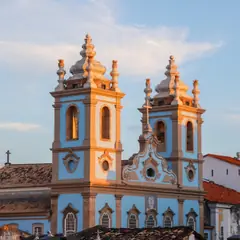
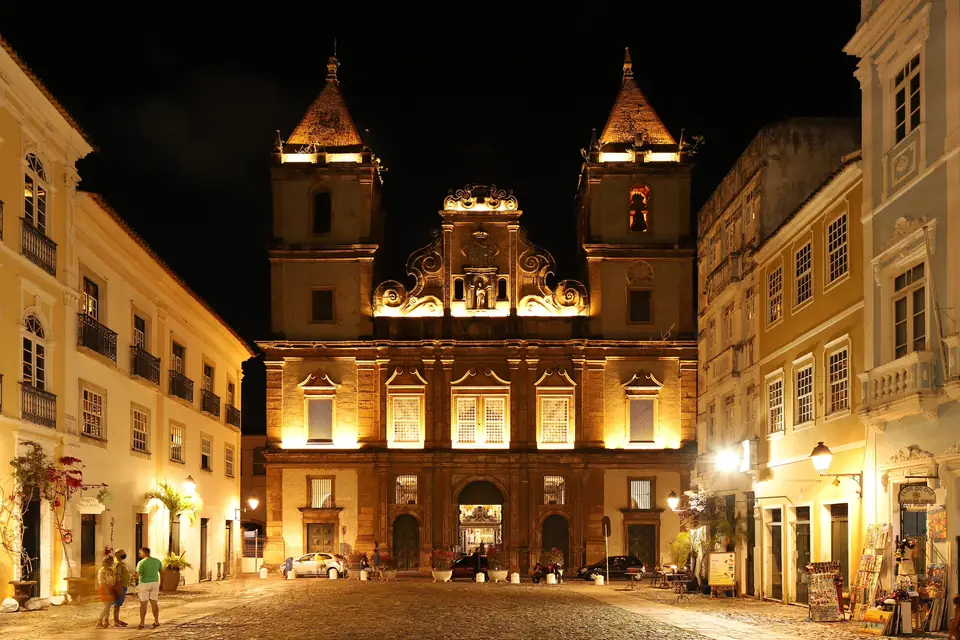
In front of the main façade, the sandstone reads like layers of time. Three arches at the base, a pediment between large volutes and, in the niche under the Franciscan coat of arms, a white marble statue of Saint Francis now covered in layers of paint. On the frontispiece the date 1720 was carved, that of the end of the body of the church. The two sober towers were not completed until 1796-1797, and the blue and white azulejo of their pyramidal tops came almost a century later.
The chronology is not entirely peaceful: some versions place the church’s foundation stone in 1708 and its completion in 1723, and there is no agreement either on why the convent was rebuilt, whether because the first was destroyed during the Dutch invasions or because of a 1675 decision to enlarge it as the community had grown.
Behind these walls also begins one of Salvador’s founding legends. The convent’s Franciscan tradition tells that an image of Saint Anthony, desecrated by French sailors at the African fort of Arguim, ended up thrown into the sea in a storm and reappeared in 1595 on the sand of Itapuã, in front of its own captors. That image made the saint the city’s first patron and even a captain-mor with a salary. The final twist of the story, and the reason why nobody today knows which of the convent’s images is the miraculous one, is left for the narration.
The church of gold behind the closed door
Main church door
Summary of this stop
At the main door, the visitor today meets a closed threshold. On the other side awaits a three-nave interior where walls, columns, ceiling and chapels are covered in gilded wood carving: rosettes, volutes, angels and birds, and eight great carved atlantes holding up the side altars. The author of that carving is unknown. A popular story circulates of cherubs carved by enslaved people with deformed features whom the friars supposedly chiselled, but historiography does not document that episode.
So much ostentation soon bothered other religious. In the 18th century some Italian Capuchins protested at the Franciscans’ continual requests for alms to complete the decoration, and in the 19th some German Franciscans wanted to remove all the gold except that on the liturgical objects, without success. Beyond the nave, the two-storey cloister, built between 1707 and 1752, holds 37 blue-and-white azulejo panels with moral scenes inspired by Horace, based on engravings by Otto van Veen, master of Rubens; their authorship, attributed to Bartolomeu Antunes de Jesus, remains disputed.
On 5 February 2025 the nave’s ceiling collapsed, with paintings from the 1733-1737 Marian cycle attributed to Friar Jerônimo da Graça: a 26-year-old tourist died and several were injured. In 2022 the Iphan had fined the Franciscan province for the deterioration of the church, and two days before the collapse the convent’s guardian asked for an inspection because of a swelling of the ceiling lining. The Iphan maintains that this warning did not indicate an emergency; the Franciscans, that the inspection was never carried out. What else that nave holds, from a reliquary above the choir to the high altar, is told in front of the door.
The façade saved by a hammer blow
Igreja da Ordem Terceira de São Francisco
Summary of this stop
Attached to the convent rises the church of the Ordem Terceira, designed and built by Gabriel Ribeiro, a native of Porto, in record time: foundation stone on 1 January 1702 and structure finished on 22 June 1703. Its façade, completed in 1705, is the only carved one of its kind in Brazil, covered in high reliefs with mermaids holding crowns, atlantes with wings on their heads, a feline carranca and an eagle with a Latin motto, beneath the coat of arms of Portugal. The Iphan relates it to Spanish Plateresque; other authors consider it Baroque or Churrigueresque.
For more than a century nobody saw it. In the neoclassical renovation of 1827-1835 it was covered with mortar as out of fashion and forgotten, until in 1932 an electrician installing lights struck it with his hammer and part of the plaster fell away.
From here you look again at the church next door, which awaits its own reopening. The Franciscan order plans to reopen it by 2029, with 20 million reais from the Novo PAC against a first-stage project of about 61 million, and on 27 March 2026 the Iphan contracted the restoration through June 2027. What exactly appeared beneath that first hammer blow is the last discovery of the route.