18th-century Black brotherhood
Rosário dos Pretos Church Audio Guide (Igreja de Nossa Senhora do Rosário dos Homens Pretos)
A blue church with two towers that enslaved and freed Africans raised stone by stone in their hours of rest, and where every Tuesday the Mass still rings out with atabaque drums.
- 30 min of audio
- Colonial Baroque
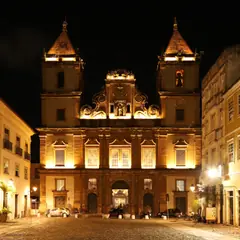
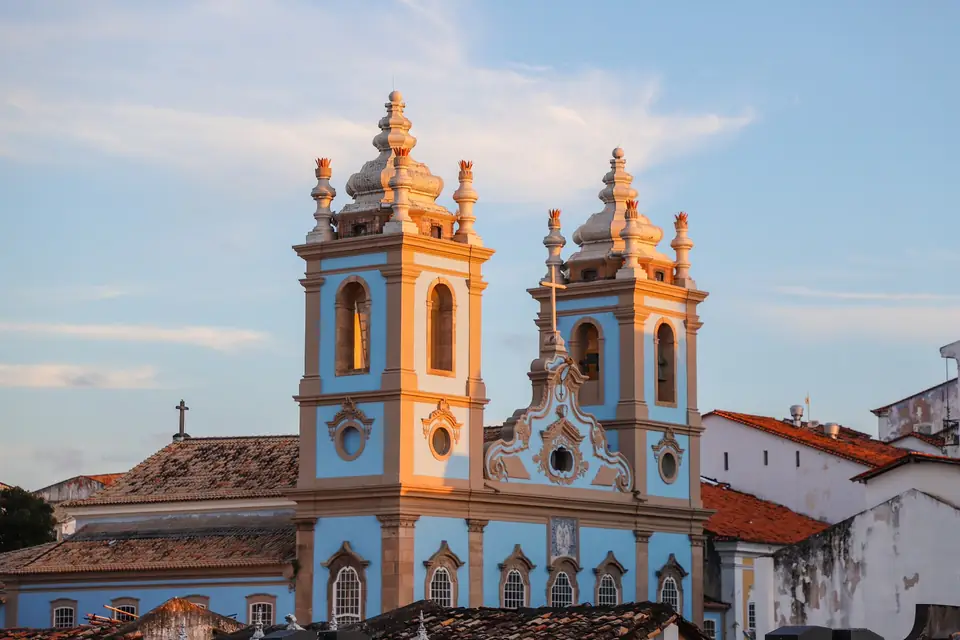
In the lower part of the Largo do Pelourinho stands the temple of the Irmandade de Nossa Senhora do Rosário dos Homens Pretos, formally constituted in 1685 and one of the first Black brotherhoods in Brazil. In 1704 it obtained permission to build next to the Portas do Carmo, and the work dragged on for almost the whole 18th century because it was done by the brothers themselves, enslaved men who could only work in their free time. It was considered finished in 1796, with a blue stone façade and two towers topped with azulejo bulbs.
Those two towers were a challenge: in the slave-owning Salvador, for a Black brotherhood to crown its church that way was an exceptional sign of economic power. In 1786 the brothers asked Lisbon to celebrate Mass with masks, dances and songs in the language of Angola, and the Crown said no. Today, every Tuesday, the Terça da Bênção is sung with atabaques and ends with the distribution of blessed bread.
Highlights
- Blue façade and two towers with azulejo bulbs, raised from 1780 by master builder Caetano José da Costa
- Nave ceiling painted in 1870 with Our Lady of the Rosary and the allegories of the four continents
- Portuguese azulejo panels from around 1790 with the life of Saint Dominic
- Altars of Black saints: Santo Antônio de Categeró and São Benedito, beside an ivory Christ
- Terça da Bênção: Tuesday Mass at 6 pm with atabaques and baskets of blessed bread
The story of the Rosário dos Pretos Church begins long before its walls. From the early 17th century, enslaved and freed Africans venerated the Virgin of the Rosary at a side altar of the old Sé of Bahia. In 1685 that devotion became a brotherhood with its own statutes, although the date of origin is disputed: Prior Adonai Passos Ribeiro places its beginning in the basement of the Sé in 1604, and some press accounts take it to the early 18th century. In July 1899 the brotherhood was raised to Ordem Terceira.
The temple is the house that brotherhood built for itself. In 1704 it gathered the money and obtained from Archbishop Sebastião Monteiro de Vide permission to raise its own church next to the Portas do Carmo, and the brothers built it in their hours of rest until it was considered finished in 1796. Sources do not fully agree on the dates of the work or its duration, which some put at almost a century and others at almost 80 years; what nobody disputes is who laid the stones. Protected by the IPHAN since 1938, it closes the lower end of the Largo do Pelourinho with its blue façade.
The story of the Rosário dos Pretos Church lives on in its festivals: that of Nossa Senhora do Rosário, held since 1820 and an intangible cultural heritage of Bahia since 2024, and that of Santa Bárbara every 4 December. The audio guide covers the façade, the churchyard, the nave and the altars with documented narration checked against historical sources, which keeps its most surprising episodes for the place itself.
From its churchyard the Largo do Pelourinho unfolds, and a few minutes on foot away the gold of the São Francisco Church tells Salvador’s other Baroque, that of the friars. Afro-Brazilian popular devotion has its great sanctuary to the north, at the Bonfim Church.
Two towers paid for with hours of rest
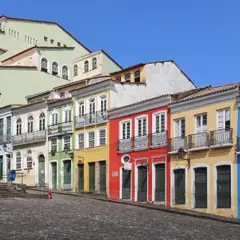
Largo do Pelourinho
Summary of this stop
From the lower part of the Largo do Pelourinho, the blue façade looks like just another colonial backdrop. It is not. The body of the nave was raised first, and between 1718 and around 1740 the temple, still half built, even served as the seat of the new parish of the Senhor do Passo. The façade and the two towers came later, from 1780, under the direction of master builder Caetano José da Costa, and the whole work advanced at the pace of the free moments of some enslaved men.
The architecture of the Rosário dos Pretos Church reads vertically: a two-storey central body crowned by a pediment with volutes, five doors below, five windows above and, at the sides, two stone towers with bell chambers, oculi and superimposed bulbs clad in azulejos. In the slave-owning city, those towers were an assertion of economic power hard to overlook.
The square also has an annual appointment with this door. During Bahia’s War of Independence, the Irmandade dos Homens Pretos was the main institution where people gathered to resist the Portuguese troops, and that is why every 2 de Julho the civic procession, with the float of the Cabocla and the Caboclo, stops here to receive a wreath of flowers. Why that date counts double for the brothers is revealed when you listen to the narration on the spot.
A gate in the city wall, struck
Railed churchyard and staircase
Summary of this stop
The small railed churchyard you climb to from the slope occupies a place with memory: here stood the Portas do Carmo, one of the gates of the walled city, from which the road left for the Carmo convent, the present Ladeira do Pelourinho. Before it open the five doors of the façade; the fifth, at the base of the right tower, leads not to the nave but to the oratory.
This threshold has always lived under pressure. In 1786 the brotherhood asked the Crown for permission to celebrate Mass with masks, dances in the language of Angola with their instruments, songs and praises, as was done in other countries of Christendom, and Lisbon refused. In 1969 the Prefeitura painted the church without IPHAN authorisation.
And in 1998 came the literal blow: a concrete mixer rolled down the Ladeira do Pelourinho out of control and backwards and crashed into the temple, wrecking the staircase railing and the right portal of the façade. Both were repaired, and what trace of that collision can still be read in the stone is one of the details the audio guide points out on the spot.
Four continents above a Bantu brotherhood
Painted nave ceiling
Summary of this stop
Inside, the nave shows a redecoration from the late 19th century. In 1870 José Pinto Lima dos Reis painted the ceiling with the Virgin of the Rosary in the centre, Saint Dominic and Saint Peter Martyr at her sides and the allegories of the four continents, although some attribute the painting to José Joaquim da Rocha, active in the 18th century. Between 1873 and 1875 two new doors were opened beside the main one and in 1895 the church was gilded. On the walls, azulejo panels made in Portugal around 1790, probably at the Real Fábrica do Rato, tell of the devotion to the Virgin of the Rosary of Lisbon and the life of Saint Dominic.
Beneath that ceiling it was decided who could be a brother. By agreement with the archbishop, only Africans born south of the equator were admitted, the so-called Bantu, mainly from Angola, Congo and Mozambique; those of Yoruba origin therefore founded the Irmandade dos Quinze Mistérios. Admission was opened to all Afro-descendant Brazilians in 1896, eight years after the Lei Áurea. And the brotherhood, a refuge and mutual aid that came to buy the freedom of many enslaved people, also counted slave owners among its members during the colonial period.
The nave also has a contemporary face. Gilberto Gil’s family considers it their church, and in January 2024 the singer Preta Gil chose this temple to give thanks for her recovery from cancer. What happened in the same nave a year and a half later closes a story that the narration tells right there, beneath the four continents.
The Black saint who kept the bread
Altars of the Black saints
Summary of this stop
Before the neoclassical high altarpiece, carved in 1871 by João Simões F. de Souza, presides the 17th-century image of Nossa Senhora do Rosário that was venerated in the old Sé and moved here when the church was finished. For the members of the brotherhood, that Virgin is at once Iemanjá. On the altars she is accompanied by Black saints such as Santo Antônio de Categeró and São Benedito, beside Santa Bárbara and an ivory crucified Christ.
The music Lisbon banned in 1786 sounds today every Tuesday at 6 pm at the Terça da Bênção, the Mass dedicated to Categeró: songs in African rhythms with atabaques, tamborins and repiques, and baskets of bread that the brothers, first the women and then the men, leave on the altar steps to be blessed and handed out at the end. Every 25 November, moreover, the baianas de acarajé begin their day here with a Mass before setting off in a procession with drums to the Praça da Cruz Caída.
According to tradition, the October festival holds another ritual with a history: the bacalhau de Nossa Senhora, a scalded cod dish with vegetables and bacon that the brotherhood has served free for almost a hundred years and that is said to have been born after the Malê revolt of 1835. What bacon had to do with that revolt, and why the Tuesday bread ended up in the hands of a Black saint, is what the route leaves for the end.