7th-century Sogdian murals
Afrasiab Museum Audio Guide (Afrosiyob muzeyi)
Under the grassy mounds around this Soviet-era museum sleeps the Samarkand that came before the Mongols. Inside, a room painted around 648-651 where Chinese envoys with silkworm cocoons, ambassadors in feathered headdresses and long-braided Turkic warriors file before King Varkhuman: a bulldozer found it and wrecked half of it in the same stroke in 1965.
- 60 min of audio
- Sogdian Silk Road art
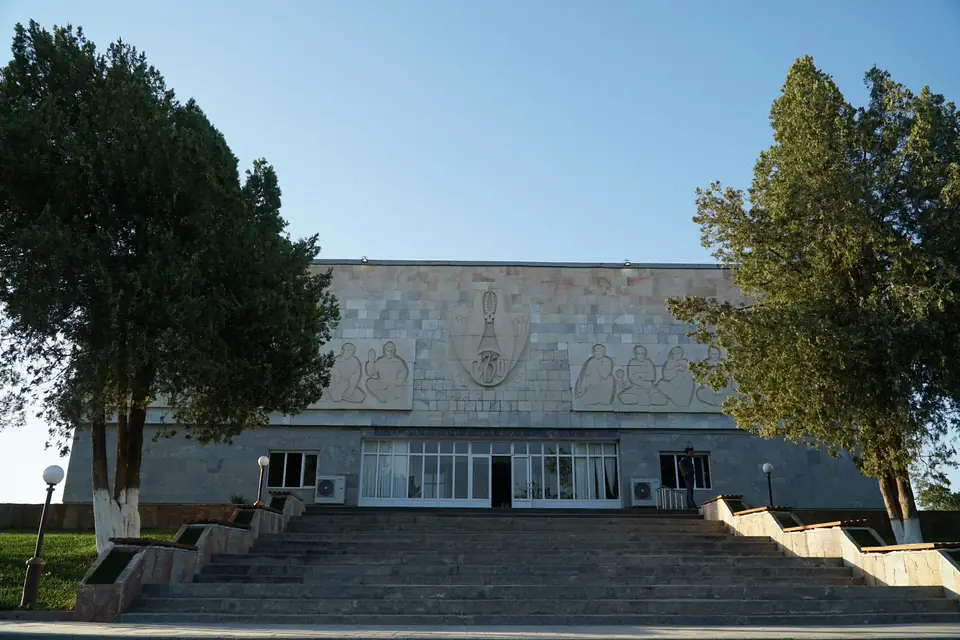
The Afrasiab Museum, the Afrosiyob muzeyi, has occupied a two-storey Soviet modernist building since 1970, designed by the Armenian architect Bagdasar Arzumanyan and opened for the 2,500th anniversary of Samarkand's founding. It stands on a site of some 220 hectares, with archaeological layers 8 to 12 metres thick, inhabited from around 500 BC until 1220. After the Mongol destruction nobody lived on these hills again. Its collection exceeds 22,000 pieces.
The piece that justifies the visit turned up by accident. In 1965 the local authorities decided to cut a road through the middle of the mound and the machines struck a room decorated with 7th-century Sogdian paintings, now known as the Hall of the Ambassadors. The bulldozers saved the lower register of the walls and almost completely destroyed the upper one. On the cloak of one of the envoys you can still read, in Sogdian, a chancellor's introduction to the king of Samarkand.
Highlights
- Afrasiab hills — the Samarkand inhabited from 500 BC until the Mongols
- Wall of the ambassadors — Chinese envoys with silk cocoons and delegates with feathers in their headdress
- Sogdian inscription — the chancellor of Chaganian presents himself to King Varkhuman
- North wall — a lady feeding fish from a Chinese boat
- The lost upper register — what the 1965 bulldozers wiped out
The mounds of earth around the Afrasiab Museum are not hills: they are a city. This was Maracanda, ancient Samarkand, and here, according to the historical tradition, Alexander the Great killed his general Cleitus the Black in 328 BC, during a banquet in the satrap’s palace. Here, in the 7th century, Varkhuman reigned, recognised between 650 and 655 by the Chinese emperor Gaozong as ruler of Samarkand and Sogdiana. And here it all ended in 1220: after the Mongol destruction the survivors moved to the southwest, where the later Samarkand grew, and these mounds were left empty for good.
The name came much later. “Qal’a-ye Afrasiab”, Afrasiab’s castle, appears in texts only in the late 17th century, and refers to Afrasiab, the legendary king of Turan and great enemy of Iran in the Shahnameh, who already in the Avesta lived in an underground fortress of metal. For centuries the locals believed the huge city of that mythical king lay under the grass, although the site’s name seems to be in fact a corruption of the Persian Parsīāb, “beyond the black river”. Today that word travels at 250 km/h: the Uzbek high-speed train, built by Spain’s Talgo, is called Afrosiyob after these hills.
Afrasiab’s history has its debates too: the dates of the murals range between 648-651 and shortly after 658, and the modest size of the painted building points to a private residence rather than the reception hall of a royal palace. The audio guide covers the museum in four stops, with documented narration checked against historical sources that identifies the figures on the walls one by one.
On the slope of these same hills, less than a kilometre to the southwest, the street of mausoleums of the Shah-i-Zinda Necropolis climbs up, and the district that inherited Afrasiab’s commercial life still sells bread at the Siab Bazaar. A little over a kilometre to the east, the Ulugh Beg Observatory holds the Samarkand that measured the stars.
A Soviet staircase above the buried city
Afrasiab Museum
Summary of this stop
The visit begins on the wide entrance staircase, before a 1970 façade decorated with bas-reliefs of birds. The building, the work of the Armenian architect Bagdasar Arzumanyan, opened to celebrate the 2,500th anniversary of Samarkand’s founding, and today holds more than 22,000 pieces, from the painted hall to the Sogdian ossuaries, small ceramic urns for bones decorated with deities, sacred fire and dancers.
All around stretch the mounds of raw earth and grass of a site of some 220 hectares, with layers 8 to 12 metres thick and more than seventeen centuries of occupation, from 500 BC to 1220. That nobody settled them again after the Mongols explains why the city is still down there. Why people preferred to imagine on them the palace of an epic villain is the first story of the narration.
Silk cocoons before King Varkhuman
Wall of the ambassadors
Summary of this stop
The west wall, opposite the entrance, is the main one. The paintings date to around 648-651, when the Western Turkic Khaganate was declining and the Tang dynasty was extending its rule over Central Asia, and they decorated room 1 of a house in sector 23 of Afrasiab, which V. Shishkin and L. Al’baum called the Hall of the Ambassadors. In it, groups of envoys with gifts file among Turkic soldiers towards a central figure now lost: King Varkhuman crowned at Nowruz, a deity or the Turkic khagan, depending on the reading.
The delegations can be told apart one by one: the Chinese, with silk and a string of silkworm cocoons; the Iranians, with necklaces and embroidered silk; highlanders with yak tails; long-braided Turks, and two envoys with no gifts and two feathers in their headdress, identified as Koreans from Goguryeo, although some think their image comes from a model in Chinese art. On the cloak of one of them, a Sogdian inscription presents Pukarzate, chancellor of Chaganian. What exactly that message from thirteen centuries ago says is heard in front of the wall.
Nowruz geese and a pond-side China
The king's procession and the Chinese boat
Summary of this stop
The south wall shows a procession: four geese and a riderless horse, men wearing the padām, the face mask of the Mazdean priests, two men with sacrificial maces on a camel and, behind them, a large rider on a larger horse, interpreted as the king. Opposite, the north wall depicts China in two scenes: a rider driving his spear into a leopard and, in a pond full of aquatic creatures, a lady larger than her companions feeding the fish from a boat with a bird-head prow, with musicians and singers on board.
What that Chinese scene tells remains open: a wedding with a princess, an imperial hunt or a festival of the Chinese calendar. The whole, however, had a recognisable model. The New Book of Tang, compiled in 1060, describes in Kushaniya, a Sogdian city west of Samarkand, a royal pavilion painted with Persians and Byzantines to the west, Chinese to the north and Turks and Indians to the east. How that twin hall fits with what you see here is explained by the audio guide between the two walls.
The half the bulldozer took
Lost upper register
Summary of this stop
What is missing from the room tells as much as what is painted. The murals had two superimposed registers: the top of the walls had already been lost by the 10th and 11th centuries, and the upper register was almost entirely destroyed by the 1965 bulldozers, the same ones that, cutting the road through the middle of the mound, brought the rest to light. Since then most of the paintings have been detached, restored and put on display here; some parts went to the Samarkand Archaeological Institute and the Museum of History in Tashkent, and in 2014 France announced it would fund their restoration.
Before the road there were other layers of destruction. Varkhuman’s palace was destroyed by the Arab general Sa’id ibn Uthman between 675 and 677, and eight years before the Mongols the city suffered a catastrophe of its own: around 1211 its Qarakhanid ruler rebelled against the shah of Khwarazm, who was his father-in-law. What happened in 1212 to the city and its painted palace closes the tour.