Tamerlane's grand mosque
Bibi-Khanym Mosque Audio Guide (Bibixonim masjidi)
Tamerlane came back from India with elephants and wanted a mosque to the measure of his empire: a 167-by-109-metre courtyard, a portal he ordered torn down for being too low and a dome that began shedding bricks almost as soon as it was finished. Nearly everything you see here has fallen at some point, and someone insisted on raising it again.
- 40 min of audio
- Timurid architecture
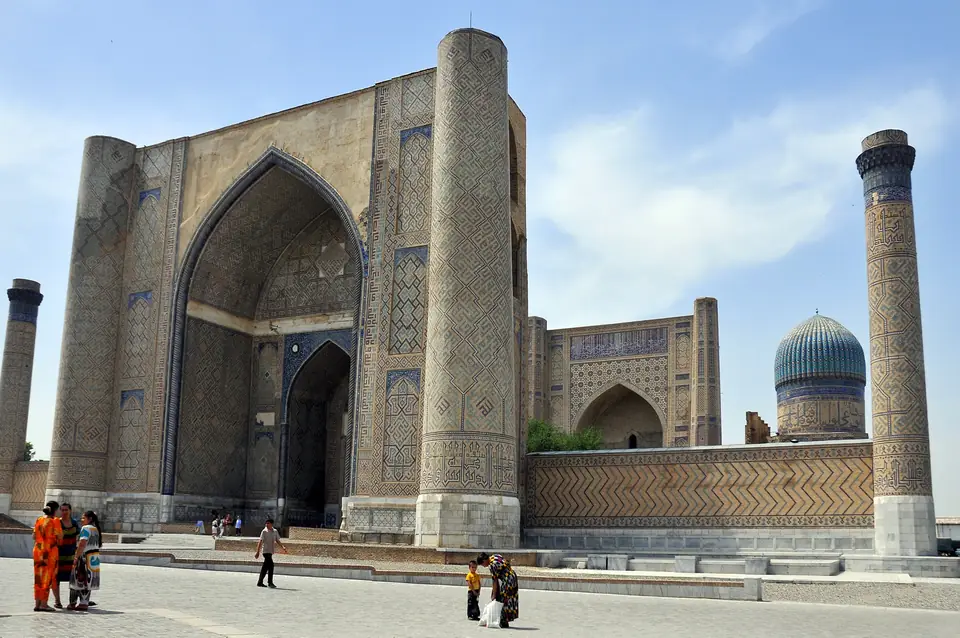
The Bibi-Khanym Mosque, the Bibixonim masjidi, was born of Timur's return from his Indian campaign in 1399. To haul the materials, 95 elephants were brought to Samarkand, 200 stonemasons from Azerbaijan, Fars, Hindustan and other countries worked on the site, and another 500 men carved stone in the mountains. The inscription on the gate dates the completion to the year 806 of the Hijra, 1404 of the Christian era: a compound of 167 by 109 metres aligned to the qibla, with a 35-metre portal and double domes designed to be seen from afar.
A Castilian witness left a written account of its strangest moment. The ambassador Ruy González de Clavijo was in Samarkand in 1404 when Timur, ill and carried in a litter, judged the newly finished portal too low and ordered it pulled down. Who gives the mosque its name is not clear either: it is associated with Saray Mulk Khanum, Timur's chief wife, while Clavijo describes it as built in memory of that wife's mother, and legend makes the queen the patron of the work.
Highlights
- 35-metre portal — the one Timur had pulled down in 1404 for being too low
- 167-by-109-metre courtyard — without the galleries that once stood on more than 400 columns
- Ulugh Beg's marble lectern — moved into the courtyard in 1875 for fear of the dome
- Double 40-metre dome — and the legend of the kiss through the veil
The Bibi-Khanym Mosque is the portrait of an ambition that moved faster than technique. Timur decided to build a gigantic mosque in his capital on returning from India in 1399, and wanted it so large that the scale and haste of the work pushed what his builders knew how to do to the limit: within a few years of completion, the first bricks began to fall from the great dome over the mihrab.
The history of Bibi-Khanym has been a chain of collapses ever since. In the late 16th century Abdullah Khan II, the last Shaybanid khan of Bukhara, cancelled all restoration work. For centuries the people of Samarkand carried off bricks and columns from the courtyard galleries for their houses, Russian artillery damaged it in the siege of 1868 and the 1897 earthquake brought down the inner arch of the portal. In 1974 the government of the Uzbek SSR undertook a complete reconstruction, and a good part of what is seen today dates from the late 20th century, with criticism of a restoration done in haste.
The dates argue with each other too. The inscription on the gate closes the work in 1404, but Clavijo’s account shows the new portal that same year still under construction, halted by the winter snows. The audio guide covers the mosque in four stops, from the street to the sanctuary at the back, with documented narration checked against historical sources that explains why it came down and how it was raised again.
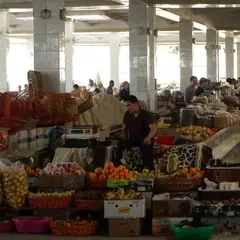
Right against its side bustles the Siab Bazaar, from whose stalls the mass of the dome can be seen, and some 600 metres to the east begins the street of mausoleums of the Shah-i-Zinda Necropolis. The man who commissioned the mosque rests in the Gur-e-Amir Mausoleum, on the other side of the historic centre.
The portal Tamerlane had torn down
Bibi-Khanym Mosque
Summary of this stop
The tour starts in front of the pishtaq on the northeast side, a portal some 35 metres high flanked by minaret bases. It is not the first one built here. In 1404, just after the mosque was finished, Timur judged it too low and ordered it demolished at once to raise another, digging new foundation trenches. The work had begun on the return from India, with 95 elephants brought from there to haul the materials.
What followed was witnessed by a Castilian. Ruy González de Clavijo, ambassador in Samarkand, saw Timur, ill and carried in a litter, spend almost the whole day beside the trenches of the new portal and have cooked meat and coins thrown to the workers. The work went on day and night until the snows stopped it. How much of that portal survives in the one you see today is the first surprise of the narration.
A courtyard that lost its galleries
Inner arch of the portal
Summary of this stop
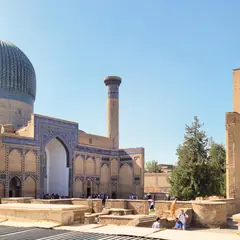
Under the arch of the portal the full scale of the compound opens up: a rectangle 167 metres long by 109 wide, oriented northeast to southwest along the qibla and marked by minarets at the corners. The one at the northwest corner is the one that survived of the originals, and in Samarkand it is known as “Yakka minor”, the lone minaret. That arch, incidentally, is largely a reconstruction: the original collapsed in the 1897 earthquake.
The most telling thing about the courtyard is what is missing. It was surrounded by open galleries 7.2 metres high, covered by small vaults and domes on hundreds of marble columns, more than 300, more than 400 or 480 depending on the source. Locals dismantled them over the centuries as building material and today barely a trace remains. In 1868, during the Russian siege of Samarkand, cannon shells also hit the mosque; what General Kaufmann ordered afterwards against the city is the darkest episode of this stop.
Ulugh Beg’s marble table
Ulugh Beg's marble lectern
Summary of this stop
In the middle of the courtyard, a great lectern of carved marble blocks gives the human scale of the whole. It was a gift from Ulugh Beg, Timur’s grandson: it measures about 230 centimetres long and stood first in the sanctuary, under the dome. In 1875, for fear that the great dome would collapse, it was moved to the centre of the courtyard, where it remains. It is said, without proof, that Ulugh Beg placed on it the great Quran attributed to the caliph Uthman that would end up in Tashkent.
The lectern also has a popular life. Local tradition says that a woman who passes beneath its blocks will have children, and another version speaks of couples who walk through it so that she will soon become pregnant. Why that gesture can no longer be repeated, and what protects the stone today, is told by the audio guide beside the lectern.
The dome that began to fall
Great iwan of the sanctuary
Summary of this stop
At the back of the courtyard, the sanctuary’s great iwan hides the main turquoise dome from inside; it is best seen from outside and from the sides. It is a double dome: the inner one, over the mihrab, is 30 metres high, and the outer one reaches 40, with a gap between them so that it could be seen from afar. Within a few years of completion bricks were already falling from it. In the iwan runs a band of inscriptions with the sura of the Cow, added in the reconstruction begun in 1974.
Legend has its own explanation for the mosque’s fate. It says that Bibi-Khanym had it built as a surprise during one of Timur’s campaigns, that the architect refused to finish it unless she gave him a kiss, and that the kiss, through the veil, left a mark on her cheek. What Timur did on his return has several versions. The work, meanwhile, is not finished: in October 2024 the Qatar Fund for Development and the Uzbekistan Art and Culture Development Foundation agreed to contribute 4,175,000 dollars to the Aga Khan Trust for Culture to complete the restoration while training local craftspeople. How the story of the kiss ends closes the tour.