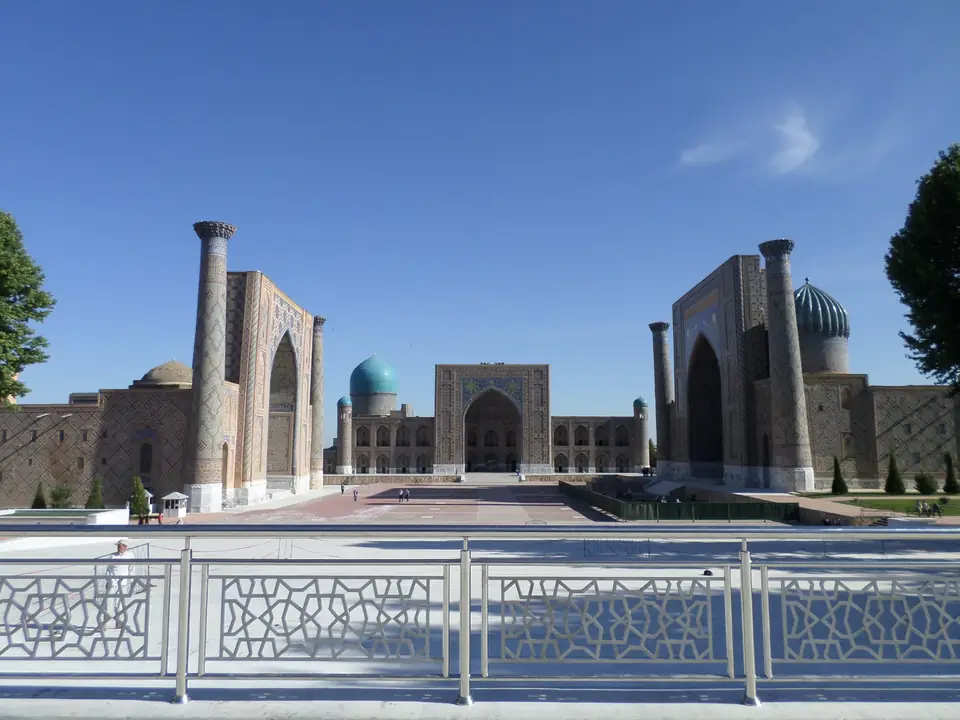
Three madrasas face to face
Registan Square Audio Guide (Registon maydoni)
A square of sand where decrees were proclaimed to the sound of copper horns, closed in by three madrasas that face each other: that of the astronomer prince Ulugh Beg and two more raised two centuries later over the ruins of his buildings. What looks today like an intact stage set is also the work of the engineers who straightened its minarets.
- 90 min of audio
- Timurid and Shaybanid architecture
The Registan, the Registon maydoni of Samarkand, was the city's public square: people gathered here to hear royal proclamations, announced with enormous copper horns, and public executions were held here. On the west side stands the Ulugh Beg Madrasa (1417–1420), the oldest building and the only survivor of the 15th-century Timurid complex. Facing it, Sher-Dor (1619–1636); to the north, Tilla-Kari, finished in 1660. Yalangtush Bahadur had both built on plots of Ulugh Beg's buildings.
The perfection seen today has small print. In the early 20th century the north and south façades of the Ulugh Beg Madrasa were rubble and one of its minarets had collapsed in 1870. Soviet restorations rebuilt all three madrasas with reinforced concrete and newly made tiles, and in 1982 they presented the restored Registan. How much of the most photographed square in Central Asia is original remains a matter of debate.
Highlights
- Registan esplanade — from proclamations and executions to the Sharq Taronalari festival
- Ulugh Beg Madrasa — the portal of stars of a school of astronomers
- Northeast minaret — tilted in 1918 and straightened by Vladimir Shukhov in 1932
- Tilla-Kari golden mosque — gold mihrab under a dome rebuilt in 1975
- Sher-Dor Madrasa — felines with a human-faced sun on a religious portal
In 1888, George Curzon, the traveller who years later would become viceroy of India, called the Registan “the noblest public square in the world”. By then the square was already almost five centuries old. The history of the Registan begins with Ulugh Beg, Tamerlane’s grandson, who between 1417 and 1420 raised a madrasa on its west side and surrounded it with mosques, caravanserais, a bazaar and a Sufi khanaqah. Of all that only his madrasa remains. Two hundred years later, Yalangtush Bahadur, ruler of Samarkand, built Sher-Dor over the khanaqah and Tilla-Kari over the caravanserai, and closed the square as it is known today.
The dates shift depending on the source: the Ulugh Beg Madrasa appears as 1417–1420 or 1417–1421, and Sher-Dor as 1619–1636 or 1616–1636. Nor does the name have a single reading. Registan is translated as “place of sand” or “sand-covered place”, though the Uzbek encyclopedia prefers “place paved with small stones”, alluding to the paving that kept off dust and mud. And there is the dark version that circulates in Samarkand, without any proof: that the sand was spread over the execution ground to soak up the blood.
The architecture of the Registan is, besides, a debate about restoration. In the 1920s Boris Zasypkin argued for conserving the monuments as they had come down, with their original materials; the later campaigns, led by Kryukov, rebuilt with reinforced concrete and new ceramics. The audio guide covers the square in five stops, with documented narration checked against historical sources, and on each façade separates what is 15th century, what is 17th and what the 20th-century engineers added.
The astronomer prince has his other great stage some 3 km to the northeast, at the Ulugh Beg Observatory, and he rests beside his grandfather in the Gur-e-Amir Mausoleum, southwest of the square. Less than a kilometre to the northeast stands the Bibi-Khanym Mosque, Tamerlane’s great congregational mosque.
A square for proclamations, sentences and concerts
Registan
Summary of this stop
The tour starts on the southern edge of the esplanade, with the three madrasas in view: Ulugh Beg on the left, Sher-Dor on the right, face to face, and Tilla-Kari closing the back. This open space was the public heart of Samarkand. Here people gathered to hear the royal proclamations, announced with enormous copper horns called dzharchis, and here public executions were held.
The same ground changed function more than once. Since 1997 the Registan has hosted every two years the Sharq Taronalari international music festival, “Melodies of the East”, with an open-air stage surrounded by the three madrasas. And the Hungarian traveller Ármin Vámbéry left a written scene that, according to his account, turned the square into a colossal kitchen: the triumphal entry of the emir of Bukhara, with pilaf cauldrons that took a sack of rice and three quartered sheep. Why, with all that past, an English traveller ended up calling it the noblest square in the world is what the narration unpicks on the esplanade.
A school of sciences under a portal of stars
Ulugh Beg Madrasa
Summary of this stop
The Ulugh Beg Madrasa is the oldest on the square and its great portal, the pishtaq, announces it with a display of blue stars over the pointed arch: the reflection of its founder’s passion for astronomy. It was not only a school of theology. Mathematics, geometry, logic and natural sciences were taught here, and among its professors were Qazizade Rumi, al-Kashi, Ali Qushji and Ulugh Beg himself. The Persian poet Jami studied in its classrooms.
Samarkand State University dates its origin to this madrasa, in 1420. Tradition preserves the day of the inauguration: for the opening lecture, on Ptolemy’s theory, Ulugh Beg chose a simple but highly learned man, Mawlana Muhammad Khawafi. He spoke before a hundred scholars. How many of them were able to follow him, and who, is the anecdote the audio guide saves for the foot of the portal.
A crooked minaret and an engineer from Moscow
Ulugh Beg's northeast minaret
Summary of this stop
The Ulugh Beg Madrasa occupies a rectangle of 56 by 81 metres, with a courtyard of 30 by 40 surrounded by fifty student cells, the hujras, and a 33-metre minaret at each corner. The verticality seen today was not always there. Photographs by Friedrich Sarre published in 1901 show the north and south façades turned into heaps of rubble, and one of the western minarets had collapsed in 1870.
In autumn 1918 it was detected that the northeast minaret was leaning. After a project begun in 1920 by Mikhail Mauer, the Moscow engineer Vladimir Shukhov straightened it in 1932; the southeast one needed the same operation in 1965, carried out by the engineer E. M. Gendel. In Samarkand a saying circulates about this madrasa, the most massive of the group, which in light of that history sounds almost like a diagnosis. The narration tells it at the northeast corner, under the minaret they had to put upright.
Gold under a dome rebuilt without a model
Tilla-Kari golden mosque
Summary of this stop
Tilla-Kari, “the gilded”, closes the north side with a symmetrical two-storey façade of arches and corner towers. Yalangtush Bahadur began it in 1646 over Ulugh Beg’s 15th-century caravanserai, by then badly decayed, partly reusing its foundations and walls, and it was finished in 1660. It was both a madrasa and Samarkand’s congregational mosque until the 1920s; since 1927 it has been a museum.
On the west side of the courtyard, the prayer hall passes from half-light to radiance: gilded mihrab and minbar and vaults painted with gold. Above them, a blue dome with a peculiar story. The original collapsed after a great earthquake in 1818 and no photographs or drawings of it survive; the present one was added in a long restoration campaign finished in 1975. How a dome is rebuilt when no image of it remains is the question the audio guide poses under that gold.
Sun tigers facing the stars
Sher-Dor Madrasa
Summary of this stop
The tour ends before Ulugh Beg’s mirror. The Sher-Dor Madrasa, the work of the architect Abdul-Jabbar for Yalangtush Bahadur, occupies the site of the khanaqah the astronomer prince had raised in 1424 opposite his madrasa. Its portal shows something rare in an Islamic religious building: felines carrying on their backs a sun with a human face, alongside deer. Hence the name, Sher-Dor, “the one bearing lions”, although the mosaics are also described as tigers, as “tiger-lion” or as snow leopards.
On either side of the iwan two ribbed domes peep out. According to legend, Yalangtush asked Abdul-Jabbar for domes of which the sky itself would be envious, and the work turned out so fragile that they began to sink a few years after it was finished in 1636. It stayed that way for some three centuries, until Soviet restorers rebuilt the building in the early 1960s. What that legend says about its patron’s pride is the last story of the tour.