Timurid astronomy
Ulugh Beg Observatory Audio Guide (Ulug'bek rasadxonasi)
On a hill on the outskirts of Samarkand, a trench cut into the rock holds the marble arc of the greatest astronomical instrument of its day. With it, a grandson of Tamerlane measured the sky with the naked eye and fixed the length of the year with a smaller error than Copernicus.
- 45 min of audio
- Medieval science
The Ulugh Beg Observatory, the Ulug'bek rasadxonasi, began to be built in 1420, the year 823 of the Hijra, and was ready around 1428-1429. It was a cylinder some 46 metres in diameter and three storeys, about 30 metres high, faced with glazed tiles and marble slabs. Its heart was the Fakhri sextant, aligned on the meridian, with a radius of about 40 metres: so as not to raise an unstable building, its lower part was dug into the rock. Ulugh Beg gathered more than 60 mathematicians and astronomers here.
All that is left of the building is a circle on the ground. Ulugh Beg was murdered in 1449 on the orders of his own son, the scholars eventually emigrated and in the late 16th century locals dismantled the cylinder to reuse its bricks. For centuries travellers looked for it where it was not, until in 1908 the archaeologist Vasily Vyatkin found it thanks to a 17th-century land document. Today it lies buried in the centre of the site.
Highlights
- Circular foundations — the footprint of a three-storey cylinder some 30 metres high
- Tomb of Vasily Vyatkin — the archaeologist who found the observatory in 1908
- Arc of the Fakhri sextant — degrees of 70 centimetres carved in marble
- Zij-i Sultani — a catalogue of 1,018 stars that corrected Ptolemy
Jamshid al-Kashi, the first director of the Ulugh Beg Observatory, wrote from Samarkand to his father, in Kashan, a letter describing his patron. In it he tells how one day, riding on horseback, the prince calculated from memory the true longitude of the Sun, in degrees and minutes, without dismounting. Al-Kashi admits that he himself only managed the degrees. Such was the man who had the greatest astronomical instrument of his age carved into the rock of this hill.
The history of the Ulugh Beg Observatory is that of a work that outlived its building. Around 1437 the Zij-i Sultani came out of here, a catalogue of 1,018 stars in Persian, the only major campaign of direct observation of stellar coordinates in the medieval Islamic world. Its end, however, is told two ways: a widespread version, partly from the Soviet era, has it destroyed by fanatics in 1449, after the sultan’s murder, while other sources keep it in operation under Ali Qushji until 1469 and have it dismantled in the late 16th century to reuse its bricks.
There is not complete agreement on what you see, either. Most identify the instrument as a sextant, but Vyatkin interpreted it as a quadrant, and the surviving part is not enough to settle it; the measurements of the arc and the building vary slightly depending on the source, as do the dates the work began, 1420 or 1424. The audio guide covers the site in four stops, with documented narration checked against historical sources, from the empty foundations to the bottom of the marble trench.
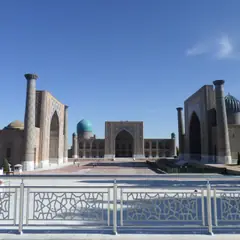
The other half of Ulugh Beg’s story is in Registan Square, where his madrasa had astronomers for professors and where travellers searched in vain for the observatory. A little over a kilometre to the west, the Afrasiab Museum keeps the city that came before his.
A three-storey cylinder that is no longer there
Ulugh Beg Observatory
Summary of this stop
The visit starts beside the circular layout of the foundations, which traces on the hilltop the outline of the old building. Here stood a cylinder some 46 metres in diameter and three storeys, about 30 metres high, faced with glazed tiles and marble slabs. Work began in 1420 and around 1428-1429 the installation and adjustment of the instruments began.
Ulugh Beg invited more than 60 mathematicians and astronomers. Jamshid al-Kashi directed the observatory until his death in 1429, Qadi Zada al-Rumi succeeded him and the last director was Ali Qushji. Half a century after the sultan’s death, a young Timurid prince who would go on to found the Mughal empire of India saw the building still standing and described it in his memoirs. Who he was and what he wrote about it is the story with which the narration begins.
Murdered by his son, found by a paper
Tomb of Vasily Vyatkin
Summary of this stop
In the centre of the site, beside the sextant, lies the tomb of Vasily Vyatkin (1869-1932), the archaeologist who discovered the observatory. Before him came a long fall. Ulugh Beg, Timurid sultan from 1447, was murdered on 27 October 1449 on the orders of his own son, Abd al-Latif, and his death marked the beginning of the decline. The empty building stood for decades, until in the late 16th century the people of Samarkand dismantled it to carry off its bricks and the hill covered what remained with earth.
When Ulugh Beg’s catalogue became known in Europe, travellers passing through Samarkand looked for the observatory in the wrong place: some thought it was the Tilla-Kari dome, in the Registan, and Ármin Vámbéry thought in 1863 that it had been inside the Ulugh Beg madrasa. In 1908 Vyatkin located it thanks to a 17th-century document, a land donation to a dervish community that described the site. How a three-century-old paper gave back to Samarkand what no one could find with the naked eye is the story the audio guide tells before the tomb.
A millimetre of marble, five seconds of sky
Marble arc of the Fakhri sextant
Summary of this stop
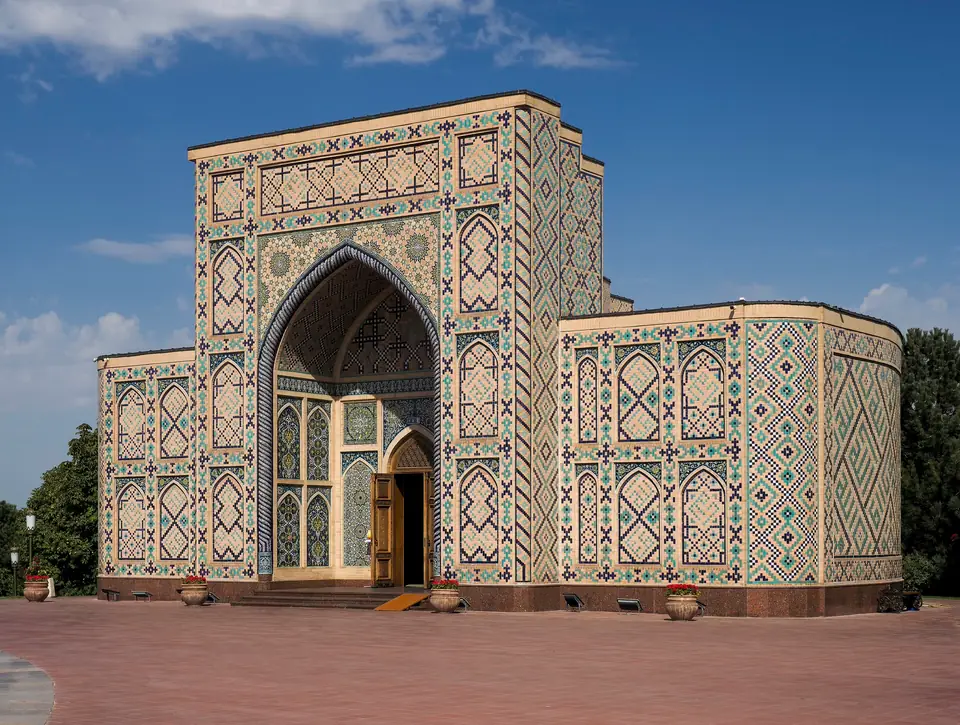
Under an entrance pavilion, heir to the brick vault of 1915, you go down into the trench cut into the rock, about 2 metres wide and oriented north to south. It is what Vyatkin unearthed in 1908: the underground part of the Fakhri sextant, two parallel walls faced with marble and the stretch of scale corresponding to solar altitudes between 80 and 57 degrees, with brick stairs on both sides along which the observers moved.
The precision can be read in the stone. On the arc each degree took up about 70 centimetres and the finest marks, barely a millimetre apart, equalled about 5 arcseconds. With those measurements, Ulugh Beg fixed the tropical year at 365 days, 5 hours, 49 minutes and 15 seconds, with an error of about 25 seconds, smaller than Copernicus’s, which was around 30. What else al-Kashi told his father about his patron in that letter is the portrait with which the narration closes this stop.
A thousand stars that travelled to India
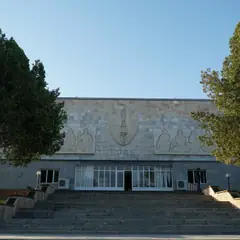
Ulugh Beg Observatory Museum
Summary of this stop
The small museum beside the ruins keeps copies of manuscripts of the Zij-i Sultani, European editions of the tables, astrolabes and a model of the complete observatory. That catalogue of 1,018 stars, finished around 1437, corrected Ptolemy’s and was used in the Islamic world until the 19th century.
The work lived on after the crime. The observatory ran for some twenty more years under Ali Qushji, and only in 1469, when the ruler of Samarkand Abu Said died, did the scholars emigrate to Herat; Qushji ended up in Constantinople. Centuries later, the enormous masonry instruments that Jai Singh built in the 18th century in five cities of India, among them Jaipur and Delhi, followed in Samarkand’s wake. How the idea of a hill carved to measure the sky travelled to India is the last twist of the tour.