Samarkand's great market
Siab Bazaar Audio Guide (Siyob bozori)
Wall to wall with the Bibi-Khanym Mosque, Samarkand's biggest bazaar sells tandoor bread, dried fruit and wedding halva from before dawn. Not a single old building is left, but the market trade of this strip of the city has not stopped for seven centuries.
- 45 min of audio
- Silk Road market
The Siab Bazaar, the Siyob bozori, takes its name from the historic district of Siyob and the river that runs nearby: “black water” or “black river” in Persian and Tajik. The area was the commercial and artisan suburb of the south of the city between the 8th and 13th centuries, and in the late 13th and early 14th centuries it became the focus of urban revival when life died out in Afrasiab, the ancient city 2 kilometres to the north. Until the early 20th century, its workshops, warehouses and caravanserais were the centre of Samarkand's public life.
The current market is seven large covered pavilions and other shop halls on more than 7 hectares, with one building just for meat, another for bread and sweets and another for naswar, chewing tobacco. It is a dehkan market, of Uzbek farm produce, and it has withstood everything: in 2019 plans were made to put a three-storey hypermarket in its place, and in 2025 it was still running as a traditional market.
Highlights
- Triple-arched gate — blue majolica facing the Bibi-Khanym Mosque
- Bread row — more than 17 kinds of Samarkand bread baked in tandoors
- Sweets and spices rows — cake-shaped halva for weddings
- Covered pavilions — a dehkan market that opens before dawn
In 1404, a Castilian ambassador strolled through Samarkand and took note of what he saw in its squares: meat already stewed or roasted, poultry, bread and fruit, and a traffic that did not stop by day or night. He was Ruy González de Clavijo, and that same year he saw Timur order a street of shops opened right across the city: the houses along the route were pulled down without regard for their owners and in twenty days a wide street was done, with shops on both sides, stone benches, fountains and a vaulted roof with windows.
The history of the Siab Bazaar rests on that calling more than on its walls. A local guide credits it with more than 2,000 years and presents it as a key point of the Silk Road, but what the sources document is more modest and more interesting: a suburb of merchants and artisans between the 8th and 13th centuries that inherited the life of Afrasiab when the ancient city went dark. Until the early 20th century, the strip between the Registan and Afrasiab was the meeting point of merchants from China, India and Iran. There is no agreement on its size either: more than 7 hectares according to encyclopedias, 5 of rows according to tourism portals.
What to see at the Siab Bazaar is measured in smells and counters: the bread row, the mountains of walnuts, dried apricots, almonds, spices and bunches of navat, the sugar crystallised on strings, and the pavilions where you shop before the sun comes up. The audio guide covers it in four stops, with documented narration checked against historical sources that sets today’s stalls against Timur’s merchant Samarkand.
Leaving by the triple arch, the Bibi-Khanym Mosque is right opposite, and the city whose life this district inherited can be visited at the Afrasiab Museum, built on its hills, to the northeast.
A blue triple arch facing Bibi-Khanym
Siyob Bozori
Summary of this stop
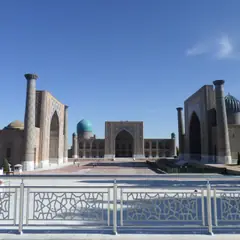
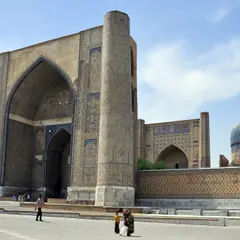
The main entrance, the south one, is a triple arch faced in blue mosaic and majolica, with carved wooden columns. From here you can see the great portal and turquoise domes of the Bibi-Khanym Mosque, stuck to the side of the bazaar: the daily market and the imperial mosque live wall to wall.
The name holds another geography. Siyob is the historic district and the river that runs nearby, and it means “black water” in Persian and Tajik. This district was the commercial suburb of the south between the 8th and 13th centuries and, when in the late 13th and early 14th centuries life died out in Afrasiab, 2 kilometres to the north, it became the focus of the city’s revival. How Samarkand moved from one hill to another is the starting point of the narration.
Seventeen breads and the air of Samarkand
Bread row
Summary of this stop
Beside the entrance the bread stalls line up: piles of round loaves, shiny with oil, decorated with stamped patterns and sesame. In this row more than 17 kinds of Samarkand bread are sold. The most characteristic is obi-non, baked in clay ovens, the tandoors, round as a sun disc and thinner in the centre. Alongside it is sold the tkech, the spiked stamp used to prick and decorate the dough.
Vendors claim this bread keeps for up to three years if sprinkled with water and warmed again, and few travellers leave without a tower of loaves. There is also a legend that in the row is taken as true: a khan of Bukhara who took the best baker in Samarkand with his oven, his flour and his water, and still could not get the same bread. What was missing is the answer the audio guide keeps for this stop.
Wedding halva and Timur’s street
Rows of dried fruit, sweets and spices
Summary of this stop
In the upper part of the market the rows of dried fruit, sweets and spices follow one another: walnuts, dried apricots, almonds, figs, raisins, barberries, mountains of spices and bunches of navat. Among them stands out the cake-shaped halva, decorated with nuts and messages of love and happiness, which in Samarkand is bought for weddings or given to the couple at the engagement.
This stop links to the street of shops that Timur ordered opened in 1404 by tearing down houses without compensating their owners. According to the account of the time, the evicted residents did not dare complain before him and turned to some sayyids, descendants of the Prophet and favourites of the court, who raised the matter while playing chess with the emir. What Timur answered about the land of Samarkand is the episode the narration tells among the sweet stalls.
Modern halls, a seven-century trade
Covered pavilions
Summary of this stop
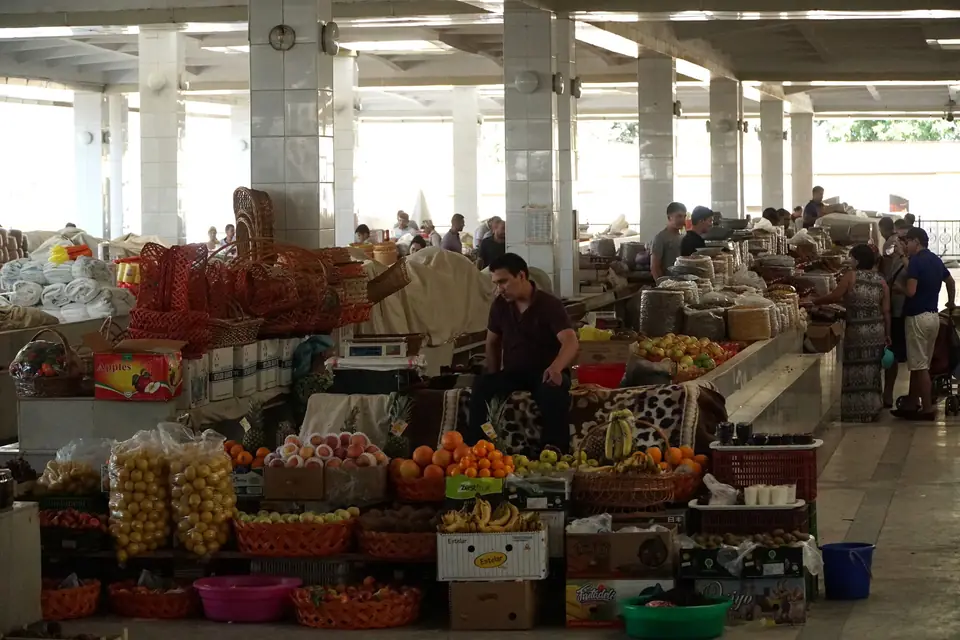
Under the covered pavilions, the counters are arranged by product: fruit and vegetables, dairy, grain. Apart stand the meat building and the naswar pavilion, and inside the compound rises the five-storey Shodiyona shopping centre. The market no longer keeps its old buildings, but it is still a dehkan market, where trading starts before dawn and ends late at night.
Continuity has not been simple. In October 2015 the bazaar was closed for three days to paint stalls and repair buildings ahead of a visit by US Secretary of State John Kerry, and in 2019 it was planned to replace it with a three-storey hypermarket. In 2025 it was still open as a traditional market. Why the buildings change and the trade does not is the idea with which the audio guide closes the tour.