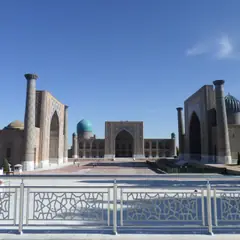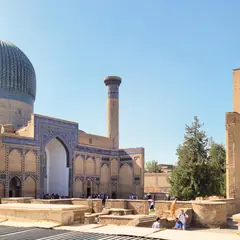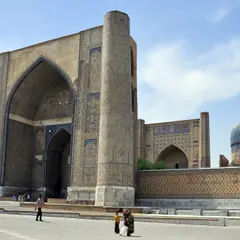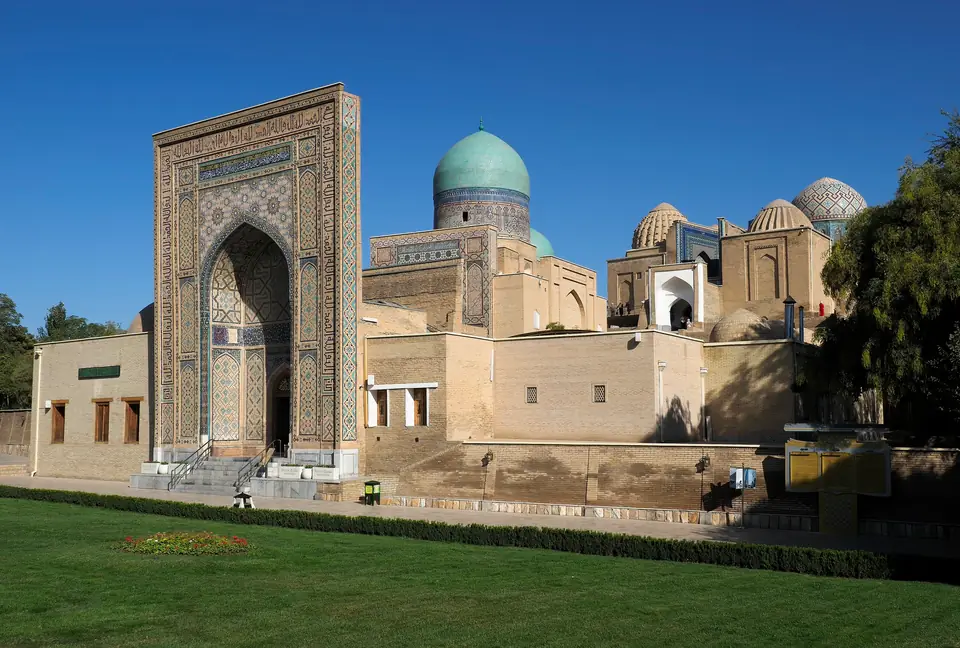
Street of Timurid mausoleums
Shah-i-Zinda Necropolis Audio Guide (Shohi Zinda majmuasi)
A narrow street of blue domes climbing the slope of Afrasiab towards the tomb of the Living King, a cousin of the Prophet who, according to legend, never quite finished dying. Along the way, the women of Tamerlane's family rest under the finest Timurid ceramics in Samarkand.
- 60 min of audio
- Timurid ceramics
Shah-i-Zinda, the Shohi Zinda majmuasi, was built up over almost four centuries around a venerated tomb. The complex began with the Qarakhanids, who in 1066 raised the madrasa of Tamgach Bughra Khan beside it, and was closed in 1434/35 with the entrance portal of Abdulaziz, son of Ulugh Beg and great-grandson of Tamerlane. Between one date and the other, a brick staircase and a street of mausoleums where the conqueror's niece and sister rest, with portals of carved glazed terracotta reminiscent of Chinese lacquer.
Behind the ceramics beats a pilgrim road. Ibn Battuta saw locals climb to the tomb of Qutham ibn Abbas on the eve of every Tuesday and Friday, and not even official Soviet atheism emptied the street: in 1945 a decree returned it to worship. The restoration after 2005, however, raised new mausoleums and replaced part of the original ceramics with industrial tile, and it is still heavily criticised.
Highlights
- Staircase of 40 steps — counted going up and going down, according to tradition
- Double-domed mausoleum — attributed to an astronomer, it held the remains of a woman
- Shadi Mulk Aqa Mausoleum — carved terracotta of 1372 like Chinese lacquer
- Shirin Biqa Aqa Mausoleum — the tallest dome of the central group
- Carved door of Qutham ibn Abbas — dated 1404–1405, once inlaid with ivory
The name says it all and, at the same time, proves nothing. Shah-i-Zinda means “the Living King”, and refers to Qutham ibn Abbas, a cousin of Muhammad, who according to tradition died a martyr in the first Arab siege of Samarkand, in 676 or 677. Local legend does not accept that ending: it has him escape death by hiding in a niche or throwing himself into a well, where he would still be alive underground. The shrine, incidentally, was not always called that: until the 16th century it was the “Mazar of the Shah”.
The history of Shah-i-Zinda is full of names best heard with caution. There is no proof that the tomb existed before the 11th century, an Uzbek heritage record calls it an “imaginary tomb” and the versions of the saint’s end contradict each other. Nor are the identities of some of the women buried along the street clear, not even the number of steps in the staircase: 40 in tradition, 36 in another heritage record.
What you do see is one of the most beautiful funerary streets in Central Asia: a corridor of glazed portals climbing from the portal of 1434/35 to the saint’s carved door, built by the Qarakhanids, the Timurids and the restorers of the 21st century. The audio guide walks it in five stops, from the staircase to the shrine, with documented narration checked against historical sources that separates what the documents say from what the pilgrims tell.
The street climbs the slope of Afrasiab, the pre-Mongol city whose story is told by the Afrasiab Museum, less than a kilometre to the northeast. To the west, some 600 metres away, rises the great dome of the Bibi-Khanym Mosque.
Forty steps counted twice
Shah-i-Zinda
Summary of this stop
The tour starts at the foot of the slope, before the great entrance portal raised in 1434/35, the year 838 of the Hijra, by Abdulaziz, son of Ulugh Beg and great-grandson of Tamerlane. Its foundation inscription closes almost four centuries of building on the complex. Behind it begins the brick staircase that climbs to the street of mausoleums; the current one, of 40 steps, replaced in the 18th century another that had fallen into ruin.
The staircase is also a rite. According to tradition, visitors and pilgrims count the steps going up and coming down, and if the two counts match, the person is freed from sin. Legend also places here Bahauddin Naqshband, founder of the Naqshbandi Sufi order, who is said to have spent forty days in retreat climbing a single step each day. Who met him when he reached the last one is the story the narration tells while looking upwards.
The astronomer’s tomb that held a woman
Double-domed mausoleum
Summary of this stop
Halfway up the staircase stands a two-chambered mausoleum with blue domes; the taller rises on an elongated drum almost to the level of the mausoleums at the top. Tradition attributes it to Qazi Zade Rumi, the astronomer who was Ulugh Beg’s teacher, an attribution now considered probably wrong.
On 5 November 1979 the tomb was opened and what appeared was not a scholar: according to one version, the remains of a woman aged between 30 and 35; according to another, the bones of two women. It is a small revelation that forces you to look at the names along the whole street with different eyes, and the audio guide uses it to explain how such attributions come about.
Women’s prayers under Soviet watch
Amirzade and Tuglu Tekin mausoleums
Summary of this stop
Between the facing mausoleums of Amirzade and Tuglu Tekin, of 1386 and 1376, with decorated colonnettes on the corners of their façades, you understand that this street never stopped being a place of prayer. In the early 1330s, when Ibn Battuta passed through Samarkand, locals went to Qutham’s tomb on the eve of every Tuesday and Friday, and the Mongols also visited it and offered it cattle, sheep, dirhams and dinars to support travellers and the shrine’s servants.
Six centuries later, on 27 March 1945, decree no. 410 of the Council of People’s Commissars of the Uzbek SSR handed Shah-i-Zinda, along with six other mazars, to the Spiritual Administration of the Muslims of Central Asia and Kazakhstan. Around 1979, the historian Daniel C. Waugh witnessed an early-morning prayer in the Amirzade mausoleum in which, apart from the imam, all those attending were women. A policeman watched from a distance, and what he did when the service ended is the punchline of this stop.
Ceramics in relief like Chinese lacquer
Shadi Mulk Aqa and Shirin Biqa Aqa mausoleums
Summary of this stop
At the top, the street reaches its artistic summit. The mausoleum of Shadi Mulk Aqa, Tamerlane’s niece, was commissioned in 1372 by her mother Turkan Aqa, although the latter’s identity varies by source. It was signed by the architects Shamseddin, Bareddin and Zainuddin Bukhari, and its portal is covered in glazed terracotta carved in deep relief reminiscent of the carved Chinese lacquers of the late Yuan and Ming dynasties, a technique concentrated in a few tombs of Shah-i-Zinda. It is among the best-preserved mausoleums, and its inner dome keeps its original ceramics.
Opposite, the mausoleum of Shirin Biqa Aqa, Tamerlane’s sister, built on his orders in 1385/86, has the tallest dome of the central group, on a 16-sided drum with stucco lattices and coloured glass. The contrast comes with the restoration after 2005, which raised new mausoleums, replaced part of the Timurid ceramics with industrial tile and demolished the remains of the 1066 madrasa portal. Where to tell the original from the new is what the narration shows in front of these two portals.
The door of the saint who never died
Carved door of the Qutham ibn Abbas complex
Summary of this stop
Under the arch at the end, on the right, a carved wooden door dated 1404–1405, originally inlaid with ivory, gives access to the Qutham ibn Abbas complex. Just behind it appear the remains of the Qarakhanid minaret, the oldest visible trace of the shrine, from the time when in 1066 the madrasa of Tamgach Bughra Khan was raised beside the venerated tomb. Beyond, the pilgrims’ antechamber lets you see the cenotaph through a carved wooden lattice of the 14th century.
Here the circle of the Living King legend closes. According to popular tradition, Tamerlane, back from a campaign, wanted to know whether the saint was really still alive, and as no one dared go down into the well, a warrior named Hida volunteered for the reward. What he found down there, and the prophecy Tamerlane received in return, is the story with which the audio guide ends the tour.