Tamerlane's mausoleum
Gur-e-Amir Mausoleum Audio Guide (Amir Temur maqbarasi)
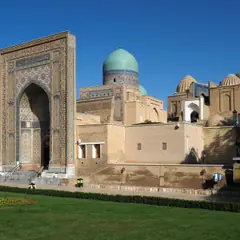
A blue 64-ribbed dome raised in 1403 for Tamerlane's grandson and heir ended up holding the conqueror himself, buried at the feet of his master under a broken slab of nephrite. The Mughal tombs of India, all the way to the Taj Mahal, learned from this Samarkand mausoleum.
- 45 min of audio
- Timurid pantheon
Gur-e-Amir, the mausoleum of Amir Temur, began to be built in 1403 after the sudden death of Muhammad Sultan, Timur's favourite grandson and heir, for whom it was intended. It rose beside the complex the prince himself had built in the late 14th century, with a two-storey madrasa and a khanqah, a Sufi hospice. Two years later, Tamerlane died in the middle of his campaign against China and ended up buried here, in a building still unfinished, which in time became the pantheon of his dynasty.
The gravestones seen in the golden hall, surrounded by a marble lattice, only mark the burials: the bodies of Timur, his sons Shah Rukh and Miran Shah, his grandsons Muhammad Sultan and Ulugh Beg and his master Mir Sayyid Baraka lie in the crypt below, closed to the public out of respect for Islamic rite. That crypt was opened in June 1941, and what the Soviet scientists found there dismantled one of Samarkand's most persistent legends.
Highlights
- North portal — signed by Muhammad ibn Mahmud of Isfahan, what remains of the original complex
- Ribbed dome — 64 blue ribs, the model for Humayun's Tomb and the Taj Mahal
- Kök Tash — the coronation stone of Central Asian rulers, according to tradition
- Timur's nephrite slab — war booty of 1425, stolen by Nader Shah in 1740 and returned
- Closed crypt — the 1941 exhumation and the legend of Tamerlane's curse
Tamerlane did not want to rest in Samarkand. He had prepared a tomb for himself in Shahrisabz, beside his Ak-Saray palace, but when he died in 1405, on the campaign against China, the mountain passes to Shahrisabz were covered in snow. He was buried in the mausoleum he had ordered built two years earlier for his grandson Muhammad Sultan, and which was not yet finished. The story of Gur-e-Amir is that of a borrowed tomb that became the pantheon of a dynasty.
Those who came after kept moving pieces around. In 1409 Shah Rukh, Timur’s youngest son, brought from Andijan the remains of Mir Sayyid Baraka, his father’s spiritual master, and buried them here; since then Timur has lain at his feet. In 1425 Ulugh Beg opened a new entrance on the east so as not to approach by the master’s head, and covered his grandfather’s tomb with a slab of nephrite brought as booty. Even the dead of the family travelled: according to the chronicles, Shah Rukh’s body reached Samarkand after being taken hostage by his own grandson and dug up in Herat.
The architecture of Gur-e-Amir looks to the future as much as to the past: it was a forerunner of the tombs that Timur’s Mughal descendants raised in Kabul, Delhi and Agra. It is also a heavily restored building. The minarets fell in 1886 and 1903 and were rebuilt in 1996, when many Timurid tiles were replaced by modern majolica, and the state of the epigraphy remains a source of criticism. The audio guide covers the mausoleum in five stops, with documented narration checked against historical sources, from the ruined portal to the staircase of the crypt that is not visited.
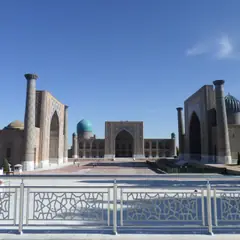
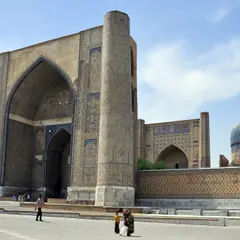
Tamerlane’s other great work in the city is the Bibi-Khanym Mosque, the grand mosque he had built on his return from India. Less than a kilometre from the mausoleum, Registan Square preserves the madrasa of Ulugh Beg, the grandson who covered his grandfather’s tomb with nephrite.
The complex of an heir who died before his grandfather
Gur-e-Amir
Summary of this stop
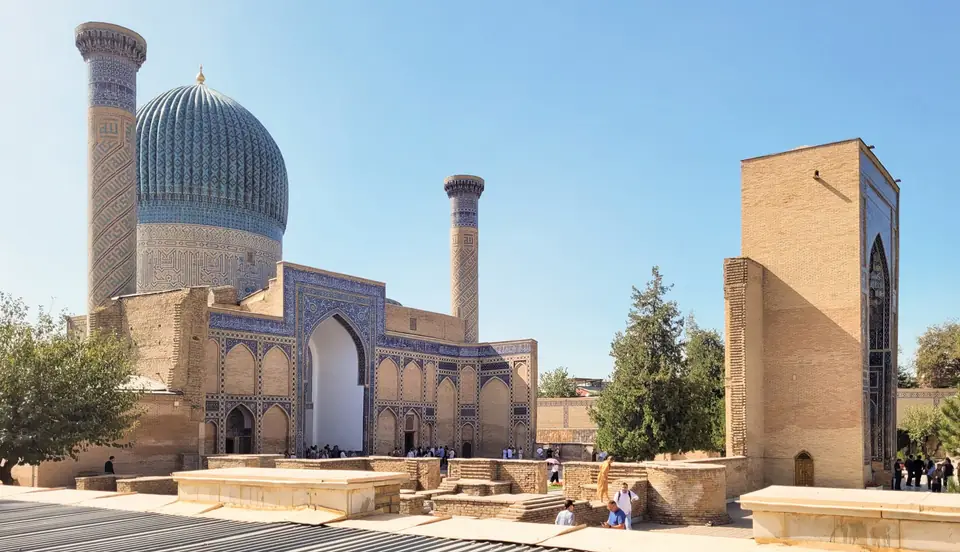
The visit begins in front of the north portal, decorated with carved brick and mosaic and signed by the master Muhammad ibn Mahmud of Isfahan. It is what still stands of the complex that Muhammad Sultan raised in the late 14th century: a two-storey madrasa to the east and a domed khanqah to the west, of which only foundations, low walls and part of one of the four minarets remain today.
The mausoleum came later, and through misfortune. In 1403 Timur’s favourite grandson and heir died suddenly and the tomb begun beside it was meant for him. Neglect did the rest: by the late 17th century the madrasa was deserted and the khanqah’s dome had collapsed; of the two minarets that held out, the southeast one fell in the great earthquake of 1886 and the southwest one was ruined on 18 May 1903. What it means that the building’s first occupant was not its most famous owner is the thread with which the narration begins.
The dome that looked ahead to the Taj Mahal
Courtyard with the Kök Tash
Summary of this stop
From the centre of the courtyard the outer dome dominates, an intense blue, some 15 metres in diameter and 12.5 high, run through by 64 ribs that spread its weight to the base and raised on a drum with great inscriptions. That silhouette had descendants: Gur-e-Amir was a forerunner of the Bagh-e-Babur in Kabul, of Humayun’s Tomb in Delhi and of the Taj Mahal in Agra, the tombs of the Mughals who claimed to be Timur’s heirs. The minarets that accompany it, however, date from 1996, from the renovation for the conqueror’s 660th anniversary.
On the courtyard floor rests the Kök Tash, the “blue stone”, a block of greyish marble about three metres long decorated with arabesques. Tradition, disputed, holds it to be Timur’s throne and the coronation stone of Central Asian rulers. In 1863 it was still in the citadel, and pilgrims recited three fatihas before it and rubbed their heads against the stone; it reached the mausoleum courtyard in the 1960s. What those pilgrims believed they absorbed by touching it is explained by the audio guide beside the stone.
A door opened out of respect for a master
Ulugh Beg's east gallery
Summary of this stop
The vaulted gallery on the east side, through which the hall of tombs is entered today, was built by Ulugh Beg in 1425. It was not a matter of convenience: entering from the side of Mir Sayyid Baraka’s head was considered disrespectful, so a new door was opened. That gallery has been the main entrance ever since.
The gesture says a lot about the mausoleum’s hierarchy. Mir Sayyid Baraka, whose remains Shah Rukh brought from Andijan in 1409, occupies the head, and Timur lies at his feet, as a disciple, in a building that was not even meant for him: he was buried here because snow closed the road to Shahrisabz. How the most feared conqueror of his time fits the role of pupil is what the narration unpicks under the vault.
A nephrite slab that travelled and came back
Timur's nephrite slab
Summary of this stop
In the main hall, under an inner dome covered in papier-mâché cartouches gilded and painted in blue and gold, over a plinth of greenish onyx, the gravestones of Timur, his sons Shah Rukh and Miran Shah, his grandsons Muhammad Sultan and Ulugh Beg and Sayyid Baraka are arranged, surrounded by a lattice of carved marble. In the centre Timur’s stands out, very dark green, almost black, with the join line of its two pieces in plain view.
Ulugh Beg obtained that nephrite as booty in 1425, after his victory over the Mughals, though another tradition has it coming from the palace of the Chinese emperor. In 1740 Nader Shah, ruler of Persia and an admirer of Timur, had it carried off; the misfortune that followed was taken as a bad omen and his advisers made him return it. Where and how it broke is the subject of differing versions. Very close by rests Ulugh Beg, defeated in 1449 by his eldest son and murdered soon after: what his bones revealed five centuries later is the grimmest episode of this stop.
The closed crypt and the curse that wasn’t there
Access to the crypt
Summary of this stop
On the east side, a staircase goes down to the crypt where the royal burials lie. It is not visited, but it has been seen. In 1863 the Hungarian Ármin Vámbéry arrived in Samarkand disguised as a Sunni dervish; according to his account, the mausoleum’s inspector kept him as a guest all day and granted him a favour rare even for locals: to go down that narrow staircase to the crypt.
In June 1941, on dates the sources place between the 19th and 21st, the Soviet anthropologist Mikhail Gerasimov exhumed Timur, reconstructed his face from the skull and confirmed that he stood 172 centimetres tall and walked with a marked limp. Before the opening, three elders had handed the writer Sadriddin Ayni a manuscript that, they said, forbade opening the tomb. The popular version links that exhumation to the German invasion of 22 June, but no curse was found engraved on the coffin. What inscriptions there really were, and how Ayni answered the elders, closes the tour.