UNESCO World Heritage Site
Drottningholm Palace Audio Guide (Drottningholms slott)
On the shore of Lake Mälaren, the palace a regent queen built to show off Sweden's power holds an 18th-century theatre whose sets are still changed by hand in six seconds, a garden of bronzes taken as booty and a Chinese pavilion born as a surprise gift. And since 1981 it has been the royal family's home.
- 120 min of audio
- Baroque and Rococo
The name Drottningholm, «the Queen's islet», dates from 1579, when Johan III had a stone house built here for Queen Katarina Jagellonica. The present palace is another story: the dowager queen Hedvig Eleonora bought the estate in 1661, saw it burn that very December and commissioned Nicodemus Tessin the Elder to build a new building over the cellars that survived. With up to 400 men working at once, the main body was ready by the summer solstice of 1664, and the whole complex ended up some 160 metres long. In 1991 the Royal Domain of Drottningholm became Sweden's first World Heritage Site.
What is surprising about Drottningholm is that almost everything still works. The theatre, forgotten for more than a century as a furniture store, keeps its wooden winches, drums and counterweights; the garden's cascades, which never ran as planned, finally flowed in 1961; and in the south wing live King Carl XVI Gustaf and Queen Silvia, who in 2017 stated on television that the palace has ghosts, many of them, and friendly ones.
Highlights
- The palace theatre of 1766, with hand-operated wooden stage machinery that changes a set in about six seconds
- Hedvig Eleonora's state bedchamber, finished in 1683 after fifteen years of work: the most lavish Baroque decoration in Sweden
- Hercules Fountain with the dragon, a copy of the bronze by Adriaen de Vries brought from Prague as war booty
- Cascades and the Crown Fountain, which did not work as planned until 1961
- The Chinese Pavilion of 1763–1769, heir to a wooden pavilion given as a surprise in 1753, and the Confidencen dining room
On the island of Lovön, on the shore of Lake Mälaren on the outskirts of Stockholm, Drottningholm Palace, Drottningholms slott in Swedish, is the pleasure palace of the Swedish court and, since 1981, the royal family’s residence. Its story begins with a 23-year-old widow: Hedvig Eleonora, who lost her husband in February 1660 and governed as regent for her son Karl XI, wanted here a residence worthy of the head of government of a great power. She bought the estate in 1661, saw it burn on 30 December of that same year and, by the spring of 1662, already had approved the plans by Nicodemus Tessin the Elder to build another palace over the ruins.
What came next is a succession of queens, gifts and whims that left their mark. In 1744 Drottningholm was the wedding gift of Princess Lovisa Ulrika of Prussia, who turned it into a hub of arts and sciences; with her came a theatre, a Rococo library and a Chinese pavilion that began as a birthday surprise. Her son Gustav III decided each morning the plan for the day with a playing card. Decades of neglect and restoration followed and, in 1991, the inscription of the Royal Domain of Drottningholm as Sweden’s first World Heritage Site.
What to see at Drottningholm Palace comes down to five settings: the façade from the jetty, the queens’ rooms, the palace theatre, the axis of the Baroque garden and the Chinese Pavilion at the far end of the park. The audio guide, documented and checked against historical sources, walks the complex in that order over about two hours and reserves for each point the story best understood on the spot.
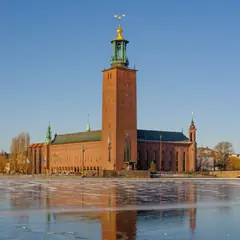
In the centre of Stockholm, the Royal Palace of Stockholm rose over the ruins of Tre Kronor castle, and on the shores of the same Mälaren Stockholm City Hall hosts the Nobel banquet every 10 December.
A façade that was red and had a tower
Façade on the Mälaren and jetty
Summary of this stop
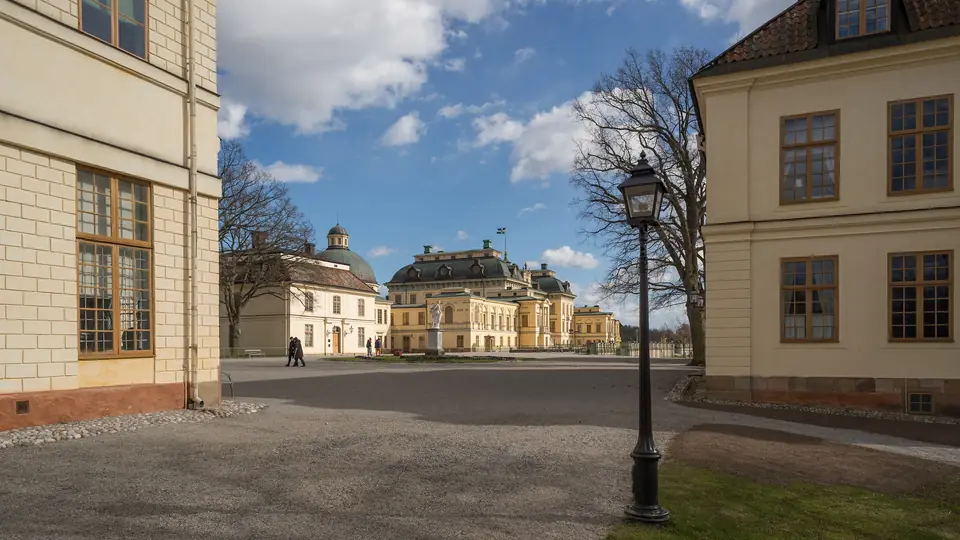
From the jetty where the boats arriving from Stockholm dock, Tessin’s long eastern façade opens out, some 160 metres long and 50 wide. Today it is pale, but its walls were originally painted red, with grey cornices and joinery. Above the centre, a small copper-clad tower with its flagpole takes the place of the crowned tower that topped the building until it was removed in 1686.
The name of the place is older than the palace. Drottningholm, the «Queen’s islet», honours not Hedvig Eleonora but another queen: in 1579 Johan III had a stone house built here, on the old royal estate of Torvesund, for his wife Katarina Jagellonica, the work of the architect Willem Boy. More than eighty years later, that house burned and Tessin the Elder used the cellar walls and vaults that survived to build the new residence.
Work moved at an urgent pace: up to 400 men worked at once, among them soldiers assigned to it, and the main body was ready by the summer solstice of 1664. What remains of that first 16th-century house beneath the Baroque façade is the detail the narration points out by the water.
The bedchamber where a regent held audiences
Hedvig Eleonora's state bedchamber
Summary of this stop
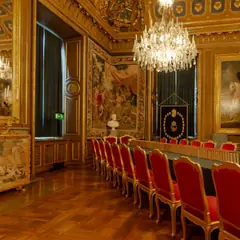
Behind Tessin the Elder’s monumental staircase, with its stuccoes, its perspective paintings and the statues of Apollo and the Muses by Nicolaes Millich, wait Hedvig Eleonora’s rooms. Her state bedchamber, finished in 1683, took fifteen years to complete and brings together the most lavish Baroque decoration in Sweden. It was not a private space: it served as an audience hall, and its state bed, painted ceilings and symbols of power spoke of a queen who governed.
In the adjoining room, the court painter David Klöcker Ehrenstrahl painted the story of the queen’s marriage and her fear that her son would not survive, with the goddess of fate measuring the thread of his life. A few decades later came another style and another queen: Lovisa Ulrika, who received the palace as a wedding gift in 1744, commissioned from Jean Eric Rehn around 1760 the library of gilded columns where Carl von Linné catalogued the natural objects of her collections.
The palace also lived through decline: under Karl XIV Johan it was left with cracks, broken windows and its furniture auctioned off, until Oscar I’s repairs from 1846 and the great restoration of 1907–1911. Today the royal family lives in the south wing, and Queen Silvia said in 2017, in a Swedish public television documentary, that the palace has ghosts, many of them, that she has noticed them and that they are friendly. Legend has it they never left; who they might be is the question that accompanies the walk through the rooms.
The theatre that slept as a furniture store
Drottningholms slottsteater
Summary of this stop
From the outside, the palace theatre looks like a plain manor house and gives no hint of what it holds. Carl Fredrik Adelcrantz built it from 1764 and it opened in 1766, on the same site as the first theatre, of 1754. That one burned in August 1762 during a performance for Lovisa Ulrika’s name day: the French actress Marie Baptiste came on stage to raise the alarm and the audience at first believed it was part of the play. Four people died, and the actors, who lived in the building, lost everything.
Inside, the auditorium is made of faux marble, papier-mâché and stucco, and at the back opens a stage of about 20 metres. Its great rarity is the 18th-century wooden stage machinery, still moved by hand with winches, rollers, drums, ropes and counterweights: the system of carriages and shafts changes a set in barely six seconds, and there are wave machines, thunder machines and a flying chair. About thirty sets survive. Who designed that mechanism is still debated among historians. The auditorium is entered from the Déjeuner salon that Gustav III added in 1791 to a design by Louis Jean Desprez.
The paradox is that this machinery exists because nobody touched it. After the assassination of Gustav III in 1792, the theatre fell into disuse and served as a furniture store. In the spring of 1921, Agne Beijer, a clerk at the Royal Library, arrived looking for a painting by Elias Martin and found the almost forgotten theatre, which reopened on 19 August 1922. With what performance it reopened is the finale of this stop.
Booty bronzes and cascades that waited centuries
Hercules Fountain
Summary of this stop
The Baroque garden stretches out from the palace with an embroidery parterre, a water parterre with twelve small fountains and, on the central axis, the Hercules Fountain, designed by Nicodemus Tessin the Younger in the late 1680s. Its centrepiece, Hercules fighting the dragon, was cast by Adriaen de Vries, sculptor at the court of Rudolf II, between 1590 and 1594, and came from the Wallenstein palace in Prague as war booty. The park’s bronzes, brought from Prague in 1648 and from the Danish castle of Frederiksborg in 1659, came to number 32; those seen today are copies, and the originals rest in the De Vries Museum.
At the far end of the parterre wait the cascades that Tessin built in 1685. They never worked, despite the network of ponds and oak-log pipes laid by the French engineer Louis de Cussy from 1683, and in the 1820s they were demolished. Ivar Tengbom rebuilt them with modern pumps, and on 16 June 1961 water ran down the fourteen small falls and through the Crown Fountain just as planned almost three centuries earlier.
The bronzes museum has its own story: the old Dragoon Stables, built around 1816 for a hundred horses, were converted in 1924, according to a documented custom, into a fold for up to 250 sheep bought in England. The king’s sheep grazed in the English park until the 1950s, and in summer they still graze on an island in the park. Which island that is and why it can only be visited in winter is revealed by the narration beside the fountain.
A surprise gift with stucco dragons
Kina slott
Summary of this stop
At the far end of the park, between avenues of chestnut trees, appears the Chinese Pavilion: lacquer-red walls, stucco dragons and curved wings, built by Adelcrantz between 1763 and 1769. Its origin is a fairy-tale scene. In 1753 Adolf Fredrik gave Lovisa Ulrika, as a surprise on her birthday, a first pavilion prefabricated in wood in Stockholm and brought by water to Lovön; when the door opened, out stepped the seven-year-old crown prince Gustav, dressed as a Chinese prince and carrying golden keys on a red velvet cushion. Rot forced it to be pulled down in 1763.
Beside the pavilion, the small Confidencen dining room let the royal family dine without servants: the table and sideboard were prepared on the floor below and, at a signal, rose up into the room. Thanks to the 1777 inventory, when Drottningholm passed to the state, it is known that most of the pavilion’s objects remain in their original place. From then on, Gustav III pinned a playing card each morning to the door of his audience room: hearts meant good weather and a day at the Chinese Pavilion in simple clothes; spades, bad weather and the palace. His sister-in-law Hedvig Elisabeth Charlotta complained that he sometimes changed the card two or three times in a morning.
The pavilion’s calm was broken one early morning in August 2010, when thieves forced its back doors and in a few minutes took pieces from the 1753 collection. It was the first theft in its history, and it had an unexpected ending years later. How they got away and how the pieces came back is the episode that closes the tour.