Municipal palace and Nobel venue
Stockholm City Hall Audio Guide (Stockholms stadshus)
A red-brick palace on the Riddarfjärden that looks medieval and is barely a century old: three golden crowns atop the tower, a Blue Hall that is not blue and a Golden Hall where a saint rides without his head.
- 60 min of audio
- Home of the Nobel banquet
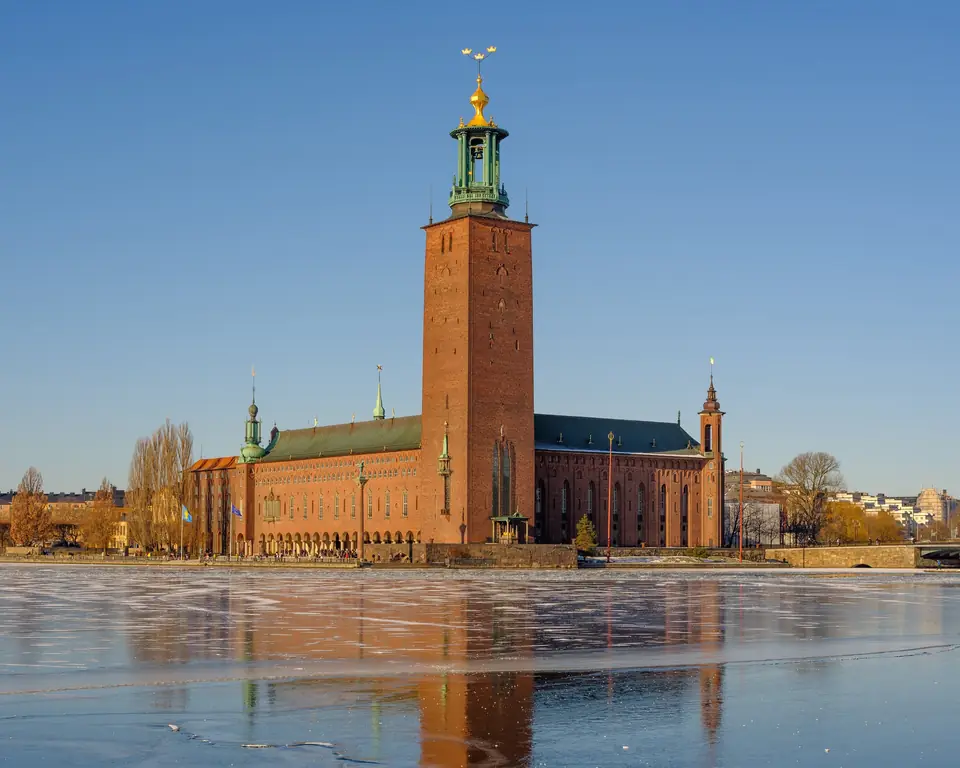
Stockholms stadshus, Stockholm City Hall, began as a courthouse project and ended up as the city's home. Ragnar Östberg built it between 1911 and 1923 on the southeastern tip of Kungsholmen, on the site of a burned-down mill, with echoes of the Doge's Palace in Venice and a brick copied from a piece attributed to the vanished Tre Kronor castle. It opened on 23 June 1923, four centuries after Gustav Vasa's entry into Stockholm, and today it hosts the Nobel banquet every 10 December.
Behind the solemn air there are absences, donations and mistakes: a golden sarcophagus that is still empty, a copper roof paid for plate by plate by thousands of residents, a hall that was to be granite and turned to gold thanks to an anonymous patron, and a mosaic that came out so tall that the ceiling cut off Saint Erik's head.
Highlights
- 106-metre tower topped by three golden crowns, each 2.2 metres, facing the Royal Palace
- Blue Hall, 50 × 30 metres of hammered red brick, home of the Nobel banquet with about 1,300 guests
- Golden Hall with more than 18.6 million glass and gold tesserae and the Queen of Lake Mälaren on the north wall
- Headless Saint Erik, a mosaic that came out taller than planned and was cut off by the ceiling
- Empty cenotaph of Birger Jarl, founder of Stockholm, in gilded lead at the foot of the tower
On the southeastern tip of Kungsholmen, with the Riddarfjärden lapping at its arches, stands Stockholms stadshus, Stockholm City Hall. It looks like a castle centuries old, but it is an invention of a hundred years ago. The story of Stockholm City Hall begins in 1902, with a competition for a new courthouse won by Ragnar Östberg; in 1907 the city council decided to separate functions, left the courts for another building by Carl Westman and reserved the site of the old Eldkvarn mill for the city hall. Construction lasted from 1911 to 1923.
The architecture of Stockholm City Hall mixes Venice and medieval Sweden: an open gallery of arches on the water, courtyards with arcades, a 106-metre tower and almost eight million dark red bricks. The copper roof did not come out of the municipal budget either: in 1920 more than three thousand donors each paid for a plate, and their names were noted in a book, the Kopparboken, beside the number of the piece they paid for. Not everyone applauded in 1923: the building earned Östberg the RIBA gold medal in 1926, but some critics questioned whether it was truly «Swedish» and others judged it old-fashioned.
Beneath the glitter, the building still governs the city. The city council meets every third Monday in the Council Chamber, 19 metres high with a wooden ceiling inspired by the Viking era, and in the Prince’s Gallery Prince Eugen painted frescoes, between 1917 and 1923, of the Stockholm shores that repeat on the wall the real view coming in through the windows. What to see at Stockholm City Hall is organised into five points, from the tower and the park by the water to the Citizens’ Courtyard, the Blue Hall and the Golden Hall. The audio guide, documented and checked against historical sources, walks through them in that order and keeps for each room the detail that can only be understood there.
The Nobel has another appointment at Stortorget, in Gamla stan, where the Literature prize is announced; a kilometre away, Kungsträdgården is the city’s open-air living room, and following the Mälaren to the west the Drottningholm Palace keeps an 18th-century court theatre.
A golden sarcophagus awaiting its founder
Birger Jarl's cenotaph
Summary of this stop
At the eastern foot of the tower, beneath a canopy of four granite columns, lies the figure of Birger Jarl, the founder of Stockholm, in gilded lead, carved by Gustaf Sandberg in the early 1920s. Below, a black iron door closes a crypt. But the sarcophagus is empty: the remains were meant to come from the monastery church of Varnhem, and its parish council refused to hand them over.
That tomb without a body sums up the whole building, a new palace that fabricates a past out of pieces of what was lost. The dark red brick, 270 × 130 × 95 millimetres, is larger than the Swedish standard because Östberg copied a piece found in 1909 beside the Royal Palace and attributed to Tre Kronor castle; a little over a million handmade bricks and almost seven million machine-made ones were used.
Above, the 106-metre tower rests on eight concrete piers sunk to bedrock 11 metres beneath the clay, and ends in three golden crowns of 2.2 metres. They look towards the Royal Palace, where Tre Kronor stood until it burned in 1697. Why a city hall insists on looking at a vanished castle is the key the narration opens in front of the tower.
A courthouse with a view of Venice
Stadshusparken
Summary of this stop
From the park, the gallery of arches over the water frames Riddarholmen Church and shows the debt to the Doge’s Palace in Venice. At the southeastern end, a column of about twenty metres holds the statue of Engelbrekt, and by the shore Carl Eldh placed in 1923 three nude marble figures with the features of Strindberg, Fröding and Josephson, which in their day raised protests. It could all have been different: the winning 1902 project was a courthouse, and Östberg wanted to crown the tower with a 7.6-metre Saint Erik by the Sandberg brothers. A full-size test in lightweight material showed it was unworkable; the summit became a viewing platform and the plaster model stayed in the tower museum.
High up hang nine bells cast in the Netherlands, the largest called Saint Erik and the smallest Saint Örjan. According to documented tradition, every day of the summer half-year, at 12 and 18, they play the medieval Sankt Örjansvisan, and on a balcony on the north face a copper automaton of Saint George, the maiden, the squire and the dragon is supposed to come out, although the machinery does not always respond. Since 1937, Swedish radio has opened its midday programme with a recording of these bells.
The tower, with about 365 steps and ramps and the museum of models halfway up, will be closed to the public for a restoration planned between early 2027 and the end of 2028, with reopening expected in 2029. What the song of Saint Örjan has to do with an old battle is left for the audio, beside the gallery.
A burning mill and a shipwreck door
Citizens' Courtyard
Summary of this stop
The Citizens’ Courtyard, Borgargården, opens with its arcades towards Hantverkargatan street. Beneath that floor stood Eldkvarn, a steam mill from 1805 whose fire of 31 October 1878 lit up the whole city and left Swedish with an expression, «not since Eldkvarn burned». Despite the fire, the mill kept grinding until 1906, when its demolition began.
The building that replaced it opened on a date loaded with intent: Midsummer Eve, 23 June 1923, when 400 years had passed since Gustav Vasa’s entry into Stockholm to take the throne. Verner von Heidenstam and Hjalmar Branting spoke. On the granite relief to the right of the north portal, Östberg left his signature: a carnation and the years 1901–1923.
The great portal is of black oak, wood that spent centuries under water. It is said to come from the Riksäpplet, a 17th-century warship sunk by a storm in the Stockholm archipelago in 1676, whose wreck was blown up with explosives in 1921 to extract the timber. How a shipwreck ended up as the city’s most solemn door is told in front of the portal itself.
A blue hall of red brick
Blue Hall
Summary of this stop
The Blue Hall, Blå hallen, is a covered courtyard of 50 × 30 metres and 22 metres high. It was to be plastered and painted blue to evoke the water of the bay, but during construction Östberg preferred red brick and had it hammered for texture; the name, by then popular, stuck. From a high gallery an organ of 10,271 pipes, inaugurated in 1925, presides over the hall, and a marble staircase, probably inspired by the Scala dei Giganti in Venice, descends to the floor.
Down that staircase file the waiters of the Nobel banquet, held in this hall since 1974 with about 1,300 guests. Before that it was held in the Golden Hall and at the Grand Hôtel, and the Nobel Foundation’s own sources do not quite agree on the dates of the move. In 1956, because of the Hungarian uprising, the banquet was replaced by a simple lunch at the Swedish Academy.
The hall of celebrations has also been the hall of mourning. On 15 March 1986 it hosted Olof Palme’s funeral ceremony before delegations from more than 120 countries, and in 2003 the tribute to Anna Lindh, the assassinated foreign minister. Between the two farewells there is a thread that was repeated in this same hall seventeen years later, and the narration reveals it at the foot of the staircase.
The golden queen and the headless saint
Golden Hall
Summary of this stop
The Golden Hall, 44 metres long, was first designed as a medieval-looking granite hall. It was turned into a hall of gold by an anonymous donation of 300,000 crowns paid between 1917 and 1919; the donor was Josef Sachs, founder of the Nordiska Kompaniet department store. The mosaics, from sketches by Einar Forseth based on an idea by Östberg, were assembled between 1921 and 1923 by the Berlin firm Puhl & Wagner, with a little over 18.6 million glass tesserae and 11 kilos of 23.5-carat gold leaf.
The north wall is entirely taken up by Mälardrottningen, the Queen of Lake Mälaren, seated with sceptre and crown and the city hall in her lap, flanked by East and West. The nickname for Stockholm that gives the figure its name has circulated since at least the 1860s, and in 1931 a joking birthday proposal suggested replacing her with a councillor in person.
Opposite, above the door of the south wall, Saint Erik rides without his head. The mosaic came out taller than calculated because the wall’s high plinth was forgotten, the head ended up above the ceiling and correcting it would have been too slow and costly. That error, more human than solemn, closes the tour; what it says about the whole palace is heard in front of the golden queen.