Royal Baroque palace
Royal Palace of Stockholm Audio Guide (Kungliga slottet)
A flawless Baroque façade that is really the scar of a fire: Tessin's palace rose over the Tre Kronor castle, which burned in 1697 with the dead king's body inside, and its medieval walls still stand beneath the north wing.
- 75 min of audio
- Tessin's Baroque
The Royal Palace of Stockholm, Kungliga slottet, is the great Baroque mass that Nicodemus Tessin the Younger designed six weeks after the fire that consumed Tre Kronor castle on 7 May 1697. Six years of work were estimated and it took almost sixty. For more than a century it was all of Sweden under one roof: the court, the Riksdag of the Estates, the Council of the Realm, the National Archives, the National Library and the Supreme Court.
Behind the most severe façade, the one facing the Norrbro bridge, the old castle's medieval towers with arrow slits survive, and the two bronze lions guarding its ramp were cast from the bronze of a well taken as war booty from a Danish castle. In this palace a queen replaced her diamonds with rock crystal to finance a coup.
Highlights
- 212-metre north façade, the only large fragment of Tre Kronor castle to survive the 1697 fire
- Bronze lions of Lejonbacken, cast in 1702 and 1704 from booty bronze taken at the Danish castle of Kronborg
- South façade conceived as a Roman triumphal arch, born of rivalry with the Copenhagen palace
- Changing of the Royal Guard in the Outer Courtyard, a corps founded by Gustav Vasa in 1523
- 13th-century defensive wall, five metres thick, at the entrance to the Tre Kronor Museum
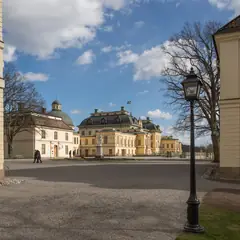
At the northern tip of Gamla stan, between the Norrbro bridge and the Skeppsbron quay, stands the Royal Palace of Stockholm, Kungliga slottet, the Baroque palace that replaced Tre Kronor castle. The first document on the medieval castle dates from 1252, and the excavations on Helgeandsholmen (1978–1980) found wooden structures from the late 10th century that some read as a fortress and others only as pile barriers in the channel to Lake Mälaren; whether it is called the oldest palace in Europe still in use as an official royal residence depends on that reading. Nor is there agreement on the number of rooms: the official site of the royal palaces gives more than 600, and a count recorded in 2008–2009 reaches 1,430, 660 of them with a window.
The story of Kungliga slottet begins with a catastrophe. On the afternoon of 7 May 1697 fire consumed Tre Kronor while the body of Karl XI was still lying in state inside. Six weeks later Nicodemus Tessin the Younger already had the plans for the new building, but the defeat at Poltava halted work in 1709 and the royal family did not move in until December 1754. Since 1981 the king and queen have lived at Drottningholm, although the palace remains their official residence, the venue for state banquets and the office of the court.
There is also a less official story: popular tradition speaks of a White Lady who announces the deaths of the royal family and of a Grey Man identified with Birger Jarl, the founder of Stockholm, and Carl XVI Gustaf himself has told the press that he has felt «strange things» in the palace. The audio guide, documented and checked against historical sources, circles the building along its four façades, from the foot of Lejonbacken to the changing of the guard, and ends at the medieval walls that survived the fire.
Behind the palace, a few steps away, Stortorget is the oldest square in the city; across the water, Kungsträdgården was originally the king’s cabbage garden, and on the shore of the Mälaren the Drottningholm Palace has been the royal home since 1981.
Danish booty at the foot of the surviving façade
Lejonbacken
Summary of this stop
The north façade, facing Norrbro and Gustav Adolfs torg, is the most severe of the palace and measures 212 metres. There is a reason: it is the only large fragment of Tre Kronor castle to survive the fire. Tessin had remodelled it between 1692 and 1695 in Roman Baroque, and behind that classical front the old castle’s medieval towers with arrow slits still stand.
On either side of the double ramp of Lejonbacken two bronze lions stand guard on granite plinths. They are the work of Bernard Foucquet, after the model of the Medici lions; they were approved in 1700 and cast in 1702 and 1704 from the bronze of a well taken as booty at the Danish castle of Kronborg, in Helsingør, during the campaign of Karl X Gustav.
The ramp itself holds another inheritance. Between May 1697 and the spring of 1700 some 300 men demolished the ruins of Tre Kronor, and the remains of the keep that gave the castle its name ended up as fill for Lejonbacken. What exactly is left of that castle beneath the paving and behind the Baroque is what the narration reveals at the foot of the lions.
A plaque, 57 years of work and a crown of crystal
Logården
Summary of this stop
Between the eastern wings opens Logården, a small garden looking out over Skeppsbron and the water, facing the «queen’s» façade with its colossal pilasters. A plaque there sums up the history of the building: the rebuilding of the north wing between 1690 and 1697, the fire of 7 May 1697 and the palace inhabited by the king since 7 December 1754. Between one date and the other lies a long silence: in 1709, the year of Karl XII’s defeat at Poltava, work stopped entirely and the palace stood as a half-built shell until 1727, when the Riksdag voted money again, a year before Tessin’s death. Carl Hårleman took over and brought the Rococo to the interiors.
During those 57 years the royal family lived in the Wrangel Palace on Riddarholmen, where the guard was also quartered. Adolf Fredrik and Lovisa Ulrika finally moved in, in December 1754, to today’s Bernadotte apartment.
What followed is one of the darkest episodes of the palace, preserved as documented tradition. To pay for a coup that would return absolute power to the king, Lovisa Ulrika had the 44 large diamonds that the Riksdag had given her for her wedding in 1744 taken from her crown and replaced with rock crystal. The stones were pawned in Hamburg (other accounts say Berlin) with an antiquarian who turned out to be an agent of the French government. How the deception was discovered and how it all ended on 22 June 1756, with cannon aimed at the palace, is told in the garden.
The façade that could not lose to Copenhagen
Slottsbacken
Summary of this stop
Towards Slottsbacken, the south façade was designed as a Roman triumphal arch, with texts in homage to Karl XII, and leads into the South Portico. Its origin is a competition: while designing the Stockholm palace, Tessin was also designing the Copenhagen one for the King of Denmark, and Karl XII demanded that the Swedish one not be outshone in magnificence by the Danish.
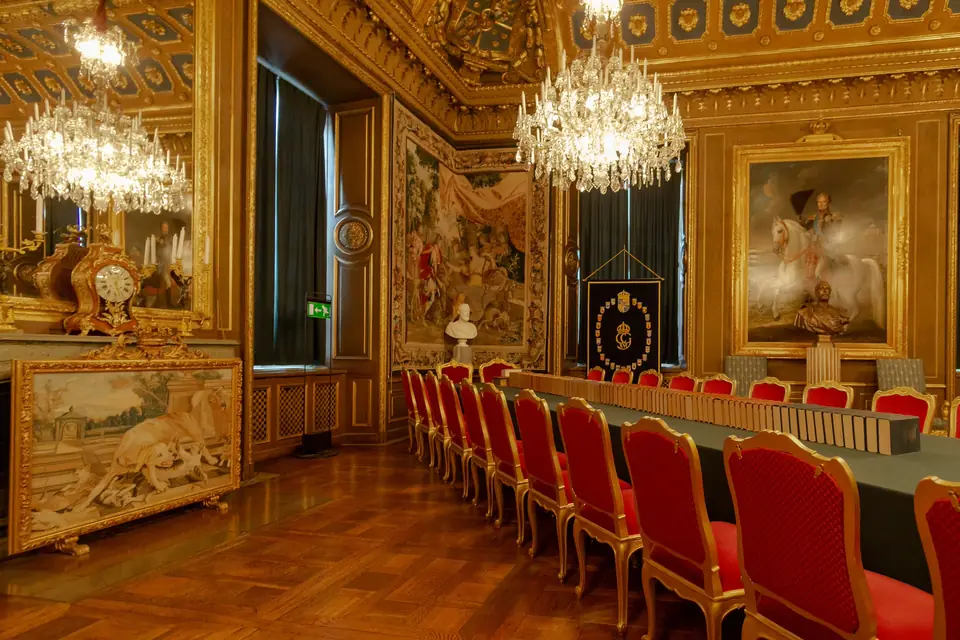
Behind that façade a building was planned for the king and for the whole state: the Riksdag of the Estates, the Council of the Realm, the National Archives, the National Library and the Supreme Court. They moved out little by little, the Archives in 1865, the Library in 1877 and the Supreme Court in 1949. On one side of the portico is the Hall of State, ready for the 1755 Riksdag, where the king opened parliament each year until 1974, with the silver throne that Magnus Gabriel De la Gardie gave Queen Kristina for her 1650 coronation; on the other, the Royal Chapel. Throne and altar thus face each other.
From here one can sense the inner courtyard where, according to documented tradition, on 6 February 1914 more than 30,000 farmers from all over Sweden heard Gustav V give a speech that contradicted his own government. Who wrote it in secret, and who stopped it from being softened at the last minute, is the episode the audio guide reserves for this stop.
Soldiers, firefighters and an empty attic
Yttre borggården
Summary of this stop
The Outer Courtyard, semicircular and closed by two curved wings to the west of the palace, is the stage for the changing of the Royal Guard. Above the windows of this «king’s» façade hang lead medallions from 1745, about 1.5 metres across, with the kings from Gustav Vasa to Karl XI, and in the courtyard stands the statue of Kristina Gyllenstierna, erected in 1912.
The guard has existed since 1523, when Gustav Vasa founded it. Until the mid-19th century it was made up of between 100 and 200 soldiers who were also the city’s fire and public-order service; today there are about 35, drawn from units across Sweden. The ritual lives on because the palace does: although Carl XVI Gustaf and Silvia moved to Drottningholm in 1981, this is still the office of the king and queen and of the court.
The irony lies in the fire of 1697. In February 1698 the castle court sentenced the fire chief Sven Lindberg and the soldier Mattias Hansson to death; Karl XII commuted the sentence to seven runs of the gauntlet and six years of hard labour in the fortress of Karlsten. Why those men took the blame, and what became of Lindberg, is explained in the middle of the courtyard.
The medieval walls of Tre Kronor
Medieval wall of the Tre Kronor Museum
Summary of this stop
On the ground floor of the north wing, beneath Lejonbacken, the way into the Tre Kronor Museum passes through a 13th-century defensive wall five metres thick. Inside there are models of the old castle and objects rescued from the fire. It is the place to understand what was lost on 7 May 1697, when around two in the afternoon the fire broke out in the attic above the Hall of State; the fire watchmen were not at their posts and the cause was never cleared up.
Karl XI had died on 5 April and his body was still lying in state in the castle. Some officers carried it out through the flames to the royal stable on Helgeandsholmen, and from there it ended up in Riddarholmen Church; the funeral was not held until 24 November. With the castle burned the royal library and much of the Realm’s Archives: of some 24,500 printed works and almost 1,400 manuscripts only 6,000 books and 300 manuscripts were saved, and with them a good part of the sources of the Swedish Middle Ages.
A legend also hangs over that castle, which Prosper Mérimée published in 1829: shortly before dying, Karl XI was said to have seen the long-closed Hall of the Estates lit up, and inside it a trial of ghosts foretelling blood «five reigns later». What the king saw according to the tale and what proof was left in his slipper is the scene that ends the tour.