Medieval square in Gamla stan
Stortorget Audio Guide
At the top of Gamla stan, between colourful façades and a well with lion heads, Stockholm's oldest square was a market, a scaffold and the stage of the 1520 Bloodbath. Today, each October, the Nobel Prize in Literature is announced from one of its buildings.
- 30 min of audio
- Medieval Swedish history
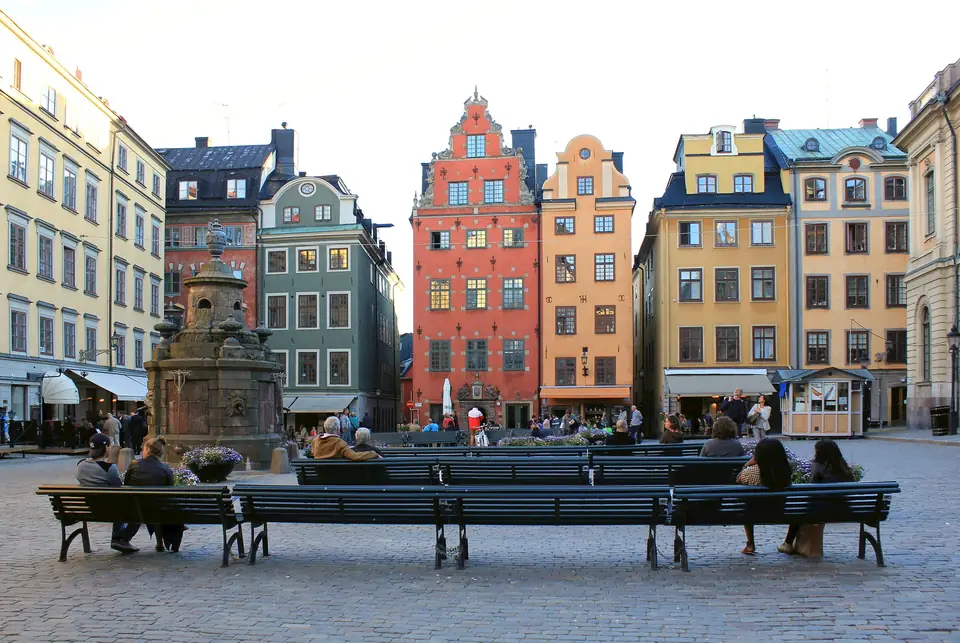
Stortorget grew without a plan on the summit of the island of Gamla stan, and its medieval ground lies only half a metre beneath today's paving, with coins from the reigns of Magnus Ladulås and Birger Magnusson. Its whole north side is taken up by the Börshuset, Erik Palmstedt's old Stock Exchange, built between 1773 and 1778 on the site of the old town hall; to the west runs the row of green, red and yellow gables that has made the square a postcard.
Beneath that postcard beats the great betrayal of Swedish history: Stockholm surrendered in 1520 in exchange for a full pardon and, two months later, close to a hundred people were executed in this very square. Among them was Gustav Vasa's father, and a burgher was sentenced to death just for weeping at what he saw.
Highlights
- The Börshuset, the old Stock Exchange of 1773–1778, where the Swedish Academy announces the Nobel Prize in Literature and the Nobel Museum fills the great hall
- The red house at number 20, with a stepped gable, white stones from 1628 and a 1650 portal with reclining Roman warriors
- Palmstedt's well, with four spouts shaped like lion heads, built where the Kopparmatte pillory once stood
- Scene of the Stockholm Bloodbath, in November 1520
- Cannonball walled into the corner of Skomakargatan in 1795
Small, sloping and ringed by colourful façades, Stortorget is Stockholm’s oldest square and the heart of Gamla stan. The excavations of 1995 and 1997 found the floor of the medieval square just 0.5 metres beneath today’s paving, with layers of cobbling dated by radiocarbon between 1066 and 1320. Since then the same ground has served as a market, a place of punishment with its pillory and the stage of the worst massacre in Swedish history, the Bloodbath of 1520.
The story of Stortorget is also that of a city that reinvents itself without moving. The medieval town hall gave way to a Rococo Stock Exchange, the pillory to a well and the 14th-century fairs to a Christmas market of red stalls. More than a century before 1520, according to documented tradition, a list of 76 Swedish «traitors» was read aloud right here, opening the Käpplinge massacre, and in 1529 a nobleman who asked for a trial to prove his innocence ended up beheaded in the square.
What to see at Stortorget comes down to four points: the Börshuset on the north side, the red house at number 20, the well in the centre and the cannonball corner. The audio guide, documented and checked against historical sources, walks the square in that order and keeps for each corner the story that can only be understood there.
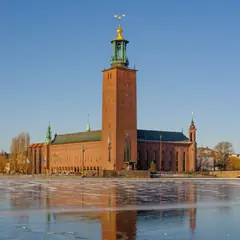
Around the corner rises the Royal Palace of Stockholm; the Nobel banquet, the prize’s other great event, is served at Stockholm City Hall, and on Djurgården Skansen gathers houses from all over Sweden on a hill.
A hand’s breadth of cobble over the Middle Ages
Börshuset
Summary of this stop
The entire north side is taken up by the Börshuset, a palace inspired by French Rococo with a central pediment and a lantern dome, which also blocks the view of the cathedral and the royal palace. It was designed by Erik Palmstedt and built between 1773 and 1778 on the site of the Rådstugan, the town hall that occupied this side of the square from the 14th century until 1732. Gustav III inaugurated it in 1776 in the Stora börssalen, the Exchange’s great hall.
Underfoot, the slope betrays the summit of the island, and the medieval ground lies barely half a metre beneath the cobbles: coins from the reigns of Magnus Ladulås and Birger Magnusson turned up there. The architecture of Stortorget begins, literally, below.
Since 1914 the Swedish Academy has occupied the upper floor of the building, and since 2001 the Stora börssalen has housed the Nobel Museum. Always on a Thursday in October, at 13:00, the press waits inside for one particular door to open. Which door it is and who comes out through it to pronounce the name of the new Nobel laureate in Literature is told in front of the façade.
The myth of the heads and the executioner with a mayor’s face
Red house at number 20
Summary of this stop
On the west side runs the row of gables that stars in the photographs: Runstenshuset in green, Schantzska huset in red and two yellow houses, the only ones in the square with private residents. The red house at number 20, documented as early as 1479, passed in 1627 from the councillor Bo Ribbing to the royal secretary Johan Eberhard Schantz, who in 1628 added the white stones around its windows. Its limestone portal, with reclining Roman warriors, is the work of Johan Wendelstam in 1650 and carries above the door a German inscription of Psalm 37:5.
Those white stones are popularly linked to the heads of those beheaded in 1520, but the link has no historical basis, and even their number changes depending on the source. The real trace of punishment stood in the centre of the square: from 1603 to 1776, the figure of Kopparmatte, a man with a raised whip, crowned the pillory called Kåken as a warning against crime. The surviving piece, from 1647, is of bronze, not copper, and is kept today in the Stockholm City Museum.
It is said that the nickname «Matte» came from his resemblance to the mayor of the day, Mathias Trost. The word kåk meant the scaffold with its pillory and survives in the name of the alley Kåkbrinken, which runs down towards Västerlånggatan. Where the figure ended up after leaving the square, and what brought it down for good, is part of what the narration reveals there.
Three days in November 1520
Stortorgsbrunnen
Summary of this stop
In the centre of the square stands Palmstedt’s well: four spouts with lion heads, iron handles topped with balls, a small sandstone tower and an urn on top. Dug around 1778 some 14 metres down to the level of Lake Mälaren, it ran dry in 1854 as the ground rose, was moved to Brunkebergstorg in 1857 and returned to Stortorget on 23 June 1953, for Stockholm’s 700th anniversary, now as a monument with mains water. According to tradition, it stands exactly where the pillory once was.
Around this spot the great betrayal took place. Stockholm, defended by Kristina Gyllenstierna, capitulated on 5 September 1520 in exchange for an amnesty with a full pardon. After Christian II’s coronation, at midday on Thursday 8 November, the executions began: first the bishops Mattias and Vincent, then 15 nobles, while the city’s mayors and councillors were hanged on a gallows raised in the square. The casualty figures vary by source, but all hover around a hundred.
Among the dead was the councillor Erik Johansson Vasa, father of Gustav Vasa, who escaped by hiding and went on to become king of Sweden. And a burgher, Lasse Hass, was sentenced to death just for weeping at what he saw. How the square looked in the following days, and who witnessed it to tell the tale afterwards, is heard by the well.
Revenge turned into ornament
Skomakargatan cannonball
Summary of this stop
On the corner with Skomakargatan, above the sign of the Stortorgskällaren restaurant, an iron ball sticks out, walled into the façade. Legend has it fired at Christian II as he leaned out of a window; the documented version is that the furniture maker Carl Adolph Grevesmühl had it walled in in 1795 in his new Gustavian house, as a symbol of Gustav Vasa’s siege that made Christian II surrender. That part of the block took the name Huset Kulan from it.
Over time, the square recovered its everyday life. In 1833, Carin Ersdotter, a young woman from Dalarna known as «the vackra dalkullan» (the beautiful Dalarna girl), sold milk from the Järla estate here and drew such crowds that she had to flee and hide several times. The Christmas market, with roots in the 14th-century fairs, was banned from 1907 because of brawls, reopened in 1915 under Stockholms-Gillet and since 1961 has been set up in red stalls designed by Nils Tesch around the well.
That harmless-looking well also keeps a custom few visitors suspect, one that has to do with every road in the kingdom. What role it played for years on the maps of Sweden is the last secret the audio guide reveals in the square.