17th-century warship
Vasa Museum Audio Guide (Vasamuseet)
Inside a former dry dock on Djurgården rests the Vasa, the flagship of Gustav II Adolf that sank 1,300 metres from the quay in 1628 and returned to the surface 333 years later, more than 98% original.
- 90 min of audio
- Naval archaeology
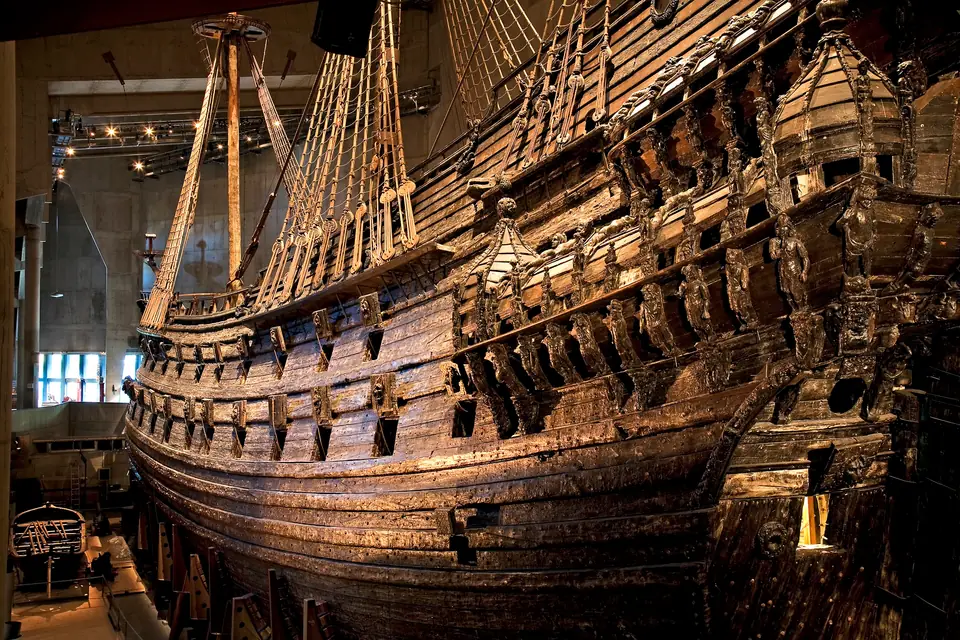
The Vasamuseet was built between 1987 and 1990 over the great 1878 dry dock of the Stockholm naval shipyard, with the ship inside the dock itself. It shows a complete 69-metre vessel, built between 1626 and 1627 for King Gustav II Adolf, with 64 guns, ten sails and more than 700 propaganda sculptures. From six levels it can be seen from bow to stern and down to the keel.
The paradox explains everything: the Vasa died of trying to impress too much, with upper works too high and heavy for its hull, and the mud that trapped it on the harbour floor is what preserved it. Along the way came an inquiry with no one punished, guns sold abroad, an amateur with a homemade core sampler and a salvage broadcast live across Europe.
Highlights
- The Vasa's hull, 69 metres long and more than 98% original, visible from six levels
- A 3-metre lion figurehead and 20 Roman emperors carved on the beakhead
- Stern with the young Gustav II Adolf, the Swedish coat of arms, Gideon, David and two Hercules figures
- Replicas painted in vivid red and gold leaf that restore the carvings to their original colours
- Masts above the roof that reach the 52.5 metres of the ship's mainmast
On Sunday 10 August 1628, the most ambitious ship in the Swedish navy set sail from in front of the royal palace in Stockholm. It covered about 1,300 metres. A gust heeled it over to port in the gap between the cliffs of Tegelviken, water poured in through the open gunports of the lower battery and the Vasa sank in 32 metres of water, 120 metres from the shore at Beckholmen. The museum puts the dead at 30, crew and guests, although other reports of the time speak of as many as 50 drowned, and only a few of their names are known.
The story of the Vasa did not end on the seabed. Between 1663 and 1665, a team led by Albrecht von Treileben and Andreas Peckell went down to the wreck with a diving bell, tore away much of the upper deck and recovered more than 50 bronze cannon that ended up sold abroad. In 1920 the brothers Simon and Leonard Olschanski asked for permission to blast the wrecks in the area and sell their blackened oak to the Art Deco furniture industry; the authorities refused. And when the ship finally came into the light in 1961, there was even a student prank: a bronze statuette of the Finnish runner Paavo Nurmi turned up on deck among the 17th-century objects.
Then came the slow part. In five months of excavation more than 30,000 objects came out of the mud, among them more than 4,000 coins, and to keep them in water every old bathtub in Stockholm’s scrapyards was bought up. So that the waterlogged wood of the hull would not crack, it was sprayed with polyethylene glycol, a water-soluble synthetic wax, from April 1962 to January 1979, followed by nine years of slow drying.
What to see at the Vasa Museum is organised into five points: the building from outside, the bow with its lion, the port side, the stern and the lower level beneath the hull. The audio guide, documented and checked against historical sources, circles the ship in that order and keeps for each point the detail that can only be appreciated there.
On the same island of Djurgården, a few minutes on foot, Skansen gathers houses and farms brought piece by piece from all over Sweden, and across the water the Royal Palace of Stockholm occupies the site of the castle the Vasa sailed from in 1628.
A roof that draws the height of a ship
Vasamuseet
Summary of this stop
From the forecourt at the entrance, the building already offers a clue. Above the copper roof rise masts that, seen from Djurgården or from the water, mark the height of the Vasa’s rigging: the tallest reaches 52.5 metres, what the mainmast would have measured from the keel. The façade combines wooden panels in Falun red, black, blue, brown and yellow, and above the door a pointed concrete structure evokes the stem of a ship.
The architecture of the Vasamuseet also hides its origin. The museum was built between 1987 and 1990 on top of the great 1878 dry dock of the Stockholm naval shipyard, and the ship rests inside the dock itself. King Carl XVI Gustaf opened it on 15 June 1990.
What it holds inside is enormous: a ship launched in the spring of 1627 at the Skeppsgården shipyard, 69 metres long, more than 50 metres from keel to the top of the mainmast and more than 1,200 tonnes, with ten sails, 64 guns and 120 tonnes of ballast. Why those figures, which then sounded like glory, were already part of the problem is what is raised before stepping through the door.
The bow as a propaganda poster
Lion figurehead and beakhead
Summary of this stop
In front of the bow waits the ship’s most famous carving: a 3-metre lion clutching the Vasa coat of arms, with figures of Roman emperors, twenty in all, on either side of the beakhead. The Vasa carried more than 700 sculptures and ornaments, and almost none was merely decorative: they were political messages.
The most direct is in front of the bow latrines: two Polish nobles carved with moustaches and long coats, humiliated before the enemy Sweden was then at war with. The king’s propaganda reached the most prosaic corner of the ship.
Today’s dark brown hull is deceptive. Between 1990 and 2002, the conservator Peter Tångeberg analysed some 1,200 paint samples: the sculptures were in strong colours with gold leaf, and the bulwarks, stern, galleries and sides of the beakhead were painted vivid red. Full-size replicas of some carvings, with their colours reconstructed, allow two ships to be compared, the one seen today and the one that sailed in 1628, and the narration explains what the king was after with so much red and gold.
The test that warned and nobody heeded
Port-side gunports
Summary of this stop
The port side shows the Vasa’s two rows of gunports. Through those of the lower battery, left open, the water came in at Tegelviken. But the warning had come earlier: in the summer of 1628, with the ship moored beside the palace, Captain Söfring Hansson had 30 men run from side to side across the upper deck in front of Vice Admiral Klas Fleming. After a few passes the heel was so strong that Fleming stopped the test. Even so, the ship was ordered to sail.
A widespread belief blames the king for ordering a second battery of guns to be added late. The records point elsewhere: the guns were ordered in August 1626, in time to include the second deck in the design, and there is no trace in the hull of an added battery. The explanation the museum favours is upper works too high and heavy for the submerged part.
Among the drowned was a woman. For sixty years, Skeleton G was taken for a man, until in 2023 DNA analyses by Uppsala University and a US identification laboratory found no Y chromosome. Today she is called Gertrud, the sculptor Oscar Nilsson has given her a face back, and the woollen cap she wore holds a detail that is revealed beside the gunports.
A king on the stern and a culprit who could no longer defend himself
Stern
Summary of this stop
The stern is the ship’s great carved façade: at the top, the young Gustav II Adolf; below, the Swedish coat of arms, Gideon with his warriors, David and two Hercules figures. It is a stern made to glorify the king, and that is why what happened after the sinking is so telling.
On 5 September 1628, a commission of 17 councillors and officers chaired by the Lord High Admiral, Karl Karlsson Gyllenhielm, the king’s elder half-brother, opened the inquiry at Tre Kronor palace. The builders argued that the design had been approved by the king himself. Nobody was punished, and the blame fell on Henrik Hybertsson, dead since 1627. The shipyard added its own tangle: more than 400 people from half a dozen countries worked with two different feet, the Swedish one of 12 inches and the Amsterdam one of 11, and the hull turned out asymmetrical, heavier on the port side, although how much that weighed in the capsizing is still debated.
Beside the museum lies Galärvarvskyrkogården, the naval cemetery where in 1963 the remains of ten men and two women from the Vasa were buried with Christian rites. Before the new museum opened they were exhumed for study, and each skeleton was given a name from its letter. Who Johan might be, the man in the long coat of fine wool, is one of the stories told in front of the stern.
From mud to steel
Steel cradles beneath the hull
Summary of this stop
The lower level leads down to the keel, and there the paradox of the salvage becomes clear. Less than three days after the sinking there was already a contract to refloat the ship; one of the first to try, the English engineer Ian Bulmer, managed to set the hull upright but left it stuck even deeper in the mud. That mud, which frustrated adventurers, treasure hunters and inventors, ended up preserving the ship for 333 years.
On 25 August 1956, the fuel engineer Anders Franzén, after years of archive work and searching the seabed, pulled up a plug of black oak with a homemade core sampler off Beckholmen. Between 1957 and 1959, navy divers dug six tunnels beneath the hull to pass steel cables to the pontoons Oden and Frigg, and after 18 partial lifts, on Monday 24 April 1961 at 09:03, the first ribs broke the surface with Swedish television broadcasting live to the whole of Europe.
The rescue is not over. The oak has lost much of its strength and the ship leans slightly to port, so since 8 April 2024 the 17 pairs of supports from the 1960s, which were deforming the hull, have been replaced by 27 custom-made steel cradles. The work is due to finish in 2028, the 400th anniversary of the sinking, and what those cradles say about the Vasa’s future closes the tour.