Open-air museum
Skansen Audio Guide
On a hill in Djurgården, a penniless man built a miniature Sweden in 1891: farms, painted houses and a wooden church brought piece by piece from all over the country, with bison, spring bonfires and festivals still celebrated where he invented them.
- 120 min of audio
- Swedish rural heritage
Skansen opened on 11 October 1891 on an initial plot of 29,493 m² around Bollnästorget, and today covers about 30 hectares. Its founder, Artur Hazelius, bought the Mora farm in Dalarna in 1885, and from there he went on moving houses, storehouses and even a rural church, dismantled and rebuilt on the hill. It served as a model for so many museums that «skansen» became a common noun for open-air museums in central and eastern Europe.
What is surprising is not only the houses but the calendar: the 1893 Saint Lucy procession, New Year's Eve with «Ring Out, Wild Bells» since 1895, the communal singing that Swedish television now broadcasts and, according to documented tradition, Sweden's National Day itself all came from this hill. It was all paid for by a founder without a fortune whom people nicknamed «the greatest beggar in Sweden».
Highlights
- Seglora Church, bought for 1,000 crowns in 1915 when it was about to end up as stables, taken down piece by piece and reopened in 1918
- Bollnässtugan, with walls painted in 1786 by Jonas Hertman: the only complete interior of his that survives
- Moragården, the Dalarna farm bought in 1885, with a storehouse from the first half of the 14th century
- Bollnästorget, the square of Hazelius's spring festivals, where Sweden's National Day was born
- European bison enclosure: in 1929 two animals left Skansen to re-found the species in Białowieża
At the top of Djurgården, Stockholm’s green island, Skansen gathers what remains of a rural Sweden that was beginning to disappear at the end of the 19th century. Artur Hazelius opened it on 11 October 1891 on a plot of 29,493 m² around Bollnästorget and the bird ponds; in 1892 the purchase of the Bredablick land multiplied the site more than sixfold, and today it covers about 30 hectares. Log houses, farms, raised storehouses and a wooden church arrived here dismantled, numbered and put up again.
The story of Skansen is also that of an idea that founded a school. It served as a model for open-air museums in Scandinavia and beyond, to the point that «skansen» is now used as a common noun to describe them in central and eastern Europe, as in Lublin or Szentendre. Its primacy, though, is disputed: the collections of Oscar II at Bygdøy, near Oslo, created in 1881, also claim to be the first. What sets Skansen apart is its scale and the mix of houses, live crafts, Nordic wildlife and popular festivals.
Because here the calendar weighs as much as the architecture. Every 30 April the Walpurgis bonfire is lit, first celebrated in 1892; since 1895 «Ring Out, Wild Bells» has been recited every New Year’s Eve at midnight, live on Swedish television, and from the Solliden stage Allsång på Skansen is broadcast each summer, the communal singing that Sven Lilja began in 1935. What to see at Skansen could fill a whole day; the audio guide, documented and checked against historical sources, traces a route of five stops from the old lower entrance to the European bison.
On the same island of Djurgården, the Vasa Museum holds the warship that sank in 1628 on its maiden voyage, and in the city centre Kungsträdgården serves as Stockholm’s open-air living room.
A play fort and not a single öre
Hazeliusporten
Summary of this stop
The route starts at the bottom, at Hazeliusporten, the museum’s old entrance, where the 1897 funicular begins its climb to Bollnästorget. Before it was a museum, the hill had another use: King Karl XIV Johan had a small fort, a skans, built here as a play place for his son, the future Oscar I. That military toy gave its name to the whole site.
The other protagonist of this stop is money, or rather its absence. Hazelius had no fortune of his own and financed his collections with donations and with a network of collectors he called skaffare, until he earned the nickname «the greatest beggar in Sweden». He himself wrote that he did not have «a single öre» to buy the Skansen land.
How a man with no resources ended up at the head of a whole hill, and what he made use of along the way, is the story told at the foot of the slope, before the climb begins.
The square where a national day was born
Bollnästorget
Summary of this stop
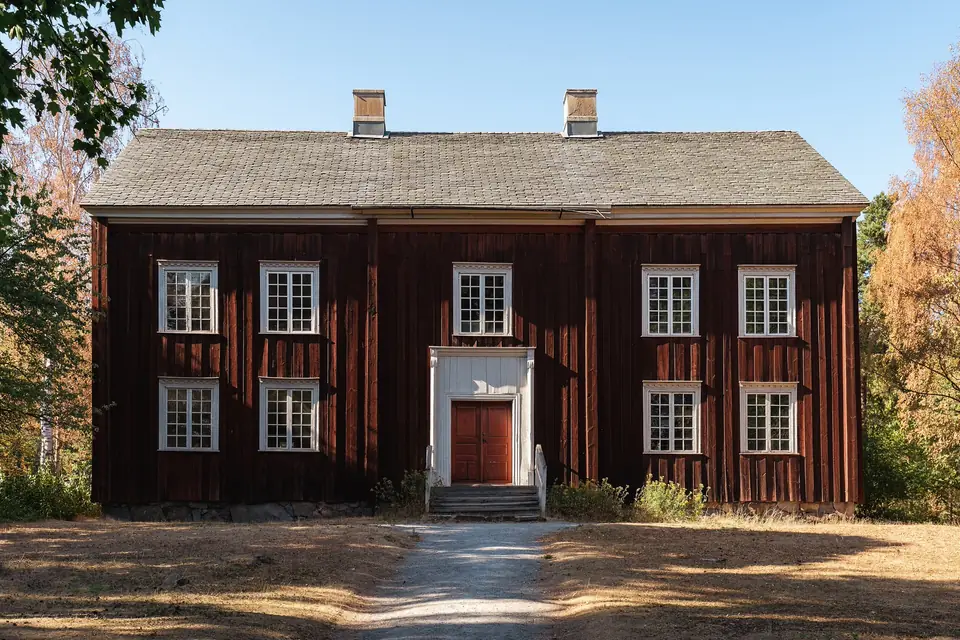
Bollnästorget was the heart of the first site in 1891 and still works as a stage: since 1903 it has hosted the Christmas market. Beside the square stands the Bollnässtugan, a single-storey log house with a decorated porch, brought in 1892 from the Knubbens farm in Herte, in Bollnäs. Its interior walls were painted in 1786 by the folk painter Jonas Hertman directly onto the logs: the Passion of Christ in the festive room and landscapes in the everyday room. It is the only complete Hertman interior to survive.
From 1893 Hazelius organised large spring festivals here with market stalls. The Bollnässtugan served as an inn, cart rides set off from it and the founder directed the party from inside, sending notes to his collaborators. According to documented tradition, that fair closed its 1893 edition on 6 June, the anniversary of Gustav Vasa’s election in 1523 and of the 1809 constitution, and Hazelius wrote that from then on it would be celebrated as the Swedish national day. The festival was unofficial until 1916, became the official national day in 1983 and a public holiday in 2005; every 6 June the royal family returns to Skansen.
The authenticity of the house itself has nuances: it received new chimneys copied from old models and a porch from another building on the farm. What role the blue and yellow flag played in that festival, and why at the time it was hardly seen on land, is revealed in the square.
The Mora farm that started it all
Mora farm and its medieval storehouse
Summary of this stop
In 1885, six years before the opening, Hazelius bought the Mora farm, Moragården, in Dalarna. Skansen regards it as its first building, although the Norwegian encyclopedia Store norske leksikon gives that role to the Kyrkhultsstugan, which arrived from Blekinge in 1891. In the yard one of its storehouses stands out, the hedninghuset, dated to the first half of the 14th century: a medieval wooden building in the heart of Stockholm.
Here one can see how a miniature Sweden is made. In the first years after the opening, the relocated houses were filled with mannequins dressed in regional costume. Hazelius soon replaced them with real people who spun, wove and practised crafts, and from that change came the idea of the «living» museum that so many others later copied.
The method had its shortcuts: Hazelius and his collaborators looked for buildings that looked old and sometimes touched them up to make them look older, and in his lifetime he was criticised for accumulating objects in poor condition. What the farm itself tells about that way of working is left for the narration in the yard.
The church that was to be a stable
Seglora kyrka
Summary of this stop
The wooden church of Seglora, in Västergötland, was built after a demolition in 1729. Outside it shows a single nave with a three-sided apse, oak shingles tarred red forming diamond patterns, and a bell tower and a sacristy from the 1780s. It was left empty when a new church was consecrated in 1903, and in 1915 the parish decided to tear it down to use the timber for stables. Skansen bought it for 1,000 crowns, took it down in 1916 numbering every piece, carried it to Stockholm by cart and train and reopened it in 1918.
Inside, the board vault painted in 1735 by Sven Wernberg tells the life of Jesus around the eye of God in a red triangle, with the name of Yahweh in Hebrew. The interior reproduces a rural church of the 1790s, and documented tradition recalls rather unsolemn Sundays: women on the left, men on the right, landowners in front and servants behind, fights over the pews and a sexton with a long pole to wake the sleepers. Outside, the stocks where those convicted of theft were displayed before the congregation still stand.
The church is not a dead piece. Skansen’s first Saint Lucy procession was held in 1893, and every year, around 13 December, the procession enters Seglora. What other faults that sexton with his pole kept watch for is told beneath the painted ceiling.
The bison that went back to Poland
European bison enclosure
Summary of this stop
The route ends before the fence of the European bison, a species Skansen has bred since it acquired its first animal in 1910. In 1918 the first calf was born here, and in 1929, with the species extinct in the wild, two bison born at Skansen travelled to Białowieża, in Poland, to re-found a viable population there.
It is the close of an idea: the museum did not just keep old houses, it also brought a species back to life and lent its name to open-air museums across half of Europe. Hazelius moved to live at Skansen with his son Gunnar in 1892, died on 27 May 1901 and was buried inside the museum on 4 February 1902; Gunnar succeeded him as head of Skansen until his own death in 1905.
What links these bison to the founder’s grave, and why Skansen’s story closes precisely here, is what the audio guide reserves for the last stop.