Royal garden and civic history
Kungsträdgården Audio Guide
The king's old cabbage garden runs down to the water opposite the Royal Palace between two bronze kings, war mortars, elms scarred by chainsaws and avenues of cherry trees: a quiet park that is really a battlefield of citizens.
- 30 min of audio
- Royal statues and the elms of 1971
Kungsträdgården is first recorded in 1430 as konungens kålgård, «the king's cabbage garden». Between the 17th and 18th centuries that court kitchen garden became an enclosed, symmetrical Baroque garden centred on a fountain, watched over by armed guards, until under Gustav III it opened to the public and in 1772 its greenhouse at the northern end launched the Vauxhall, a pleasure palace for concerts and dances. Today it is 3.3 hectares in the very centre of Stockholm, between the department stores of Hamngatan and the water.
Its most famous story happened in the small hours. In May 1971, nearly a thousand residents surrounded the century-old elms that were to be felled to make way for a metro entrance, and the chainsaws stopped within minutes. The entrance was never built beside the trees and that night marked the end of mass demolitions in the city centre.
Highlights
- Statue of Karl XII surrounded by four mortars cast in Dresden in 1678 and captured by the king himself at Neumünde in 1701
- Elms saved in the battle of 1971, with bark that has gradually covered the chainsaw cuts
- Molin's Fountain (1873): Ægir, Rán and their daughters listening to the Näcken's harp among six bronze swans
- Karl XIII and Fogelberg's four lions, each with a paw on the three Swedish crowns or the Norwegian axe
- Avenues of Japanese cherry trees planted in 1998, blooming pink in late March and April
Stockholmers call it Kungsan, and use it as the city’s open-air living room: a long park running down from Hamngatan to the waters of the Norrström, opposite the Royal Palace. But the story of Kungsträdgården is that of a piece of land disputed again and again. It was born in 1430 as the king’s cabbage garden, became a Baroque garden reserved for the court, opened to the public under Gustav III, lost almost all its greenery in 1821 on the orders of Karl XIV Johan, hosted a ruinous international exhibition in 1866 and came close to losing its elms in 1971.
Each era left something in view: an empty site where a palace stood, two bronze kings the city turned into a joke, mortars captured in the Great Northern War, a fountain paid for by a national collection, trunks that still bear the marks of chainsaws and avenues of cherry trees that every spring draw thousands of people. What to see at Kungsträdgården, then, goes far beyond a stroll among flowers.
The audio guide, documented and checked against historical sources, walks it from south to north in five stops, from the water’s edge to the statue of Karl XIII, and reserves for each point the episode that can only be understood right there.
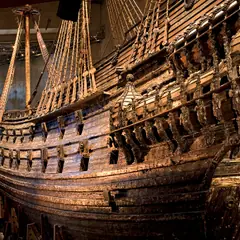
To the south, across the water, rises the Royal Palace of Stockholm, and behind it Stortorget, the city’s oldest square; to the east, on Djurgården, the Vasa Museum holds the warship sunk in 1628.
A five-storey palace that burned on a night of performance
Karl XII:s torg
Summary of this stop
The southern end of the park, Karl XII:s torg, is the most open esplanade in Kungsträdgården, framed to the west by the Royal Opera and St James’s Church. That void is no accident: it occupies the site of Makalös, «Without Equal», the palace that Marshal Jakob De la Gardie began building in 1635 with its south façade right against the water. It had five storeys, measured 47 by 28 metres and rested on 18,000 wooden piles; it was one of the most richly decorated private palaces in Northern Europe, although the family simply called it «the big house». The date it was completed varies by source, between 1642, 1643 and 1653.
In time Makalös ended up converted into a theatre, and there its story ended. On 24 November 1825, in the middle of a performance, the actor Lars Hjortsberg raised the alarm about the fire from the stage and asked the audience to leave «in good order». The audience got out unharmed through a single narrow exit; three servants died and the palace burned to the ground.
Nothing was ever built on the site again, and that absence remains the park’s biggest piece. How the footprint of Makalös can still be recognised in this square is revealed by the water, when listening to the narration on the spot.
The king with the sword and the cannons of Neumünde
Karl XII:s staty
Summary of this stop
In the middle of the square stands Karl XII on foot, hatless, with his sword in his right hand and his left pointing east. Around him are four mortars joined by an iron chain: they were cast by Andreas Herold in Dresden in 1678 and captured by the king himself in the taking of Neumünde, on 11 December 1701, during the Great Northern War, as the inscription recalls.
The statue, by Johan Peter Molin, was unveiled on 30 November 1868, the 150th anniversary of the king’s death at Fredriksten. The celebration ended badly: a third paid grandstand blocked the public’s view and set off three days of riots, with charges by the Royal Guard on horseback against the crowd.
That same morning came the grimmest episode. According to documented tradition, the writer August Blanche, one of those who had fought hardest to have the statue raised, was marching with the Uppsala students towards Kungsträdgården when he felt unwell in front of the Ugglan pharmacy, stumbled in and died shortly afterwards, without seeing it unveiled.
The elms that stopped the chainsaws
Elms of the 1971 battle
Summary of this stop
Just north of the statue, a group of old elms surrounds the tea pavilion that Erik Glemme built, along with a large stage, for Stockholm’s 700th anniversary in 1953. On some trunks the bark has gradually covered the cuts of 1971. On the night of 11 to 12 May of that year (other sources place it on 12 to 13), alerted by the telephone chain of Alternativ stad, nearly a thousand Stockholmers surrounded the 13 century-old elms that were to be felled for a metro entrance. Around three o’clock the chainsaws started under police protection; there were injuries from dogs and truncheons, and the sawing stopped within minutes with four elms damaged. The sources do not agree on the toll: one maintains that none were actually felled and another that some did fall before the work was halted.
Then came a week of celebration beside the trees, according to documented tradition: Cornelis Vreeswijk and Povel Ramel passed through, the Opera chorus sang «Låt almarna leva» («Long live the elms») from the theatre balcony and the novelist Vilhelm Moberg ordered sandwiches from the Operakällaren for those keeping watch. The station opened in 1977 with access from Regeringsgatan, and the east entrance, moved to Arsenalsgatan 10, did not come until 14 January 1987. Below, the station reproduces sculptures from Makalös and keeps an elm stump; on its damp rock walls lives, so it is said, a tiny cave spider found nowhere else in Sweden.
The echo of that night reached 2025. On 11 September the City felled one of the saved elms, sick with Dutch elm disease despite the annual vaccination of the park’s elms since 2021, and Göran Folin, who had climbed a tree during the protest, watched the felling at the age of 87. What occupies the gap left by that elm today is one of the details the narration keeps for this point.
Bronze nymphs born of a ruinous exhibition
Molins fontän
Summary of this stop
Between 15 June and 14 October 1866, the park hosted in a wooden hall Sweden’s first international exhibition of art and industry, with some 3,800 Nordic exhibitors. It was a financial fiasco: 400,000 riksdaler spent against 135,000 in income. Its emblem was a full-size plaster model of a fountain by Johan Peter Molin.
That plaster was cast in bronze thanks to a national collection and the fountain was inaugurated on 25 September 1873, after its author’s death. It depicts Ægir, Rán and their daughters listening to the Näcken’s harp, surrounded by six swans spouting water, at the point where the old Näckströmmen joined the Norrström. The weeping willows around it are called fontänpil in Swedish precisely because of it.
Behind the cheerful scene there is a dark story, recorded by documented tradition: casting began in 1871 at the Royal Mint in Stockholm, and on 28 July of that year a heavy piece fell on the founder Georg Heroldt and killed him, so the work had to be moved to Nuremberg. What happened to the figures during those years of waiting is told beside the water of the fountain.
An unpopular king among four lions
Karl XIII:s staty
Summary of this stop
In the centre of the park, Karl XIII rests his right hand on an anchor and wears a laurel crown. He was unveiled on 5 November 1821 by his adopted son, Karl XIV Johan, who removed almost all the greenery from the garden to leave an esplanade of gravel and in 1822 ordered it renamed «Karl XIII’s Square». Stockholmers replied that the statue was «a gardener without a garden, like a king without honour». In 1824 the four lions by Bengt Erland Fogelberg arrived, each with a paw on a globe bearing the three crowns of Sweden or the axe of Norway, for the union of the two kingdoms; at first there was a guard to stop children from climbing on them.
Local humour brought the park’s two kings together in a joke that was already circulating in the early 20th century and is understood by looking from one statue to the other: a play on words with mortars that look like flowerpots and lions that guard an unloved king. The humour lies in a Swedish word with a double meaning, which the audio guide explains at this point.
To the north, the old cabbage garden became a garden again. In August 1998, with Stockholm as European Capital of Culture, Aleksander Wolodarski’s redesign planted 63 Japanese cherry trees in avenues (tourist guides speak of «about 60») and created the large central pond, flanked by bronze urns by Sivert Lindblom. In winter the area becomes an ice rink, a custom that began in November 1962, and in late March and April the cherry trees are covered in pink.