Dutch fortress
Anping Old Fort Audio Guide (Fort Zeelandia)
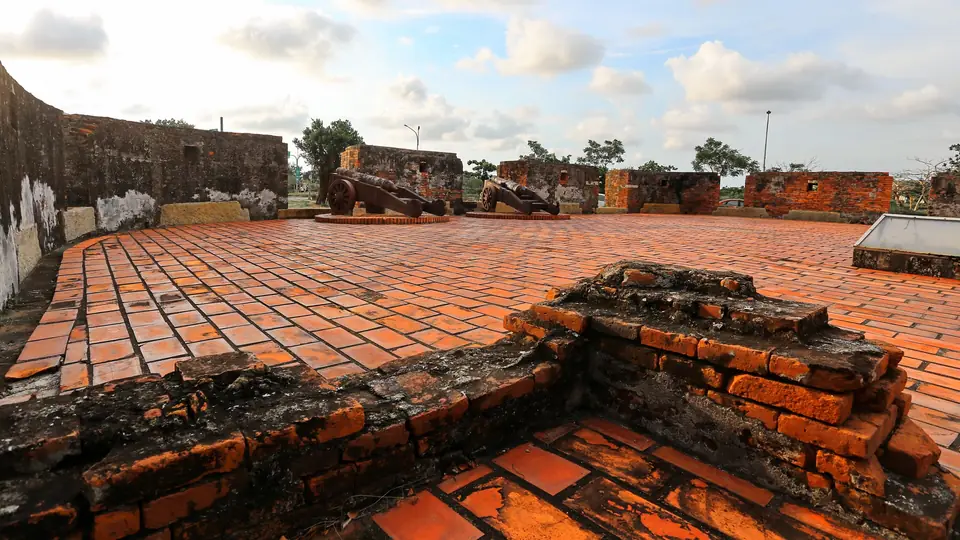
Beneath a red-brick Japanese platform sleeps Zeelandia, Taiwan's first fortress: here the Dutch East India Company ruled for 38 years until it handed the keys to Koxinga's officers in 1662.
- 60 min of audio
- 17th-century fortress
- Siege of Koxinga
Anping Fort is what remains of Fort Zeelandia, the oldest fortification in Taiwan. The VOC began rebuilding it on the Tayouan sandbar in 1624 and completed it in 1634, according to the most cited chronology. Its walls of brick brought from Java were bonded with a mortar of glutinous rice, sugar molasses, sand and oyster-shell lime. Then came the Zheng, the Qing, Japan and the postwar years, and each left its layer on top.
The most photographed image of the site, the white tower with a pointed red roof, is not Dutch: it is an anti-aircraft watchtower from around 1944 that the municipality topped with a spire in 1975. In 1983 a senior culture official ordered it demolished on the spot; the order was postponed and the tower still stands.
Highlights
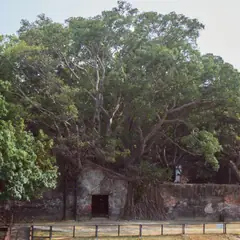
- South wall of the outer fort — some 65.8 m of Dutch brick overrun by banyans
- Scissor-shaped iron anchors — three pieces that tied the wall to the beams
- Stepped platform of 1897 — covers the razed remains of the inner fort
- Lookout tower — a Second World War anti-aircraft watchtower with a red spire from 1975
- Zeelandia Museum — a customs house of 1882 with the VOC emblem on its façade
In October 1623 the Dutch East India Company raised a provisional redoubt at Tayouan, a sandbar off the coast of Formosa. It dismantled it in April 1624, started again on the same spot in August and ten years later had Taiwan’s first fortress standing. It was first called Fort Oranje and, from 1627, Zeelandia. From its walls the VOC ruled for 38 years, withstood a nine-month siege and finally surrendered to Koxinga in February 1662.
The story of Anping Fort is that of a place that changed its name with every conqueror. The Zheng called it Anping and later “the king’s city”. The Qing used it as a quarry, Japan buried it under a platform and the postwar years added a postcard tower. In 2022 it officially regained the name Fort Zeelandia, although in Tainan almost nobody has stopped calling it Anping Fort. The site can be walked in a short visit, with a climb up the platform and the tower. The audio guide, documented and checked against historical sources, separates those layers stop by stop.
The other half of this story lies in the city centre, at Chihkan Tower, raised over the Provintia fort that surrendered to Koxinga ten months earlier, and at the exit of the site Anping Old Street still follows the grid of the Dutch quarter that grew at its feet.
A wall bonded with rice and sugar
South wall of the outer fort
Summary of this stop
The most Dutch thing left standing is the south wall of the outer fort: a stretch of red brick some 65.8 metres long that banyans have been embracing with their roots. Three scissor-shaped iron anchors are still driven into the masonry, which tied the wall to the interior beams, and an arched doorway opens in it. According to a disputed tradition, Koxinga ordered that doorway opened after closing the Dutch one, and gave it a name evoking his own surname.
The architecture of Anping Fort is explained by its materials. The brick came from Java, was fired for ten days in the kiln and laid in Dutch bond. It was held together by a mortar of glutinous rice, sugar molasses, sand and oyster-shell lime.
There is a concrete reason so little remains. In 1874, with the old fort already ruined by the explosion of its powder magazine, the imperial commissioner Shen Baozhen took apart its bricks and stones in bulk to build another battery, today’s Eternal Golden Castle. Where the rest of Zeelandia ended up is one of the surprises the narration keeps for this point.
The stele that changed owners
Stele “安平古堡”
Summary of this stop
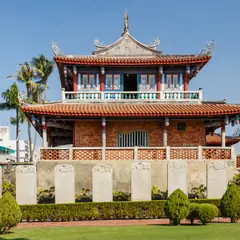
On the stepped red-brick platform, the ground hides another fort. In 1897 the Japanese administration razed the remains of the inner fort, surrounded them with this base and built on top the residence of the head of Anping customs. In 1930, for the Tricentennial Exposition of Taiwan Culture, the house was remade as the Western-style pavilion that now serves as an exhibition hall.
In front rises a stele with four characters, “安平古堡”, calligraphed by Zhuo Gaoxuan, second mayor of Tainan. The stone is older: in 1941 the Japanese erected it in honour of Hamada Yahei, and in 1946 its inscription was ordered erased. The man honoured was the merchant who in 1628 entered the fort with about ten men to ask for permission to leave and ended up, with dozens of armed Japanese waiting in hiding, kidnapping Governor Pieter Nuyts and his 6-year-old son.
The episode had a bitter epilogue that documented tradition has preserved. The boy died a prisoner in Japan before turning ten, and the Company itself ended up handing Nuyts over to the shogunate as the one responsible for the conflict. How his freedom was finally paid for is one of the most unusual details of the tour.
A false tower above a siege
White lookout tower with red roof
Summary of this stop
The white lookout tower with a red roof is the postcard of the site and also its great misunderstanding. There is nothing Dutch about it: it is a brick anti-aircraft watchtower built around 1944, to which Tainan’s 1975-1977 monuments plan added the red roof and which it painted white. In January 1983 the chairman of the Council for Cultural Affairs, Chen Qilu, ordered Mayor Su Nancheng to demolish it. The mayor promised to do so, the order was postponed and the tower can be climbed today.
From the top, the horizon that can be seen is no longer water, but in 1661 it was. On 30 April of that year Koxinga landed with about 25,000 men and 400 junks, and the siege lasted nine months. The garrison, without reinforcements from Batavia, had always had to bring its fresh water from the main island. After 1,600 Dutch deaths, Governor Frederick Coyett surrendered on 1 February 1662.
Within these walls, according to documented tradition, the most heart-rending scene of the siege also took place: that of the pastor Antonius Hambroek, sent by Koxinga to ask for surrender while his family remained hostage. What he said to the governor, whom he took leave of and why part of the account may be more theatre than history is told at the top of the tower.
The keys, the names and the Coyetts
Zeelandia Museum
Summary of this stop
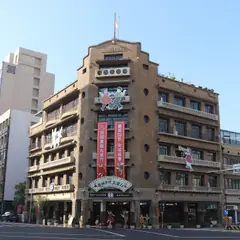
The Zeelandia Museum occupies the former Anping customs house of 1882, which keeps the VOC emblem on its façade. Its four rooms gather the reconstruction and the remains of the fort. Here the story of the names ends. On 9 February 1662, while 2,000 Dutchmen embarked for Batavia, Coyett handed the keys of Zeelandia to Koxinga’s officers on the beach.
The fort had been called Fort Oranje until in 1626 the Seventeen Gentlemen of Amsterdam ordered it renamed Zeelandia. Batavia asked that the change be announced to the neighbours with cannon salvoes and a gift of hats. Koxinga gave it the name Anping, after a village in Jinjiang, in Quanzhou, and as the three Zheng rulers lived in it, it came to be called Wangcheng, “the king’s city”. The neighbouring district of Wangcheng Xi She still remembers it. In 2022, after new remains appeared during works on neighbouring houses, the Ministry of Culture merged the site’s two national monuments under the name Fort Zeelandia, a decision some local historians dispute because it favours a single era.
The stop closes with a notable episode of gratitude between enemies. Koxinga spared Coyett’s life; it was the Company that condemned him, and centuries later his family returned to Tainan to say thank you. What happened between those keys on the beach and the 2024 reunion in this very museum is left for the narration.