Historic street
Shennong Street Audio Guide
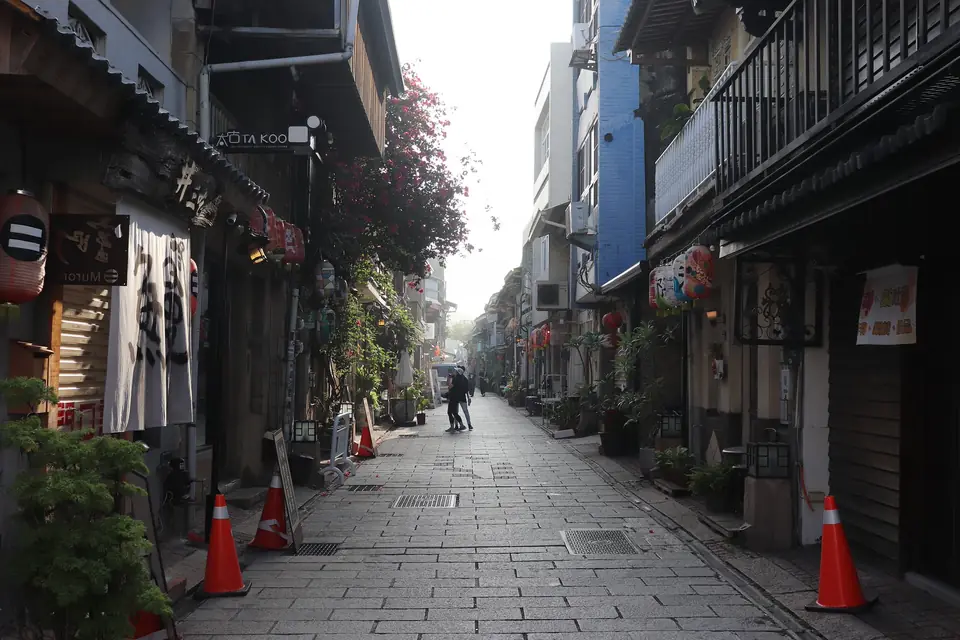
A dockers' street that ran beside one of the Five Canals of Qing Tainan: the water is gone, but the wooden warehouse houses still stand, with the loading door open on the upper floor.
- 30 min of audio
- Qing-era warehouse houses
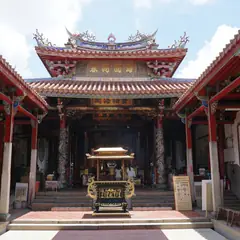
The old Beishi Jie, the “north-side street”, owes its name to the Nanshi canal, one of the Five Canals of Qing-era Tainan. Along it merchants entered the city's river ports, and it keeps many two-storey wooden houses with the shop below and the warehouse above. At the end rises the Yaowang temple, of the Medicine King, from which the modern name Shennong Jie comes.
Every cut the street suffered remains in view: the channel filled in before the Shuixian temple in 1741, the back of the Yaowang temple demolished in 1969 and the houses split in half when Haian Road was widened in 1993, whose mutilated façades ended up turned into canvases of street art.
Highlights
- Second-floor loading doors — the old warehouse to which goods were hoisted
- Jinhua Fu temple — of 1830, paid for by the dockers of the Xu clan, with a heart-shaped lock
- Yaowang temple — founded in 1685 and considered the mother temple of the Yaowang temples of Taiwan
- Cut façades of Haian Road — an 80,000-thumbtack Guan Gong that appears and disappears
- New Year lanterns — each painted with the story of the family living beneath
The history of Shennong Street begins in the water. In the Qing era, this narrow street, then called Beishi Jie, ran along the bank of one of the Five Canals (Wutiaogang) that joined Tainan to the sea, and was the merchants’ gateway to its river ports: the busiest district in the city. Today no visible water remains; the channel runs beneath streets and buildings as an underground collector. What does remain is the architecture of Shennong Street: a row of two-storey wooden houses with narrow, almost identical façades, with the shop on the ground floor and, above, the door through which goods were hoisted into the warehouse.
Three dates mark the street and all three are still inscribed in the landscape: 1741, when the canal was filled in before the Shuixian temple; 1969, when the back of the Yaowang temple was demolished to open a street; and 1993, when the widening of Haian Road split the district in two. Since 2002 the warehouse houses have filled with workshops, shops and bars, and in 2019 the street appeared on the cover of a Japanese magazine. The audio guide’s route runs from the avenue that cut it to the temple that gave it its name, and each stretch is better understood on foot.
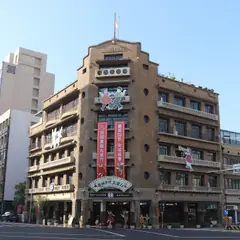
To the west, by the sea, Anping Old Street tells another story of trade and widening, and towards the centre, about 800 metres away, the Hayashi Department Store shows the commercial city of the Japanese period.
An avenue that cut the district open
Cut façades of Haian Road
Summary of this stop
The tour starts at the mouth of the street on Haian Road, facing the Shuixian temple, seat of the Sanjiao merchant guild. That temple stood over the Nanshi canal, and in 1741 the merchants who renovated it filled in the channel in front of it to turn it into an esplanade. That was the first cut. The second came in 1992, when Mayor Shi Zhiming launched the widening of Haian Road to 40 metres over 850, with an underground shopping centre: the expropriations and demolitions of 1993 left houses cut in half, exposed iron and a “lost decade” for the district, between 1993 and 2002.
Around 2004, the curator Du Zhaoxian turned those mutilated façades into canvases. At the mouth of Shennong Jie “生態物語”, by Lu Mingde, was installed, and on the other side a Guan Gong made of 80,000 thumbtacks by Chen Jun-hao, which appears and disappears as the pedestrian walks. The project won the Taishin Special Jury Prize in 2005.
An old Tainan proverb, documented in local tradition, is also set up here: “five horses look at the river and one turns its head”. The five horses are the temples at the end of the Five Canals, Shuixian included, which faced the sea to protect the ships. Who the sixth is, the one that turns, is the question the narration leaves hanging until the end of the street.
A temple paid for by the dock porters
Jinhua Fu
Summary of this stop
The bank of the Nanshi canal was territory of the dockers of the Xu clan, who came from Jinjiang, in Quanzhou, and also owned their own fleet. It was those dock coolies of the Five Canals who paid for the Jinhua Fu temple, at number 71, for the Guandi they had brought from their homeland. Its heritage record dates it to 1830, it was repaired in 1874 and 1888 and it has been a municipal monument since 2005. The dating is not unanimous: its manager, Xu Bo’an, stated in 2019 that the temple was moved to its present plot in 1913.
The building is small and wedged between the houses of the street, with the entrance hall, the worship hall and the main one in a row. On the main door, among the decorative studs of the leaf, there is a lock fitting with a heart-shaped silhouette, probably placed by craftsmen in a refurbishment more than a hundred years ago. Why it has that shape is something even the temple’s own manager cannot explain.
Shops below, goods above
Second-floor loading doors
Summary of this stop
At the crossing with Xinyi Jie, the old “Beishi cross street”, the historic Beishi Jie ends: only the eastern half of today’s Shennong Jie corresponds to the street on the north bank of the canal. It is the stretch where it is best read how that gateway to the river ports worked: shop on the ground floor and warehouse on the upper floor, with its own door on the second-floor façade to hoist the goods. A popular legend explains why the houses are so similar in size: according to the story, local timber rotted and the beams arrived imported by sea in pieces of a single length, to fit in the holds.
Over the street hang coloured lanterns that light up at dusk. They are not mere decoration: since 2018, every lunar New Year a lantern festival is held here in which university students paint each one after three months of conversations with the family that “adopts” it, so that each lantern tells the story of that house. Participation grew from 11 households in 2018 to 60 in 2024, and the lanterns stay hanging all year as lighting until the next festival.
The sixth horse, at the end of the street
Yaowang Temple
Summary of this stop
The street ends before the Yaowang temple, of the Medicine King, which stood originally at the end of Beishi Jie and was raised on its present plot in 1764. The modern name Shennong Jie comes from it, although the identification of its god with Shennong is the temple’s position and is disputed: a municipal report of 1979 maintains that the titular is the physician Bian Que. Its foundation is dated to 1685 or 1718, depending on the source, and it is considered the mother house of all Yaowang temples in Taiwan. It keeps the plaque “福壽我民” of 1788, written by the prefect Yang Tingli.
Unlike the canal temples, which face the sea, the Yaowang faces east. It is the horse that turns its head in the proverb, and tradition offers more than one explanation. Its concrete façade also keeps a scar: in August 1969 Mayor Lin Xishan demolished the back of the temple, which had three halls, to open today’s Jinhua Road, and on the single hall that remained it was rebuilt between 1986 and 1990.
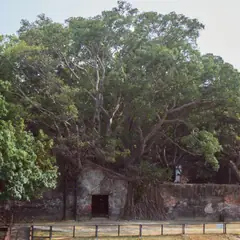
Opposite the temple, a small altar venerates as one more deity “Lord Banyan”, a tree credited with some three hundred years. The 1979 report lamented that the old shrine had been left cornered in an alley and noted that only the great banyan kept something of its former grandeur. Why the temple turns towards the mountain is the denouement the narration reserves for this last point of the tour.