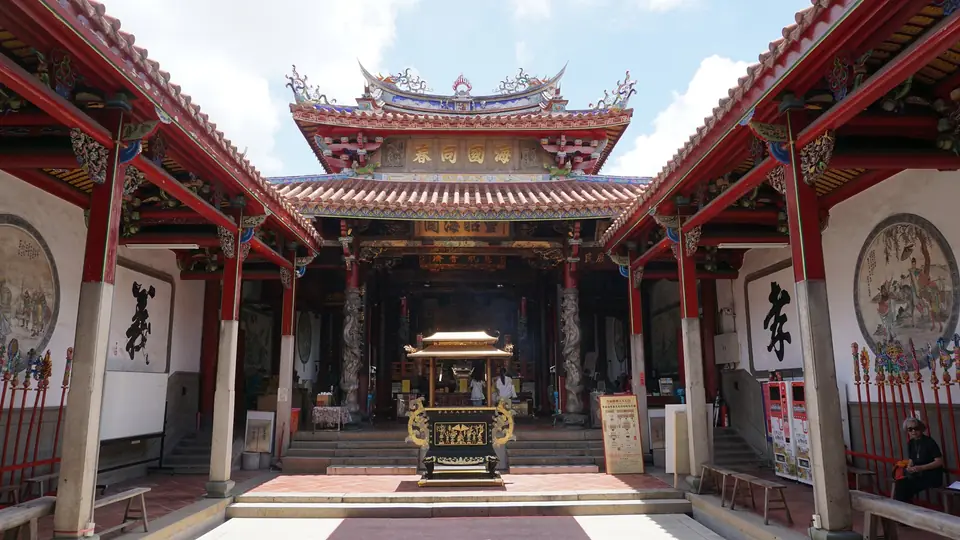
National monument
Grand Mazu Temple Audio Guide (Da Tianhou Gong)
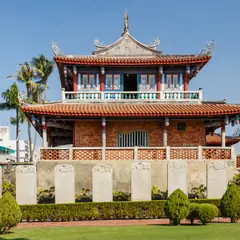
The former palace of Taiwan's last Ming prince is today the first temple to bear the name Tianhou Gong: here a kingdom surrendered, a goddess burned and today Tainan's singles tie red threads to ask for a partner.
- 30 min of audio
- Ming palace and Mazu temple
Around 1664, Zheng Jing commissioned Huang An to build a palace in Tainan for Zhu Shugui, Prince of Ningjing and a member of the Ming imperial house. That building is the core of the Grand Mazu Temple, where in 1683 Shi Lang received the surrender of the last ruler of the Kingdom of Tungning and where in 1684 Mazu debuted her title of Celestial Empress. Its gate without guardian gods, its Qing steles and its imperial plaques set it apart from any other temple on the island.
The rear hall occupies the place of the bedroom where the prince's five concubines hanged themselves in 1683, the eve of his own death. In that same wing, a few steps from the tablet that calls him “loyal to the end”, the Yue Lao shrine gathers every day single men and women who ask for a partner with makeup powder and red threads.
Highlights
- Palace gate — 73 studs instead of painted guardian gods
- Pingtai jilüe stele — the account of the taking of Taiwan, carved by Shi Lang in 1685
- Gilded-faced Grand Mazu — restored after splitting and falling to the floor in 2004
- Qing imperial plaques — originals of Xianfeng and Guangxu among the copies
- Yue Lao shrine — red threads to ask for a partner beside the prince's old bedroom
For the people of Tainan it is the “大媽祖廟”, the Grand Mazu Temple, as opposed to the “small” temple of the goddess, the Kaiji Tianhou Gong. Its history begins outside religion: in 1663 Zhu Shugui, Prince of Ningjing, arrived in Taiwan with the retreat of the Zheng, and around 1664 Zheng Jing had a palace built for him here. When in 1683 the Zheng fell at Penghu to Admiral Shi Lang, the prince’s residence became a temple of Tianfei, the “celestial princess”, and the following year the Kangxi Emperor raised Mazu to “celestial empress”. This was the first temple with the name Tianhou Gong; in 1720 it entered the official spring and autumn rites and came to be called Da Tianhou Gong.
Who turned the palace into a temple remains a matter of debate. The local Qing-era annals attribute it to Shi Lang in 1684; other researchers maintain that the Tianfei temple already existed before the conquest, that the prince donated the house to the monk Shengzhi and that the work was finished by General Wu Ying, because Shi Lang spent barely a few months on the island. Nor is there agreement on why the building faces west: towards the land of the Ming, towards the coast as a sea temple or, simply, by inheritance from the Dutch street grid of Provintia.
Then came the fire of 1818, which reduced the central and rear halls to ashes; the reconstruction paid for by the city’s three merchant guilds, which lasted until 1830; the presidential office of Liu Yongfu during the short-lived Republic of Formosa in 1895, and in 1940 an auction that nearly sold the temple and that the Japanese ethnologist Miyamoto Nobuto stopped. In 1985 it was raised to a first-class monument. The audio guide walks those layers hall by hall, from the studded gate to the room at the back, with documented narration checked against historical sources.
About 150 metres away, Chihkan Tower keeps what remains of the Dutch fort of Provintia, and about 700 metres to the south the Tainan Confucius Temple preserves the school founded by that same kingdom of the Zheng.
Palace studs instead of painted gods
Tainan Grand Mazu Temple
Summary of this stop
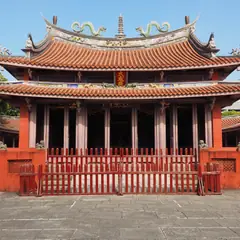
Almost all temples in Taiwan greet the visitor with guardian gods painted on the door leaves. Not here. The great red leaves of the entrance are studded with 73 door studs, an ornament reserved for palaces and official temples. At the sides stand Qing-era stone lions and reliefs with qilin, dragons and phoenixes.
That detail betrays the origin of the building: before it was a shrine, it was the house that Zheng Jing commissioned from his subordinate Huang An for a prince of the Ming dynasty, finished around 1664. Whoever crosses this gate in fact enters a palace. In the portico, a mural by Chen Yufeng from 1956 commemorates a reconciliation between temples whose history, surprisingly fragile, the narration keeps for when it is heard in front of it.
The conqueror’s steles
Shi Lang's steles
Summary of this stop
Embedded in the side walls of the worship hall are preserved the steles that Shi Lang left. In this very palace he received in 1683 the surrender of Zheng Keshuang, last ruler of the Kingdom of Tungning, and in 1685 he raised the “Pingtai jilüe” stele, with the account of the taking of Taiwan and of his subsequent government. Beside it is the stele of 1693 in his honour and those of the restorations of 1778 and 1830. The exact age of the 1685 one is not settled: some sources present it as the oldest Qing stele in Taiwan and others as the second.
The irony of the place is that it was the conqueror who, in 1684, obtained from the Kangxi Emperor the new title of “celestial empress” for the goddess. That official rank explains a custom that is still alive: as the public temple of the whole former walled city, it can ask for money in every neighbourhood for the Mazu procession, and so it is called “the tiger that goes round the whole city”. When any other temple in Tainan draws lots for the order of the palanquins at its festival, number one is reserved for the Mazu of this house.
The goddess who survived fire and fall
Gilded-faced Grand Mazu
Summary of this stop
On the central altar of the main hall rises the great image of Mazu, of clay and wood, flanked by the generals Qianliyan, green-skinned, and Shunfeng’er, red-skinned. As one climbs into the hall, four hornless dragon heads peek out of the base: they were gargoyles to drain rain and are a very rare palatial feature in Taiwan. Above the altar hang the imperial plaques, although those of Kangxi, Yongzheng, Qianlong and Jiaqing are copies: the fire of 20 April 1818 destroyed the originals, along with the image of the time and the tablets of three generations. Only those of Xianfeng and Guangxu were still original in 1984.
On 11 June 2004, on opening the temple, the staff found the goddess split from the chest upwards and fallen to the floor, because of the rot of her inner frame. During the restoration three tablets appeared inside her dating her consecration to 1822, and the face, blackened by centuries of incense, recovered its original gilding. How the craftsman who returned her to her altar was chosen, and what the president of Taiwan said at her new enthronement in 2006, is one of the episodes the audio guide tells in front of the image.
The room where the Ming dynasty went out
Zhu Shugui's tablet
Summary of this stop
The rear hall occupies the exact place of the prince’s bedroom. There, in 1683, after the defeat of the Zheng at Penghu, his five concubines hanged themselves one by one from the beams, and Zhu Shugui took his own life the following day, although a merchants’ testimony collected in Nagasaki places his death days later in the neighbouring Guandi temple. Before dying he had donated the residence so that it would become a temple.
Today in this hall the parents and brothers of Mazu are venerated, and among them is kept the tablet of Zhu Shugui, which honours him as the benefactor who donated his house and calls him “loyal to the end”. According to the tradition of Luzhu, the peasants to whom the prince had given his lands buried him in secret, hidden among more than a hundred false tombs. What was found when the real one was finally opened, and his return to this house centuries later, is left for the narration in this very room.
Red threads to ask for a partner
Yue Lao shrine
Summary of this stop
In a side chapel of the rear hall waits Yue Lao, the old man under the moon who ties marriages, beside the earth god. He is one of the four great Yue Lao of Tainan, and single men and women come to him with makeup powder and red threads to ask for a partner.
The contrast is strong: a few steps from the room of the 1683 tragedy, a board fills with photos of couples thanking the shrine for having met. So the tour ends, at the point where the story of a defeat becomes a place of hope for the city.