Taiwan's first Confucian temple
Tainan Confucius Temple Audio Guide
Founded in 1665 as the school of a kingdom loyal to the Ming, Taiwan's first Confucius temple keeps under one roof the plaques of eight Qing emperors and of every president of the island.
- 45 min of audio
- Confucian architecture
The temple-school was born in 1665, when Chen Yonghua convinced Zheng Jing, lord of the Kingdom of Tungning, to raise a shrine to Confucius with its classroom beside it. At the start of Qing rule it was the only place on the island where first-level candidates could enter official education, hence the golden sign that presides over its entrance: “Quan Tai Shou Xue”, the first school of all Taiwan. Its present plan, of open courtyards, is the one fixed by a Japanese reconstruction of 1917-1918.
The most valuable things in the temple survived hidden. The imperial plaques and the tablet of Confucius were saved from the bombs of 1945 because a keeper had taken them to the countryside; the remains of an 18th-century gate appeared in 2013 inside the trunk of a dead banyan, and in 2019 X-rays discovered that an imperial plaque concealed another beneath it.
Highlights
- Imperial plaques — 8 Qing emperors, the largest at 478 cm
- Presidential plaques — 16 gifts from presidents since 1950
- Stele of 1687 — an order to dismount, in Chinese and Manchu
- Lingxing Gate — 14 m of remains found inside a banyan
- Rite of 28 September — a real goat, pig and ox at dawn
The history of the Tainan Confucius Temple begins in 1665, year 19 of Yongli, when Taiwan was the last refuge of a kingdom loyal to the Ming dynasty. Chen Yonghua convinced Zheng Jing, lord of Tungning, to raise a temple to Confucius with a school, and the work was finished in the first month of the following year, around February 1666 (which is why some chronicles give that date as its construction). Since then, every power that passed through the island has left its mark here: the Qing emperors hung their plaques from the beams, the Japanese administration turned the site into barracks and a public school, the Allied bombs of 1945 levelled its main hall and, since 1950, each president of the Republic of China has added a sign of his own.
What to see at the Tainan Confucius Temple is not limited to its open courtyards and swallowtail roofs: the site is a classroom more than 360 years old in which the most valuable things survived hidden, in a trunk, in the countryside or beneath another plaque. Its history and architecture are best read by walking it with the audio guide, stop by stop, from the entrance gate to the classroom of the old school.
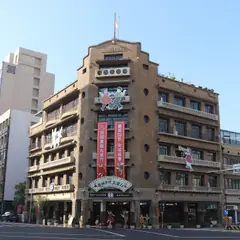
The kingdom of the Zheng, loyal to the Ming, left another mark about 700 metres away, at the Grand Mazu Temple, installed in the palace of Prince Zhu Shugui, and a couple of streets away the Hayashi Department Store tells the city of the Japanese period, with a Shinto shrine on its roof.
A gate that marks rank
Tainan Confucius Temple
Summary of this stop
The tour starts in front of the east gate of Dacheng, a walled gateway with a swallowtail ridge and a gabled roof. Above it shines in golden letters the sign “Quan Tai Shou Xue”, “first school of all Taiwan” (the one that hangs there is a replica, probably of 1917). One explanation ties the title to the fact that, at the start of Qing rule, this was the only place on the island where first-level candidates, the tongsheng, could enter official education; official tourism presents it instead as the highest-ranking official teaching institution in Taiwan until the end of the Qing.
Beside it stands, since 1687, year 26 of Kangxi, a “dismount from your horse” stele carved in Chinese and Manchu, which orders civil and military officials, soldiers and common people to get down on arrival. It is the most complete and best preserved of the four Qing steles of this kind that remain in Taiwan, and it turns a simple gateway into a border of rank.
That border was put to the test in October 2026, when the palanquin of the goddess Mazu of Shanbian, come from Miaoli, entered the temple without warning and stopped before Dacheng Hall. Criticism was swift, and the response of the temple of the lay master took the form of a quotation from Confucius; the narration keeps it to be heard right there, beside the stele.
A gate inside a tree
Panchi semicircular pond
Summary of this stop
Behind the entrance opens the semicircular Panchi pond, a half-moon with a stone railing; in the north wall is embedded the tablet “Si Le Pan Shui”, which in the Japanese period was used as material for an air-raid shelter and returned to its place in 1965. East and west of the path before Dacheng Gate rise the twin gates Limen and Yilu, small gateways with swallowtail roofs. The layout walked today is the one fixed by the reconstruction driven between 1917 and 1918 by the Japanese prefecture chief Eda Tokuji, who dismantled the buildings and did not rebuild the Zhu Xi shrine, the Lingxing Gate or the walls of Limen and Yilu.
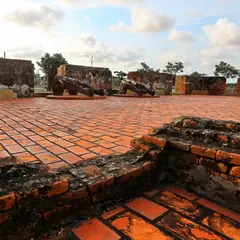
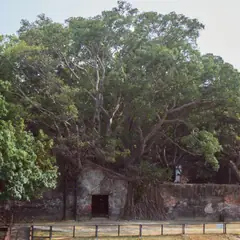
The Lingxing Gate was given up as lost for almost a century. On 20 August 2013, when the dead century-old banyan growing in front of Dacheng Gate was removed, some 14 metres of its remains appeared wrapped in its trunk: those of the second gate, the one that was moved north in 1777. The municipal government chose to keep them in situ, at ground level.
Along that same path pass today the children who start school. At the 360th anniversary, in September 2026, 120 future primary pupils received a dot of cinnabar on the hand they write with, entered through the gate of rites, left through the gate of the path of rectitude and walked around the pond.
A hall reborn after the bombs
Dacheng Hall terrace
Summary of this stop
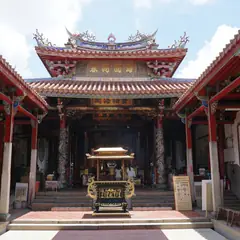
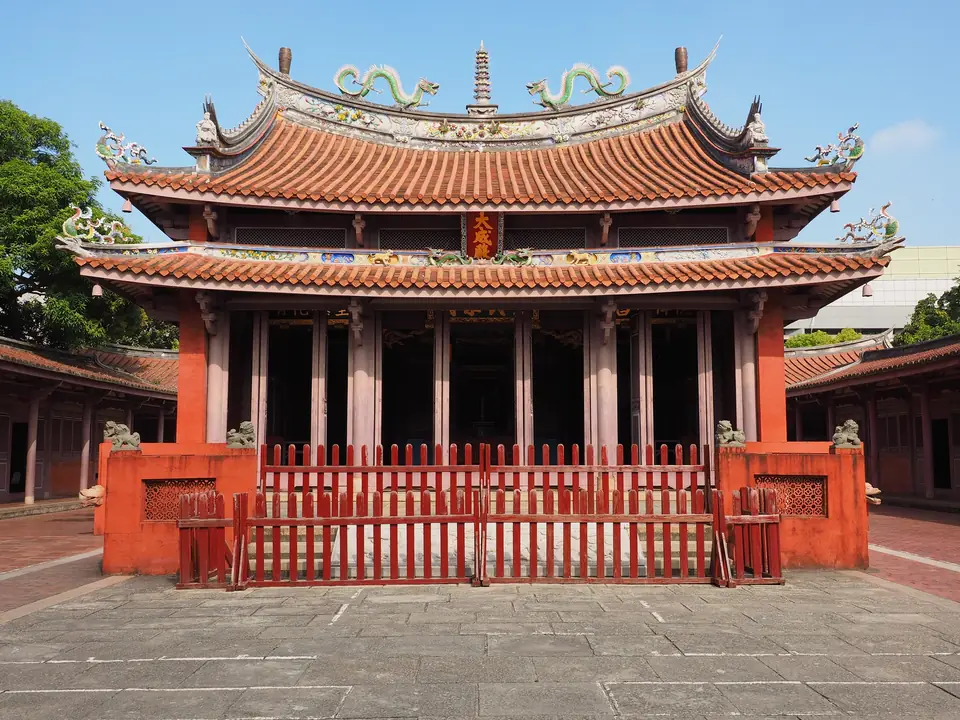
At the foot of the terrace rises Dacheng Hall, with double eaves on a base, a nine-storey pagoda on the ridge and a central ramp of dragons. What is seen is a reconstruction: the Allied bombing of 1 March 1945 destroyed the hall, the Chongsheng shrine, the library and the instrument store. The imperial plaques and the tablet of Confucius were saved because the keeper Fang Yaokun and his brother had taken them earlier to the countryside, to Yujing and Annan.
On that terrace, every 28 September, Teachers’ Day, the rite of Confucius’s birthday is held. It begins at five in the morning with 36 children dancing in six rows of six, and it is the only temple in Taiwan that still offers a real goat, pig and ox; the others replace them with animal-shaped cakes.
What happens minutes later contrasts with the solemnity of the liturgy: the crowd enters the hall to pull from the ox the “hairs of wisdom”, those around the eyes and ears, which according to tradition bring intelligence and exam luck for the following year. How they are kept, what happened to the custom during the pandemic and why some parents are not content with the little bags the temple sells is told in the narration of this stop.
The ceiling of emperors and presidents
Imperial plaques of Dacheng Hall
Summary of this stop
In the centre of the beams of Dacheng Hall hang eight Qing imperial plaques, from Kangxi to Guangxu. The first is dated 1684 in some sources and 1683 in statements on the founding of the temple. The largest, “Wan Shi Shi Biao”, “teacher of ten thousand generations”, measures 478 cm long, 173 wide and 12 thick, and the set is the best-preserved complete series of Qing imperial plaques in the world. Only that of the last emperor, Xuantong, Puyi, who came to the throne in 1909, when Taiwan had been ceded to Japan for fourteen years by the Treaty of Shimonoseki, is missing.
At the sides hang the presidential plaques. Since 1950 each president of the Republic of China has given one, beginning with “You Jiao Wu Lei”, “education without class distinction”, by Chiang Kai-shek; that of Lai Ching-te, presented in 2024 and unveiled in 2025, was the sixteenth. The sitting president’s occupies the upper right corner, the “dragon side”.
One of the imperial plaques keeps a secret. During the restoration after the 2016 earthquake, 86 X-rays of the plaque “Sheng Xie Shi Zhong”, of Daoguang, revealed another plaque beneath it, signed by an intendant and dated to the Jiaqing era. Who decided to reuse the board remains unclear, and the narration reviews the hypotheses in front of the plaque itself.
The classroom of a rebel kingdom
Minglun Hall
Summary of this stop
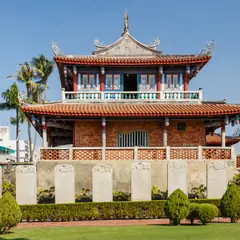
The tour ends at the east, behind the gate “Ru De Zhi Men”, before Minglun Hall, the classroom of the old school; behind it rises the three-storey Wenchang Pavilion (square, round and octagonal), dedicated to Wenchang and Kuixing. Here everything began: Minglun Hall was built beside the shrine in the work Chen Yonghua promoted in 1665 for the Kingdom of Tungning.
Two and a half centuries later, the classroom had other pupils. Under Japanese rule the site was barracks and, from 1898, the Tainan Public School for Taiwanese children, with Dacheng Hall itself turned into a classroom, until the school moved in August 1917. What a Chinese visitor found written on the blackboard in April 1916 sums up that chapter better than anything, and the audio guide tells it in the very place where it was taught.