Historic street
Anping Old Street Audio Guide
Among stalls of shrimp crackers beats the oldest market street in Anping: a layout inherited from the Dutch town of Zeelandia and the stage of Taiwan's biggest cultural protest since the end of martial law.
- 45 min of audio
- 17th-century Dutch layout
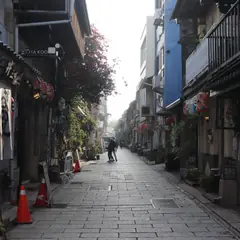
Yanping Street, the old Chhī-á-ke or “market street”, follows the layout of the Kerkstraat recorded in the Dutch land register of 1643. It had its greatest bustle in the late Qing dynasty, in the Japanese period it was a first-class commercial street, and wedding and funeral processions had to pass along it to announce themselves to the whole village.
In 1994 a road-widening project pitted intellectuals against residents for a year and a half, with all of Taiwan watching. On 1 August 1995, at 8:25, the bulldozer went in: the winding alley of two to three metres became a straight street of six, and most of its shophouses disappeared.
Highlights
- Yanping Street — the layout of the Dutch town of Zeelandia, documented in the 1643 land register
- He Wang House (No. 86) — 1920s Art Deco and headquarters of the campaign against demolition
- House of the baozheng Chen (No. 58) — the only complete shophouse on the street, amputated by the widening
- Yanping Street well — fresh water in a village with none, 94 cm across and 3.15 m deep
- Sword lions — Anping's own amulet, back on the lintels of Zhongxing Street
What to see on Anping Old Street begins with a paradox: the busiest street in the district, Yanping, is also the one that has lost the most. Next to Fort Zeelandia, the Dutch East India Company laid out three parallel east-west streets in the 17th century, and their grid can still be recognised against the winding alleys that came later. On that plan grew a market that residents called Chhī-á-ke and that in 1994 and 1995 was the stage of the “Yanping Street Incident”, a tug-of-war followed across the whole island.
The history of Anping Old Street is read today among stalls of shrimp crackers and candied fruit: in an Art Deco house that served as the protest’s headquarters, in half a shophouse that survived the widening, in a fresh-water well and in the lions with a sword in their mouths that watch over the doors. The audio guide walks those five stops with documented narration, to understand on the ground what was saved and what the bulldozer took.
About 150 metres away stand the remains of Fort Zeelandia, the fortress that shaped the district, at Anping Old Fort, and towards the city centre Shennong Street keeps the warehouse houses of the dockers, also split by a road widening.
The Chhī-á-ke, the street of weddings and funerals
Anping Old Street
Summary of this stop
At the mouth of Lane 104 begins the stretch that for more than three centuries concentrated the life of Anping. That Yanping Street, shorter than today’s, brought together market, sawmills, hospital, clinics and smithies as far as Shimen school. And it had a social function: the village’s wedding and funeral processions were obliged to walk it so that everyone learned of the event.
Its great moment came in the late Qing dynasty; in the Japanese period it was classed as a first-class commercial street, and in the 1980s the Tainan government raised at its entrance a stone stele with the inscription “Taiwan Jie” (臺灣街), “Taiwan Street”. What exactly the title “first street of Taiwan” means depends on who says it: first named street, first commercial street or the oldest in Tainan.
The Chhī-á-ke has never stopped being a market. On weekends and holidays the street fills on both sides with stalls of shrimp crackers, candied fruit, drinks, clothes and traditional toys. What that bustle hides, and why such a resounding stele ended up a matter of dispute, is revealed by the narration at this very spot.
Taiwan Wu, the headquarters of the resistance
He Wang House
Summary of this stop
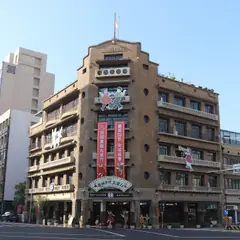
Opposite No. 86, a façade breaks the line of the street: He Wang House, a two-storey Art Deco shophouse from the 1920s, set back behind a small garden, with a pediment, a medal-shaped ornament and beige washed-stone plaster. It was the home plot of the He family, founders of the Yuen Foong Yu paper group, and in the 1970s Shiy De-jinn painted in it. It has been a municipal monument since 2003.
During the battle of 1994-1995 the house took the name “Taiwan Wu” (臺灣屋) and became the headquarters of the campaign against demolition. In mid-October 1994, questioned in the Legislative Yuan by the legislator Chou Chuan, Premier Lien Chan ordered that nothing be demolished until the monument file was processed; on 7 November the Tainan municipal monuments committee resolved not to designate the street.
The protest achieved something unusual in the Taiwan of the 1990s. On 27 December 1994, Chou Chuan, a unificationist of the New Party, appeared in Taipei alongside Chang Tsan-hung, chairman of the Taiwan Independence League, to defend the “first street of Taiwan”. How that impossible alliance ended, and what Chang did next with Anping, is part of the story this stop holds.
Half a house behind the 8:25 bulldozer
House of the baozheng Chen
Summary of this stop
At No. 58 stands the house of the baozheng Chen Zhiyun, the only complete shophouse on the street and, at the same time, an amputated house: the widening tore off its front section and it keeps only the middle and rear ones. It was registered as a historic building in 2006, and the restoration finished in 2010 replaced the façade tiles with wooden lattices.
The demolition had been brewing for months. From 6 January 1995 some residents were already knocking down their own houses, and posters appeared in favour of the widening arguing that the first street of Taiwan was on Minquan Road. On 1 August 1995, at 8:25, the City Hall bulldozer went in to carry out an urban plan inherited from the Japanese period. Some records place the amputation of houses like this one in 1994, while the press chronology puts the demolitions in 1995.
The straight street around the house is the scar of that day. According to the chronicle of the demolition, the original Yanping, laid out on beach sand, had undulations that were handled with steps and almost right-angled bends that served to protect the district. The irony left by the straightening, ten years later, is told in the audio guide in front of this façade.
The well that watered bean sprouts
Yanping Street well
Summary of this stop
At the mouth of Lane 53 on Gubao Street a round well appears, protected by an iron railing and a cement curb. It is one of the few fresh-water wells in Anping and today a municipal monument: it measures 94 cm in inner diameter and 3.15 m in depth. The ground, higher than before, leaves it low, when originally it came up to the waist.
Its life sums up that of a village by the sea. With the arrival of running water in 1923 it stopped being used for drinking and began to water bean sprouts so tasty that the surroundings ended up being called “Doucailiao” (豆菜寮). When the war destroyed the network, it gave drinking water again.
Its age is still under discussion: one version dates it to around 1634, at the time of the building of Fort Zeelandia, with a refurbishment in the Xianfeng era; another maintains it was built in that era, between 1851 and 1861. What this modest curb says about everyday life in Anping is discovered with the narration beside it.
Sword lions over the Dutch grid
Sword lions of Zhongxing Street
Summary of this stop
Zhongxing Street, narrower and better preserved than Yanping, shows the scale of the old Dutch town. The three parallel streets of the time are today Xiaozhong, Yanping and Zhongxing; according to Huang Enyu’s reconstruction from the 1643 land register, they correspond to the Breestraat, the Kerkstraat and the Nauwestraat, although other sources give Yanping the name “New Street”. In Lane 6, Sword-Lion Alley decorates its walls with sword lions and flowers.
The jianshi (劍獅), a lion’s face with a sword across its mouth, is Anping’s own amulet: it is placed over lintels and on screen walls to ward off evil. Its origin is disputed; according to the district’s tradition, garrison soldiers hung before the door their shield with a lion’s head and the sabre between its teeth, and other versions link it to the Ming-Qing navy, to the Han settlers or to Koxinga. Residents, popular belief has it, read the direction of the sabre as a code.
The amulet came close to being lost. In 2012 the district chief, Lin Guo-ming, spoke of 44 surviving old lions; around 2006-2007 the potter Song Chien-cheng, trained in Yingge, asked the elders about some blurred emblems on the old houses, and from that the campaign “find the lost lion” was born. By 2012 there were already more than a hundred jianshi on the street, and even the 24-hour convenience stores carry theirs on the sign. Who recovered each lion and which one passes for the most powerful is revealed at the end of the tour.