Dutch fort and temples
Chihkan Tower Audio Guide
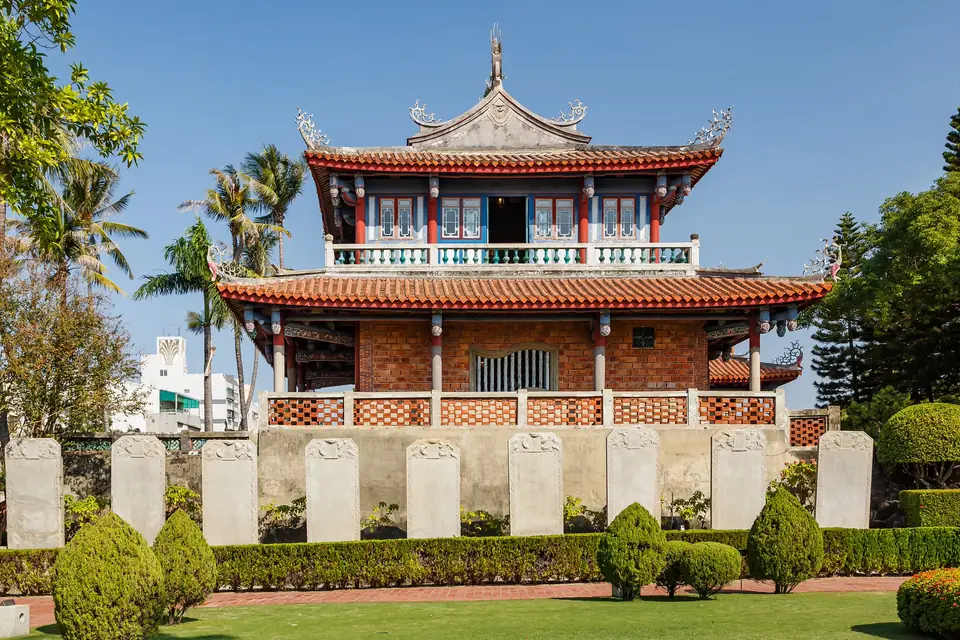
Two Chinese pavilions with double eaves over the foundations of the Dutch fort of Provintia and nine stone turtles bearing a Qing emperor's propaganda: three centuries of Tainan's owners piled up in a single garden.
- 45 min of audio
- 17th-century Dutch fort
- Chinese double-eaved pavilions
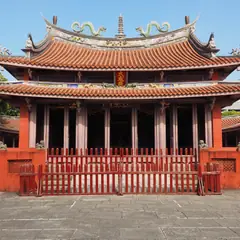
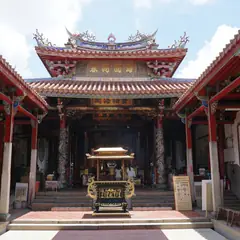
Chihkan Tower stands on the site of Fort Provintia, which the Dutch East India Company began to build in 1653 after the uprising of Guo Huaiyi and finished in 1655. Locals called it the “tower of the redheads”. It fell to Koxinga in 1661, was the seat of the Chengtian prefecture, a powder magazine and a ruin, and in 1886 the magistrate Shen Shouqian raised on its base the Haishen Miao and the Wenchang Ge, the two pavilions that define its silhouette today, rebuilt in reinforced concrete in 1965.
The nine steles flanking the Sea God temple celebrate a victory of the Qianlong Emperor in Chinese and Manchu, but they arrived here in 1961 for the anniversary of Koxinga, the hero who fought the Qing. There were ten: one turtle fell into the Kunshen lagoon during transport and, when it reappeared in 1911, ended up venerated as a goddess in a temple of the city.
Highlights
- Nine steles on bixi turtles — granite of about 3.1 m with texts in Chinese and Manchu
- Dutch half-moon well — dredged in 1935 between the two pavilions
- Haishen Miao and Wenchang Ge — double-eaved pavilions of 1886 on the base of the fort
- Stone horse with broken legs — from a Qing tomb and a peasant legend
- Northeast bastion of Provintia — red brick with a mortar of oyster lime, sugar and glutinous rice
In the very centre of Tainan, a walled garden holds one of the most tangled stories in Taiwan. In 1625 the Dutch governor Martinus Sonck bought the lands of Sakam from the Siraya village of Sinkan in exchange for 15 pieces of printed cloth and laid out there Provintia Street, the first of European plan on the island. To the north of that street the fort that gave rise to Chihkan Tower was later raised: sources place the start of the work in 1653, although municipal tourism speaks of 1652, the year of the revolt that prompted it.
The story of Chihkan is that of a plot that changed owners again and again without anyone erasing it completely. The Dutch, the kingdom of Koxinga, the Qing dynasty, the Japanese administration and postwar Taiwan built on top of what came before: a fort, a prefecture, a powder magazine, a ruin contemplated at sunset, temples, a military hospital, a protected historic site. The architecture of Chihkan Tower is that stacking, and the audio guide walks it layer by layer, in five stops around the site, with documented narration checked against historical sources.
Its twin by the sea is Anping Old Fort, the old Fort Zeelandia that held out against Koxinga until 1662, and about 150 metres away stands the Grand Mazu Temple, installed in the palace of a Ming prince.
A square born of war and a fort that surrendered without a siege
Chihkan Tower
Summary of this stop
The tour starts on the open esplanade in front of the ticket office on Minzu Road. That emptiness has an explanation: during the Second World War it was cleared as an anti-aircraft defence space, and after the war the main entrance was moved here from Chikan Street. On the lawn, a sculptural group shows Koxinga before a Dutch envoy, a scene that some present as surrender and others as peace negotiation.
Behind the statue is a fort that its own side judged too fragile. Frederick Coyett, the last Dutch governor of Taiwan, considered that Provintia served to put down revolts, but not to withstand a siege or cannon fire. On 4 April 1661 its commander, Valentyn, surrendered it with some 140 soldiers to Koxinga’s army, while Zeelandia held out until February 1662.
The scene has not stayed in bronze. Every April the community of Luermen, in Annan, re-enacts Koxinga’s landing on bamboo rafts and then marches to besiege Chihkan, with residents in period costume and foreign students in the role of generals. What links that festival with the stone of the site is told in the narration, right there.
Nine turtles of an emperor and a tenth lost in the lagoon
Steles on bixi turtles
Summary of this stop
Beside the base of the Haishen Miao stand nine granite tablets of about 3.1 metres, each on a stone turtle. They were commissioned in 1787 by the Qianlong Emperor to celebrate General Fukang’an’s victory over the Lin Shuangwen rebellion, and their faces alternate Chinese characters and vertical Manchu script. The paradox is plain: Qing propaganda ended up as the backdrop of the hero who fought against them, because in 1961 Mayor Xin Wenbing moved them here for the 300th anniversary of Koxinga’s arrival, opening a gap of some 3 metres in the wall of the Ningnan gate to bring them out.
There were ten. During transport to Tainan one of the bases fell into the Kunshen lagoon and could not be rescued; officials carved a sandstone copy and sent that stele to Chiayi. The original turtle came to light in 1911 and is venerated today as “Bailian Shengmu” in the Nanchang Bao’an Gong temple.
What almost everyone photographs as simple turtles has, according to Chinese tradition, another identity: the bixi, one of the nine sons of the Dragon King, who so liked carrying weight that he ended up shaped like a turtle. Another version links it with Yu the Great, the tamer of floods. Both stories are unspooled in the audio, in front of the row of stone.
The half-moon well that confirmed the Dutch fort
Dutch half-moon well
Summary of this stop
Between the two pavilions opens a half-moon curb. The raised ground underfoot is the base of the fort of the redheads, and before the inner Taijiang lagoon silted up the waves reached the foot of the ruin. In 1750 the magistrate Lu Dingmei moved the district seat beside it, opened it to visitors and the “sunset over Chihkan” came to figure among the city’s eight famous views.
The well has its own episode. On 5 December 1935 the Government-General of Taiwan declared the site a historic monument under the name Provintia and set aside 700 yen to dredge it. The local historian Lu Jiaxing went down to the bottom in a bamboo basket and confirmed it was Dutch work; what he found down there and the legend of tunnels that the well still feeds are left for the narration.
A tomb horse, a god of letters and a mayor at war
Stone horse of the Wenchang Ge
Summary of this stop
At the foot of the Wenchang Ge rests a stone horse with broken legs, from a Qing tomb. The tradition of Zhouzaiwei, in Yongkang, held that the horses of that tomb came out at night to ravage the fields and that the villagers broke their legs. In 1933 a pupil wrote it in his holiday homework and the trail ended in an excavation; the horse belonged to the tomb of a militia chief fallen against the same rebellion the turtles celebrate, and some attribute the broken legs to a revenge of the defeated.
Above, the plaque “文昌閣” bears the signature of Shen Shouqian, the magistrate who in 1886 raised the pavilion of the god of letters, the Sea God temple and the Wuzi Ci shrine, and founded the Penghu Shuyuan academy next to them. Under Japanese rule the pavilions served as the garrison hospital and as a residence of the Tainan Normal School, and the Wuzi Ci collapsed in a typhoon in 1911.
Inside, the bronze bust of Hatori Matao recalls the Japanese mayor who convinced the governor-general and the army to restore the two pavilions in the middle of the war, between 1 March 1943 and 20 December 1944, for 65,000 yen. The inauguration planned for 3 January 1945 was never held, and the reason is heard in the audio guide.
The last red brick of Provintia
Northeast bastion of Provintia
Summary of this stop
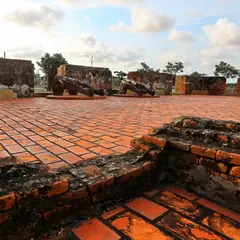
At the back of the site, where the Wuzi Ci stood, the excavated remains of the northeast bastion appear: a thick wall of red brick set with a mortar of oyster lime, sugar and glutinous rice. It is what survived everything else. Koxinga installed in the old fort the Chengtian prefecture, the island’s highest administrative body; when his son Zheng Jing abolished it in 1664, the building became a powder magazine. In 1721, during the Zhu Yigui rebellion, the cast-iron plaque of the lintel was torn off and melted down to make weapons, and typhoons and earthquakes afterwards left only ruined walls.
Even the name remains divided. The Siraya place name Sakam is transcribed with two characters, 嵌 and 崁, and the dispute between the two has defenders with weighty arguments. On 12 March 2003 the Tainan Historical Documentation Commission voted 10 to 4 that municipal documents should write 赤崁樓, but the neighbourhood keeps 赤嵌里. How that double spelling closes the circle that began with 15 pieces of cloth is revealed at the last stop of the narration.