Municipal monument
Hayashi Department Store Audio Guide
A department store of 1932 that debuted the first elevator in southern Taiwan and still keeps, on its roof, a Shinto shrine facing walls riddled with bullets in 1945.
- 60 min of audio
- Japanese colonial architecture
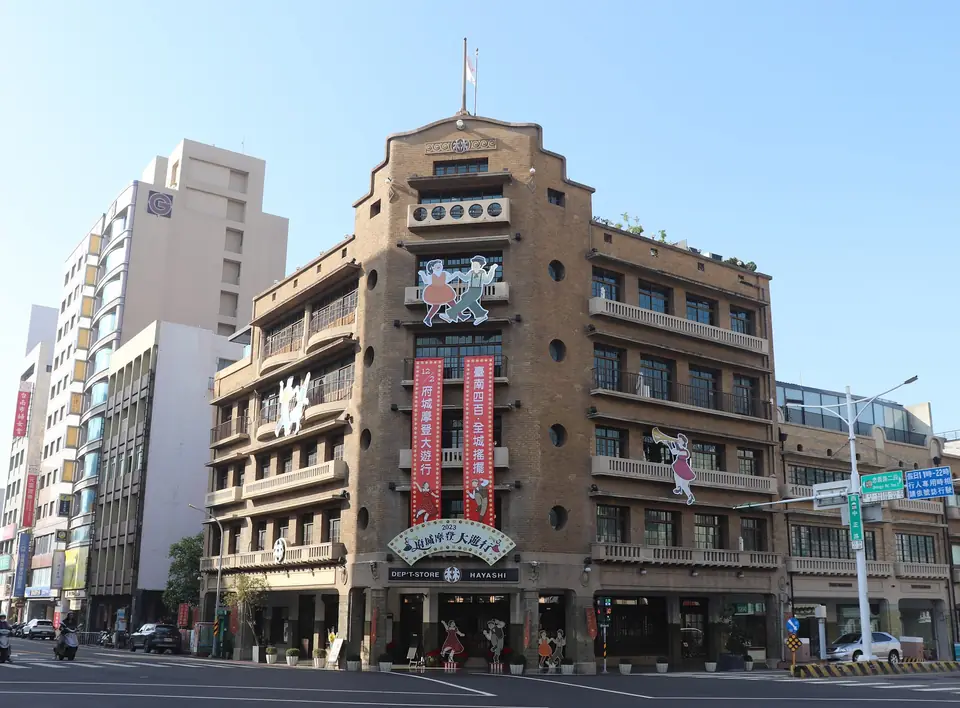
Hayashi opened on 5 December 1932 on the corner of today's Zhongyi and Zhongzheng streets: the second department store in Taiwan and the first in the south. It is the largest building on Suehiro Street, the first in Tainan planned in one go, the work of the architect Umezawa Sutejirō and nicknamed the city's “Ginza”. When finished it was the tallest building in Tainan, and today it works as a store of cultural products of the city.
Tainan people call it “the five-storey one”, although it has six. Its founder, Hayashi Hōichi, died five days after the opening, according to the best-documented version; after the war the building was divided among salt, food and a military radio, and the roof ended up with anti-aircraft artillery next to the shrine.
Highlights
- Elevator of 1932 — the first in southern Taiwan, with a needle-and-dial floor indicator
- Suehiro-sha shrine — the only Shinto shrine in a department store in Taiwan
- Strafed walls — impacts from the 1945 bombing, deliberately preserved
- Stepped façade — the crown of Suehiro Street, the “Ginza” of Tainan
- Hand-cranked metal shutter — original from 1932
The history of Hayashi Department Store (林百貨) fits in six floors. It opened on 5 December 1932, barely a few days after Kikumoto in Taipei, and was the first big department store in southern Taiwan. Its founder, Hayashi Hōichi, was a merchant from Yamaguchi Prefecture; it is said that on leaving Japan he had sworn to found the “Mitsukoshi of Taiwan”. He succeeded, but, according to the best-documented chronology, he died of cholecystitis on 10 December, aged 49, and his widow, Hayashi Toshi, stayed at the head of the store. Another version speaks of a construction accident before the opening; the two do not fit together.
Then came the Allied bombing of 1 March 1945, decades of use by public and military bodies, abandonment, the designation as a municipal monument on 26 June 1998 and a restoration from 2010 to 2013 that cost some NT$80 million. On 14 June 2014 it reopened as a department store of Tainan cultural products, and by 2019 it had already passed 6 million visitors. The audio guide, documented and checked against historical sources, climbs floor by floor from the street corner to the roof, where the building’s history is read on its own walls.
A couple of streets away is the Tainan Confucius Temple, the first in Taiwan; a little further north, the Grand Mazu Temple, and to the west Shennong Street keeps the warehouse houses of the dockers of the old port.
A corner that crowns Tainan’s “Ginza”
Hayashi Department Store
Summary of this stop
From the crossing of Zhongyi and Zhongzheng, the façade presents itself as a stepped piece: the highest parapet occupies the central corner and descends in steps towards the two wings, all clad in fluted tile. At the junction between the central body and the wings open round windows on floors 2 to 5, and square ones on the sixth, the smallest, which housed the machine room and a lookout. Hence the popular mix-up: in Tainan it is called Gō͘-chàn-lâu-á, “the five-storey one”, although there are six. When finished in 1932, it was the tallest building in the city.
The store was not conceived alone. The architect Umezawa Sutejirō planned the whole commercial street in one go, with works between 1931 and 1932, and the neighbouring shophouses of the west wing went up at the same time. Suehiro Street, today Zhongzheng, was the first in Tainan planned as a whole and earned the nickname “Ginza”. On the ground floor, the arcades keep their decorated pillars and a hand-cranked metal shutter original from 1932.
This corner is also the goal of a living ritual: since the 2014 reopening, every early December the store celebrates its birthday with a great parade along Zhongzheng Street with hundreds of participants dressed as in the Tainan of the 1930s. What that parade has to do with the first person who cut the anniversary cake is told right there, in the narration.
The “moving cage” of 1932
Elevator with dial indicator
Summary of this stop
Inside waits the device that made Hayashi a phenomenon: the first elevator in southern Taiwan, with a capacity of 12 people and operated by young elevator attendants. The island’s first public elevator was Kikumoto’s, in Taipei; what belongs to Hayashi is the primacy in the south. The restoration kept the original shaft with a 5-person car and a needle-and-dial floor indicator, probably the last of its kind in Taiwan.
In the 1930s, people came to this store just to ride the liulong, the “moving cage”, and visitors arrived even from Pingtung. “Going to Hayashi to ride the elevator” was a saying of the time, and Hokkien still keeps a mocking proverb about someone who gets into an elevator wearing a bamboo hat and sandals.
That triumphant start has its reverse. The founder barely saw his store run: the best-documented version places his death five days after the opening, in a Taipei clinic, leaving the business in the hands of his 38-year-old widow. The memory of an octogenarian who still pointed at the building in 2016 gives the measure of what that car meant.
Fifth floor: sushi, matchmaking and wedding dowries
Fifth-floor dining level
Summary of this stop
The fifth floor, devoted to food today, was in 1932 the floor of the Western and Japanese restaurants. The numbers of the time sketch the store’s daily life: a plate of sushi cost 20 sen and a Western dish 50; a new employee earned 35 sen a day and a veteran 40, and women received 5 sen more to pay for their makeup. Around 1940, at its height, the staff reached 150 people.
According to a well-documented local custom, on this floor meetings were arranged to find a partner with a view to marriage, with a reputation for turning out well; a notable Tainan family remembered that their daughters’ wedding dowries were bought at Hayashi. Behind the stoves of the Japanese restaurant was the younger brother of Lee Hsi-chuan, an employee since 1931 and head of the second floor, who in 1943 married his colleague Lee Chen Ching.
The postwar period changed the building from top to bottom: in the 1950s, floors 1 to 3 passed to the Taiwan Salt Works, the fourth to the Provincial Food Bureau and the fifth and sixth to the Air Force radio, and the top floor housed six military families until the 2000s. In 1945, the Japanese owner, who could only take 1,000 yen and two suitcases, entrusted Lee with 200,000 yen; what was left of that fortune after the currency change, and what Lee did with three display cases, is part of the story of this stop.
A shrine among 1945 bullets
Suehiro-sha shrine
Summary of this stop
The roof holds the greatest surprise. In 1933, half a year after the opening, the Suehiro-sha was finished there, a small Shinto stone shrine, closed to the public and dedicated to protecting the business: it is the only shrine in a department store in Taiwan. Beside it rises the turret containing the machinery and the elevator shaft, and at the top, the flagpole.
The Allied bombing of 1 March 1945 damaged the roof, the shrine, the exterior walls and the floors. The wall facing the shrine and the parapets are still riddled with bullet and shrapnel impacts of different sizes: the 2010-2013 restoration left them unrepaired on purpose, as a witness of the war. The torii was rebuilt from its remains, and in January 2013 Hayashi Chieko, the founder’s daughter-in-law, travelled from Japan to confirm a detail of its shape that guided the work.
The circle closed on 5 December 2013, exactly 81 years after the first opening, when the store’s flag flew again from that pole. What that Japanese family remembered about the torii, and why it mattered so much, is discovered on the roof with the narration.