Park and memorial
228 Peace Memorial Park Audio Guide
In the gentle shade of Taiwan's first European-style park, Taipei buried temples, statues and silences. Here, through a radio, through water and through a bell, the island learned to say aloud what happened in 1947.
- 60 min of audio
- Memory of 228
Planned in 1905 and opened in a first phase in 1908 as Taipei Park, what everyone called the “New Park” is a palimpsest a step from the Presidential Office: stone relics of a great Qing-dynasty Mazu temple, pedestals that held Japanese governors, the Doric portico of the National Taiwan Museum and the 1930 radio station from which the revolt of 28 February 1947 was broadcast to the whole island.
The central monument needs no words to speak: it is made of steel from Keelung harbour cranes and its bell gives 28 strikes imitating the number of the tragedy. When it finally received an epitaph, in 1997, the plaques lasted four hours before ending up at the bottom of the lotus pond.
Highlights
- 228 Monument — Keelung crane steel and a bell that strikes 28 times in series of 2-2-8
- Former 1930 radio station — taken by the crowd in 1947, now the Taipei 228 Memorial Museum
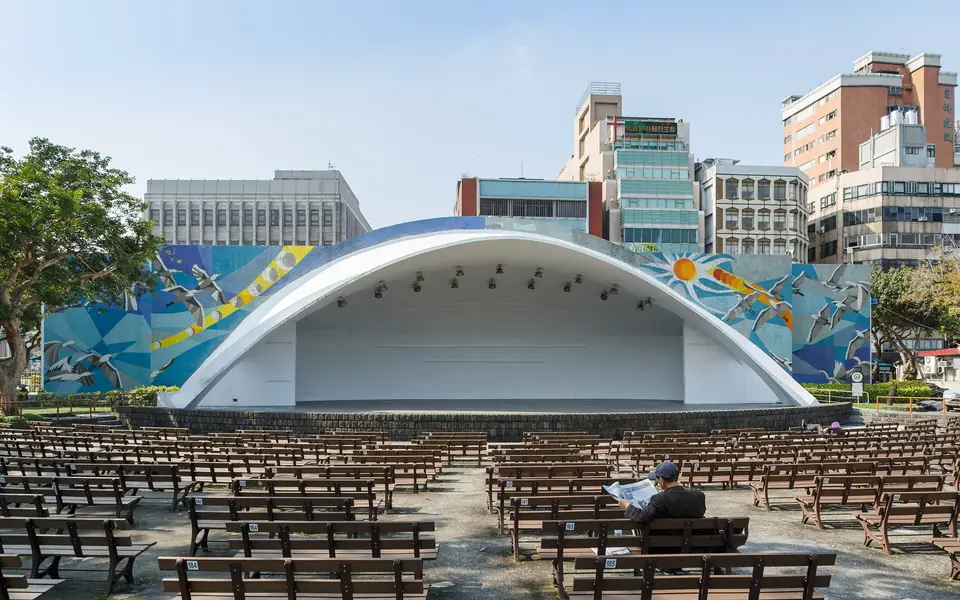
- 1931 loudspeaker pavilion — through its speakers Hirohito's surrender was heard in 1945
- Lotus pond — the night “kingdom” of Crystal Boys and the starting point of Taiwan's first Pride
- Qing gateways and bronze bulls — stone arches of 1882 and 1888 and offerings from a vanished Shinto shrine
In the political heart of Taipei, between Ketagalan Boulevard and Guanqian Road, stretches Taiwan’s first modern European-style urban park. Its birth date is still disputed: official tourism speaks of 1899 and other sources of 1900, while the most detailed history places the project in 1905, the first opening in 1908 and the present layout around 1915. It was called Taipei Park, but came to be known as the “New Park” for being later than Maruyama Park, opened in 1897. On 28 February 1996, on the 49th anniversary of the massacre and under Mayor Chen Shui-bian, it received its present name, although some sources date the change two years later.
The history of the 228 Peace Memorial Park is that of an island recovering its voice. There are 19th-century steam locomotives beside the museum, two stone pailou from the Qing period, an acoustic shell remodelled for the Taiwan Exposition of 1935 and a small Tudigong temple that its worshippers jokingly call “the first temple under heaven”: legend has it that, when they wanted to demolish it, the machines broke down as soon as they entered the site. What to see in the 228 Peace Memorial Park depends on knowing how to read its layers, and the audio guide, documented and checked against historical sources, covers them in five stops, from the National Taiwan Museum to the former radio station.
800 metres away, the Chiang Kai-shek Memorial Hall completes the reading of Taiwan’s political memory, and to the southwest, in Monga, Longshan Temple has gathered Guanyin’s worshippers since 1738.
A Mazu temple beneath the portico of a colonial museum
National Taiwan Museum
Summary of this stop
The route begins in front of a portico of Doric columns and pediment aligned with Guanqian Road: the National Taiwan Museum, built between 1913 and 1915 as a memorial museum to Governor Kodama Gentarō and Gotō Shinpei. Before it, at this northern end of the park, stood the Great Temple of Tianhou, dedicated to Mazu and founded in 1888 by Governor Liu Mingchuan. A typhoon damaged it and in 1912 it was demolished. In front of the entrance wait two bronze bulls which, according to a documented tradition, are not a pair: they arrived two years apart, from different donors, at a Shinto shrine that no longer exists.
Of the temple remain column bases, steps and stone mortars scattered around the park, which now serve as seats beneath the trees. Its image of Mazu, with a gilded face and imperial grant, before which high officials prayed and not the common people, ended up in Sanzhi, on the north coast. Since 2004, according to this living tradition, the goddess “returns” to the city every year. Who carried her palanquin through the North Gate in 2017 is told in the narration, in front of the façade.
The night kingdom of the lotus pond
Lotus pond and arched bridges
Summary of this stop
In the northwest of the park, a lotus pond with arched bridges makes a postcard scene. From at least 1959, the New Park was Taipei’s main gay meeting place and this corner the setting of Crystal Boys, Pai Hsien-yung’s novel serialised in 1977 and published as a book in 1983. For that world, the park was “the kingdom”, a place where, as the novel says, there were only dark nights and never daylight.
On the afternoon of 1 November 2003, that kingdom came into the light: from here set off Taiwan’s first Pride parade, with nearly a thousand people covering 1.5 km along Hengyang Road to the Red House in Ximending. In 2016, the city government and several LGBTQ+ NGOs painted one of the park’s iron gates with a rainbow. Who led that first march, and how they were dressed, is one of the details heard at the water’s edge.
Keelung steel that sounds like 2-2-8
228 Memorial Monument
Summary of this stop
In the middle of the park, a steel spire rises over three cubes balanced on an edge, surrounded by a circular pond of black stone. The architecture of the 228 Monument is meant to be read: its structure comes from cranes dismantled at Keelung harbour, an allusion to the troops who landed there, and to reach its centre one must cross stepping stones over shallow water that force a look at the ground.
The monument can also be heard. Its electronic bell gives 28 strikes in each peal, in series of two short and one long that imitate “er-er-ba”, that is, 2-2-8. The spire carries two abacus-bead-shaped pieces with a precise message: two times two is not eight. It stands where the statue of Gotō Shinpei stood, removed after 1945, and what then occupied Kodama Gentarō’s pedestal, until the arrival of the Peace Bell in 1998, is another of the surprises of this stop.
An epitaph that lasted four hours
Epitaph sphere of the 228 Monument
Summary of this stop
At the base of the monument, a sphere holds the epitaph on red copper plaques. Its story sums up how hard it was to put into words what happened. On 28 February 1995, at the inauguration, President Lee Teng-hui apologised for the first time to the victims of 228 and their families. Among the four architects of the design was Cheng Tzu-tsai, co-organiser of the 1970 attempt on Chiang Ching-kuo in New York, who submitted the proposal from prison. The choice of design and its location beside the Presidential Office were also disputed.
The monument spent two years without text. The families had rejected a first draft for its wording, and the 642-character epitaph of the 228 Foundation was unveiled on 28 February 1997. Four hours later, some citizens tore off the plaques and threw them into the lotus pond, in protest that it called Chiang Kai-shek “Chiang Chung-cheng”. Every 28 February, memorial events are held here, and what the State handed to several families in front of this monument in 2012 is revealed in the narration.
The radio station that woke the whole island
Taipei 228 Memorial Museum
Summary of this stop
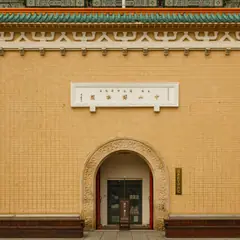
On the southeast side, beside Ketagalan Boulevard, stands a two-storey concrete building from 1930: the Taipei radio station, Taiwan’s first radio station, designed by the engineer Kuriyama Shunichi with the call sign JFAK on 750 kHz. Nearby is the 1931 loudspeaker pavilion, a small kiosk where public-listening speakers were housed when few people had a receiver; through them Emperor Hirohito’s surrender speech was heard in 1945. The radio’s antenna left another mark: on Double Ten in 1964, an F-104 fighter struck it and the fuel tank fell onto Gongyuan Road, killing three.
On 28 February 1947, around two in the afternoon, the crowd gathered in the New Park occupied the station and broadcast to the whole island what had happened in Taipei; the next day, the revolt spread across all of Taiwan. Since 28 February 1997, the same building that spread that news is the Taipei 228 Memorial Museum, with the sculpture “Earth and Mother” in its surroundings. How radio threads together the whole history of the park, from colonial loudspeaker to seized microphone, closes the tour.