Historic street
Dihua Street Audio Guide
A 7.8-metre street founded by the losers of a clan war, which still sells tea, herbs, fabrics and dried goods because its neighbours refused to let it be widened.
- 75 min of audio
- Dadaocheng shophouses
The history of Dihua Street begins in the mid-19th century in Dadaocheng, beside the Tamsui River: the merchant Lin Lantian's house dates from 1851, and after the brawl of 1853 the defeated Tong'an immigrants built adjoining shophouses here that ended up forming Taipei's great trading hub. In the Japanese era, between the late 1920s and the Second World War, merchants dressed it in modernist and pseudo-Baroque façades.
In 1977 the city government approved widening section 1 from 7.8 to 20 metres, demolishing all its old buildings. A citizens' campaign launched in 1988 and a 1995 plan preserved the width and 77 historic buildings. Today sacks of goods share the arcades with cafés and galleries, and a tiny temple holds more than 600 images.
Highlights
- Lin ancestral house — a Minnan shophouse from 1851, one of the three oldest on the street
- Xia-Hai City God Temple — more than 600 images in 152 square metres
- Pseudo-Baroque pediments — Japanese-era façades with floral reliefs and family crests
- Ten red-brick houses — former rice mills finished in 1912
- A 7.8-metre roadway — the width that survived the widening to 20 metres approved in 1977
In Dadaocheng, a step from the Tamsui River, a street with a roadway of barely 7.8 metres keeps doing what it did more than a century and a half ago: selling tea, medicinal herbs, dried goods and fabrics wholesale. It is Taiwan’s largest wholesale and retail market for dried goods, Chinese medicine and textiles, and since 1996, in the two weeks before the Lunar New Year, it hosts the Lunar New Year Market, open to the whole public. Its exact age is a matter of debate: some sources present it as the oldest street in Taipei, with stretches from the Dutch period (1624-1661), while official tourism and local history date the first shops to 1851 and the formation of the street to after the brawl of 1853.
What to see on Dihua Street goes far beyond its shop windows. Its history is that of refugees from a clan war, of a district renamed by Japanese colonial power, of a name imported from a map of China and of a neighbourhood campaign that stopped the demolition. The audio guide, documented and checked against historical sources, covers it from north to south in five stops, from the red-brick houses by Taipei Bridge to the Xia-Hai temple and the Yongle market, while the arcades stay full of sacks and counters.
To the south, in Monga, Longshan Temple has brought together since 1738 the worshippers who came from Quanzhou, and on the other side of the city, in the old port of Xikou on the Keelung River, the Raohe Night Market tells another story of river trade.
Rice mills and a name from Xinjiang
Ten red-brick houses
Summary of this stop
At the northern end, beside Taipei Bridge, numbers 348 to 366 form a continuous row of ten red-brick houses, with arches over the pavement and an inner courtyard. They were finished in 1912 for five rice mills and a sewing workshop: the grain arrived by river to the head of the bridge. The mills closed or changed trade before the Sino-Japanese War, and when the families rebuilt upwards they kept the first bay of each house. Today those façades house cafés and galleries.
The street’s name is not as old as it seems either. In 1947 the government of the Republic of China renamed Taipei’s streets by projecting the map of China onto the city, and this one, lying to the west, got Dihua, then the capital of Xinjiang and today Ürümqi. The locals, however, still call the stretch north of Minsheng West Road Central Street (Zhongjie). How the street reads from this riverside head is what the narration reveals in front of the bricks.
The Lin house and the peephole of the light well
Lin ancestral house
Summary of this stop
At numbers 154-158 of section 1 stands the ancestral house of the Lin family, built in 1851 by the merchant Lin Lantian, who had moved from Keelung fleeing pirates. It is one of the three oldest structures on the street and a clear example of a three-bay Minnan shophouse: the shop on the street, a light-well courtyard for the family and, at the back, the warehouse facing the river.
Two years later came those who would shape the street. In 1853 the Ding-Xia brawl of Bangka pitted the guilds of the three Quanzhou counties against the Tong’an immigrants; the Tong’an lost, were driven back at Dalongdong and settled in Dadaocheng, where they built adjoining shophouses along the river. That is the core of today’s Dihua Street.
The house also keeps an intimate custom: it is said that when a daughter of the family had to choose a husband, she hid upstairs, by the light well, to watch unseen the suitor who came to visit. What happened downstairs meanwhile is heard in front of the façade.
Eirakuchō pediments and the festival that filled the street
Pseudo-Baroque pediments of the central stretch
Summary of this stop
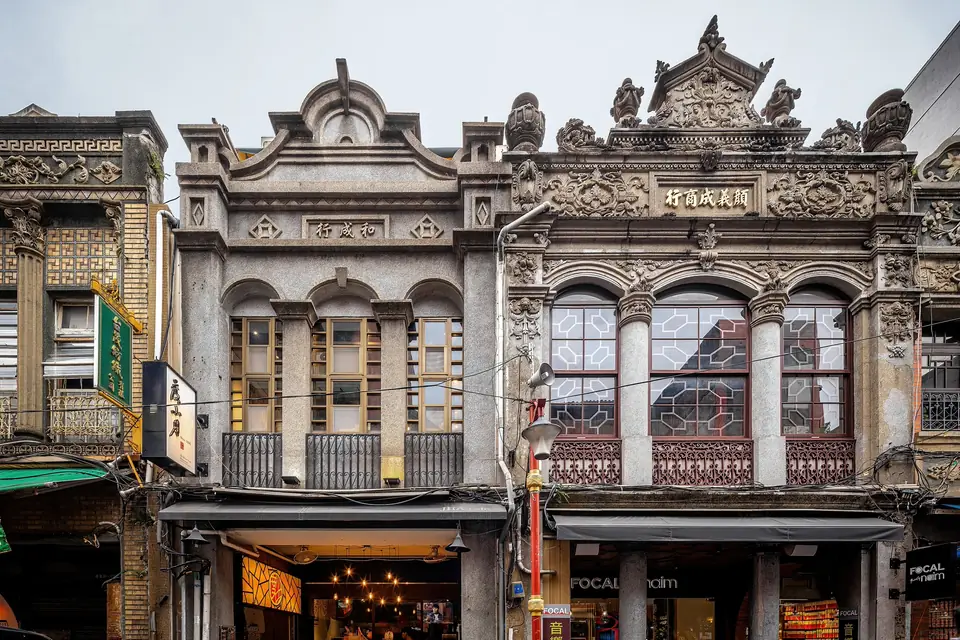
In the central stretch, façades of the Japanese era dominate, with raised pediments, flower reliefs and ball finials. In 1922 the colonial administration renamed the district Eirakuchō (Yongle) and the street Eirakuchō-dōri, and between the late 1920s and the Second World War it lived its heyday: new façades went up en masse, most of them modernist and some in Western historicist or pseudo-Baroque style, with floral reliefs and family crests. The architecture of Dihua Street is, to a large extent, that of merchants who wanted to show off.
This same narrow street filled with the procession for the city god’s birthday, on the 13th day of the fifth lunar month, already held in 1879, at the height of the tea export boom. The Japanese authorities banned it in their first years and allowed it again only in 1898, after an epidemic. According to tradition, it came to be the largest festival in northern Taiwan: the railway department estimated between 300,000 and 400,000 visitors from outside, singing courtesans performed aboard the floats and even the governor-general came out to watch the parade. Hence the saying “on the thirteenth of the fifth month, people watch people”. Why a historian of the time saw in so much festivity a calculated manoeuvre is part of what the narration tells.
Six hundred gods in a temple that cannot grow
Taipei Xia-Hai City God Temple
Summary of this stop
At number 61, wedged between shophouses, appears the Xia-Hai City God Temple: more than 600 images in 152 square metres, the highest density of statues in Taiwan. It was declared a historic monument by the Ministry of the Interior in 1985. Its origin links with that of the street: the god’s image, taken out of Bangka in 1853, waited in a pastry shop in Dadaocheng until the neighbours paid for the temple on a plot of only 46 ping donated by the naval deputy commander Su Feiran. Sources give 1856 or 1859 as the founding date: the first marks the start of the collection and the work; the second, the inauguration. In its west wing the 38 countrymen who died in the brawl are venerated.
Devotion has withstood even authority: on 28 June 1969, Mayor Kao Yu-shu forbade municipal employees from attending the god’s festival under threat of penalty, and that day almost all the officials went to the great banquet anyway.
The temple has been restored, but never enlarged in a century and a half. The explanation that circulates is feng shui: it would sit on a “broody hen’s nest”, and disturbing the ground would break the nest and the district’s peace. What fortune the neighbours attribute to that location is revealed at the temple door.
Watson’s, Yongle Market and the street that was not widened
Yongle Market
Summary of this stop
In front of Yongle Market, the roadway can be measured by eye: 7.8 metres, less than half of the 20 that the Taipei government approved on 18 October 1977 for section 1, at the cost of demolishing all its old buildings. In July 1988, with the demolition deadline about to expire, the Leshan Cultural and Educational Foundation launched, with neighbours and experts, the campaign “I love Dihua Street”. In 1995 a special district plan was approved that preserved the width and 77 historic buildings, with transfer of building rights to compensate the owners. Conservation was not unanimous: a good part of the owners defended the widening because of the risk of the old buildings collapsing, and some protested strongly after the plan.
On the corner stands the A.S. Watson & Co. building, taller than its neighbours and with the name still moulded on the façade. The Taipei Times dates its construction to 1919, though other sources give other years; it was built by the Lee family, the first in Taiwan with the right to open a Western pharmacy of the Watson’s brand. Its original shop now sells traditional Chinese medicine, and after a fire in 1998 and its restoration, the building opened in 2011 as ArtYard, with shops, a café and a theatre.
Opposite lies Yongle Market, founded in 1908 by the Japanese administration for Japanese printed fabrics and turned after the war into Taiwan’s largest textile market. How a street of wholesalers opens to everyone every New Year, and what irony the old pharmacy holds, closes the tour.