Night market
Raohe Night Market Audio Guide
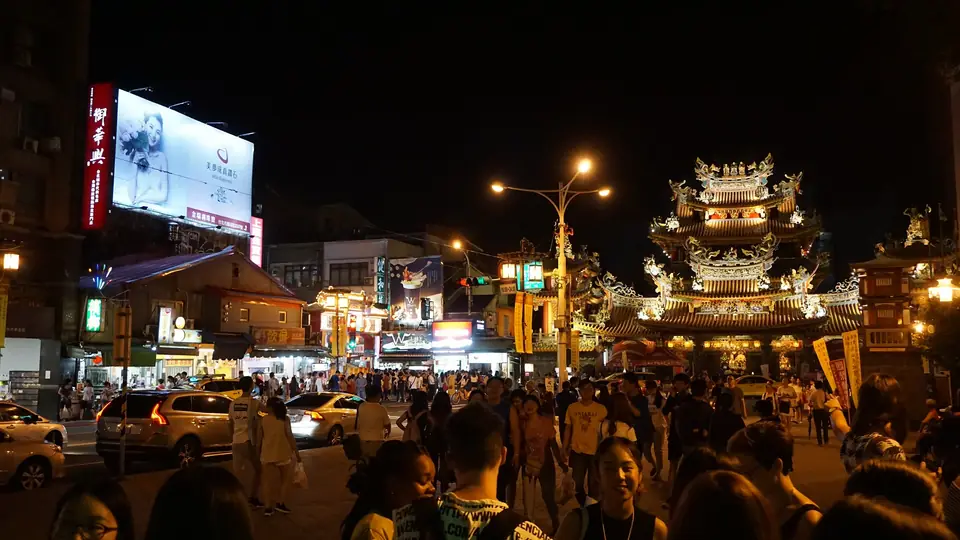
About 600 metres of stalls, charcoal smoke and oyster broth that begin at the feet of an 18th-century Mazu temple: Raohe Night Market is how an old river port of Taipei found a way to fill with people again.
- 75 min of audio
- Street food and Mazu temple
In 1987 the Taipei government gathered on Raohe Street the licensed street vendors who occupied the underside of the Nan-Songshan Bridge and planned it as a tourist market. The street, about 600 metres between Fuyuan and Bade Road, occupies the heart of Xikou, the old Keelung River port, and begins opposite Ciyou Temple, dedicated to Mazu and built between 1753 and 1757.
On opening day, 11 May 1987, many elderly people wept to see the street full of people for the first time in over a decade. A widening for cars had left it almost dead since 1975, and the neighbours raised altars along the street begging for the market to change its fortunes.
Highlights
- Ciyou Temple — a Mazu temple of 1753-1757 whose plaque keeps the old name of Xikou
- Drum ovens — pork and pepper buns baked over charcoal, Bib Gourmand in 2019
- Thin noodles with oysters — a stall from 1937, recommended by the first MICHELIN Guide Taipei
- Childbirth goddess altar — thirteen attendants, the last a midwife of Xikou
- Rainbow Bridge — the bend in the Keelung River where the port of Xikou stood
Beside Songshan station, every afternoon at 17:00 Raohe Street closes to cars and fills with stalls until midnight. It has been so since 1987, when the Taipei government imposed for the first time in the city a traffic-closure schedule for a night market and gave a 15-day deadline to the illegal vendors of the Songshan bridge who refused to move. Which tourist market in Taipei was the first is still disputed: sources agree in placing Raohe second, but not on which one preceded it.
The history of Raohe Night Market begins long before the stalls. This area was called Xikou and, thanks to the depth of the Keelung River, was the transhipment point for goods from Keelung and Yilan to Taipei, renowned as a “little Suzhou”. Then came the silting of the wharf, the railway of 1891, the fire of 1896, the renaming of 1920 and a decade of empty street. In 1938, in the middle of the Sino-Japanese War, Chinese bombs aimed at the Songshan area fell on homes at the corner with Nanjing East Road; the date, the planes and the number of dead remain the subject of conflicting accounts.
What to see at Raohe Night Market goes beyond the food: an 18th-century Mazu temple with stone lions from 1803 before its door, a mechanical clock with figures of the goddess between the station and the temple, and a red bridge over the meander that gave the district its name. In 2007 the image of the Songshan Mazu even flew over the city by helicopter during its procession, an absolute first in Taiwan. The audio guide, documented and checked against historical sources, covers the market in four stops, from the charcoal ovens at the entrance to the bend of the Keelung River.
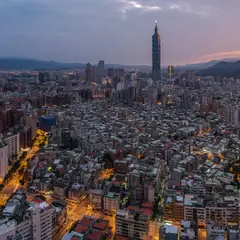
The tower of Taipei 101 is about 2.4 kilometres to the southwest, and the other great shopping street born beside a river port, Dihua Street, is in Dadaocheng, on the banks of the Tamsui. For China’s history on a grand scale, the National Palace Museum, in Shilin, holds the treasures of the Forbidden City.
Charcoal buns at Mazu’s feet
Raohe market illuminated gateway
Summary of this stop
The market’s east entrance is marked by an illuminated gateway, beside Songshan station and Ciyou Temple; a similar one closes the end of Fuyuan Street. This spot is not a recent set: before there was a large market, the forecourt in front of the temple already served as a provisional gathering of street vendors, until in 1909 the Songshan market opened, almost eight decades before the official night market.
Beside the gateway forms the most constant queue on the street. The Fuzhou Shizu stall bakes its pork and pepper buns stuck to the walls of drum-shaped brick ovens, fed with charcoal, and appeared in the 2019 Bib Gourmand selection, the year in which Raohe counted four stalls with that distinction. Its owner, Wu Yucheng, began at 16 or 17 as an apprentice to an old master who came from Fuzhou and has spent more than thirty-five years sticking each bun by hand to walls of between two and three hundred degrees.
During the twenty minutes of baking he decides by eye whether to stoke, lower or put out the charcoal. They considered a modern oven, but according to him the flavour “is not the same”. Why he is not bothered by those who stand watching in order to copy him is one of the lines the narration keeps for this spot.
The plaque that still says Xikou
Songshan Ciyou Temple
Summary of this stop
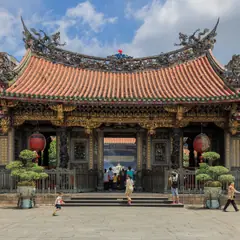
On Bade Road rises the façade of Ciyou Temple, with roofs loaded with ceramic figures and dragons and a six-storey rear tower that peeks out over the stalls. It was built between 1753 and 1757, after more than ten years of collections driven by an itinerant monk, Lin Shouyi according to the temple’s chronicle, who arrived with an image of Mazu from Meizhou. Many sources give it as founded in 1753, but that year marks the start of the works; it was finished in 1757 as the Mazu temple of Xikou, the religious centre of the district’s thirteen villages. The present main hall is a reconstruction after the fire of 1981.
The plaque above the main door still reads “Xikou Ciyou Gong”, with the district’s old name. In 2010, a delegation from the Xianxia Temple of Xianyou, in Fujian, founded with an image from Xikou, recognised in those two characters those of its own old tablet: they had found their mother temple across the strait. In 2011 they took away Ciyou’s “eighth founding Mazu”.
Inside, devotion has a domestic side. In the side wing, the goddess of childbirth is surrounded by thirteen attendants instead of the usual twelve; the thirteenth is Du Yuniang, a midwife of Xikou who assisted births without charge. Since 2003, the stair landings have shown tiles with Snoopy, koalas and elephants. And every seventh day of the lunar new year the temple offers Mazu a banquet of sweets for the gods, a custom that, according to the temple, was born from a dream; what the goddess complained about in that dream is told in front of the altar.
The street that wept as it filled up again
Rows of stalls and arcades
Summary of this stop
In the centre of Raohe Street, the stalls line up in rows and the shops occupy the arcades on both sides. It is hard to imagine this stream of people empty, but it was: in 1975 a widening project made many businesses leave never to return, traffic reduced pedestrian passage, even the temple vendors left and the street spent a decade almost without activity, eclipsed by the widened Bade Road.
That is why the inauguration of 11 May 1987 had something of a resurrection. Many elderly people wept to see the street full for the first time in over ten years, and the neighbours raised altars begging for the market to change its fortunes. Among the stalls survives one older than the market itself: the thin-noodles-with-oysters stall that the father of the current owner opened in 1937, recommended by the first MICHELIN Guide Taipei, which still prepares its pork-bone broth without starch, clear and light.
Every spring the street makes way for another crowd. The procession for Mazu’s birthday leaves Ciyou Temple, goes round the thirteen old villages of Xikou with the image on a palanquin, floats and dancers, and crosses the market itself; together with that of Guandu, it is the largest in Taipei. Why this district still celebrates it with such force, even when the government wanted to unify the date across the whole city, is explained in the middle of the stalls.
The river bend that gave Xikou its name
Rainbow Bridge
Summary of this stop
About 200 metres northwest of the market, Rainbow Bridge crosses the Keelung River with its red arch. From here can be seen the meander that explains everything: at this bend, thanks to the depth of the river, goods from Keelung and Yilan docked on their way to Taipei, until the silting of the wharf and the railway of 1891 ended the port.
The name also comes from the water. According to the most widespread etymology, though not the only one, Xikou comes from the Basay settlement Malysyakkaw, “bend of the river”. In 1920, in the Japanese administrative reform, Mizukoshi Kōichi replaced it with Matsuyama, Songshan, “pine mountain”, citing the rare pine groves of the nearby hills; after the Second World War, Xikou Street came to be called Raohe Street.
Earlier, in 1896, a year after Taiwan passed to Japan, the local Chan Chen raised 600 men against the colonisers in Xikou. He died in the revolt, and the Japanese burned as punishment almost two thirds of the district’s traditional buildings. How that fire fits into the history of a port that never stopped looking for people closes the tour by the river.