Historic temple
Longshan Temple Audio Guide (Lungshan Temple of Manka)
Founded in 1738 by the immigrants who created Monga, Taipei's Guanyin temple was a barracks in clan wars, the seal on the district's petitions to power and a survivor of an earthquake and the bombs of 1945. Today it is still full of worshippers and prays almost smoke-free.
- 45 min of audio
- Guanyin temple from 1738
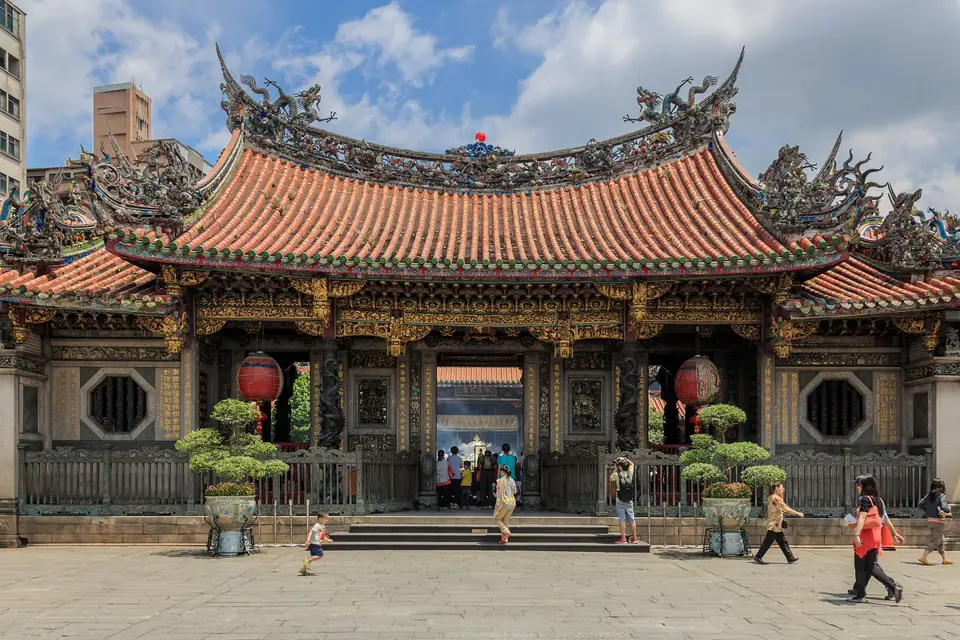
Work on Longshan Temple began in 1738, driven by Huang Dianmo, who donated the land, and by the immigrants from the three counties of Quanzhou, who built it as a branch of the Longshan of Anhai, in Fujian. Razed by the 1815 earthquake except for the Buddha's pedestal, it owes its present look to the great work of the master Wang Yi-shun, finished in 1924, and to the rebuilding of the central hall completed in 1959, after the bombing of 1945.
The largest work in its history was paid for in large part by a bankrupt pastry maker nicknamed the beggar monk: Abbot Fuzhi donated the 7,200 yuan saved over his whole life and died in 1922 without seeing it finished. And the temple that survived the fire decided, from 2020, neither to hand out nor to accept incense.
Highlights
- Bronze dragon columns — the only cast-bronze ones in all of Taiwan
- Guanyin of the central hall — the only image to survive the 1945 bombing
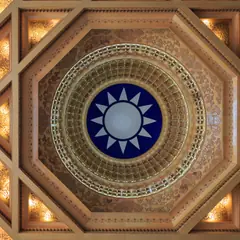
- Spiral dome — the wheel of reincarnation over 32 sets of brackets
- Bell and drum towers — a helmet-shaped roof and a bell from 1865
- Guanyin incense burner — a single incense stick since 2020
Monga, Taipei’s founding district, grew up around this temple. On the 18th day of the fifth lunar month of 1738, work began on a Guanyin shrine that immigrants from Jinjiang, Hui’an and Nan’an, the three counties of Quanzhou, built as a branch of the Longshan of Anhai, in Fujian, and which opened in 1740. Since then it has been many things at once: the seat of a trade guild with its own militia, a barracks in the clan battle of 1853, the seal on the district’s petitions to an imperial commissioner and a temple rebuilt again and again: after the 1815 earthquake and the 1867 typhoon it began to be repaired roughly every 60 years, and in 1945 the bombs hit it.
The history of Longshan Temple is spread across its walls: in the bronze columns at the entrance, in the helmet-roofed towers, in the spiral dome of the central hall and in the rear hall dedicated to Mazu. What to see at Longshan Temple and why each piece matters is what the audio guide, documented and checked against historical sources, arranges in five stops that run from the entrance gate to the façade of the rear hall, among worshippers who still come to pray every day.
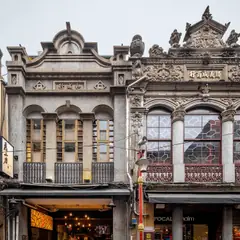
The clan brawl of 1853 pushed the defeated Tong’an people towards Dadaocheng, where they built the shophouses of Dihua Street. A kilometre and a half away, the 228 Peace Memorial Park preserves stone relics of another great Qing-era temple, dedicated to Mazu.
The mirror pond that is now a park
Lungshan Temple
Summary of this stop
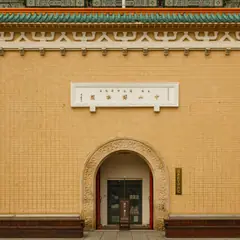
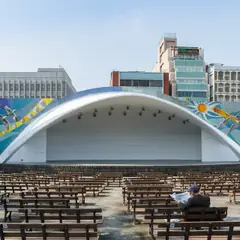
In front of the entrance gate, a four-column, three-bay arch with a double roof from the 1960s, the site reads as a geomancer read it. In 1738 Zhang Chayuan chose this plot and called it the lair of beauty; in front of the temple a pond was dug that served as the Buddha’s mirror. In 1919, when today’s Guangzhou Street was opened, the pond became a fountain, and its site is now Bangka Park.
That Monga was a rich port. The Dingjiao trade guild of the three counties had its seat inside the temple and charged a 5% tax on the value of the cargo to ships trading with the mainland. With that money it paid for roads, free ferries, granaries, night watches and the Danbei Yuyingtang orphanage, which took in babies abandoned by the brothels, and it kept its own militia.
According to a documented tradition, before the temple there was a light: around 1726 an incense bag bearing the name of the Guanyin of Longshan Temple, hung in a bamboo grove, is said to have begun to glow at night. The story circulates in several versions, with a bamboo, a tree or a great banyan, and a sailor, an immigrant or a rattan seller. Which of them is told and how that little bag led twelve years later to the first stone is heard right here.
Bronze dragons paid for by a beggar
Bronze dragon columns
Summary of this stop
In front of the central entrance of the front hall rise the two bronze dragon columns, the only cast-bronze ones in all of Taiwan. They were modelled in the 1920s by the Xiamen master Hong Kunfu and cast by Li Luxing of the Taipei Foundry: coiled dragons, figures from the novel Investiture of the Gods, a base of waves and carp and capitals in Greco-Roman style.
Behind them, the front hall is the work of Wang Yi-shun, with walls of green and white stone and an eave packed with carvings. Beneath it can be seen the network brackets, a weave of timber pieces fitted at 45 degrees that was the first of its kind in a Taiwanese temple. At the sides, visitors enter through the Dragon door and leave through the Tiger door.
This work, the largest in the temple’s history, began when in 1919 termites were eating the beams. Abbot Fuzhi, a bankrupt pastry maker nicknamed the beggar monk, donated the 7,200 yuan he had saved over his whole life; the notables put Koo Hsien-jung in charge and hired Wang Yi-shun, a master from Quanzhou. The work finished in March 1924, and Fuzhi had died in January 1922 without seeing it completed. How such a man came to move the whole district is told by the narration in front of the columns.
A clan barracks beneath the bell
Bell and drum towers
Summary of this stop
In the inner courtyard stand the bell and drum towers, hexagonal and with three eaves. Since the work of the 1920s they have been covered by a palanquin- or helmet-shaped roof that many Taiwanese temples later copied. In the bell tower hangs a bell cast in 1865, older than the tower that shelters it.
These towers face a violent past. In 1853, in the Ding-Xia clan battle, the three counties used the temple as a barracks to attack the Tong’an immigrants settled in Bajiazhuang, at the end of today’s Guiyang Street. The defeated withdrew north, to Dadaocheng, taking with them the image of their city god. The victors buried the bloodstained clothes of their dead at the foot of the Chinese myrtle shrubs that surrounded the temple.
That debt is still being paid. The great rite for the dead of the seventh lunar month, inscribed by Taipei as intangible heritage, was born after that battle: on the 13th the worship is held at the foot of the myrtles and on the 14th a paper house is burned with the tablets of the dead of the clan wars. Which vanished shrine is reborn in that paper house every summer is left for this stop.
The Guanyin the fire did not burn
Guanyin central hall
Summary of this stop
On a high stone base, with a front terrace for praying and a gallery of 22 columns, rises the central Guanyin hall. In 1945 an American bombing set it on fire along with one wing of the complex; according to the temple, it happened on 8 June and the attackers mistook the hall for a Government-General office, although other sources give another date and another motive. All the images burned except the main Guanyin, which was blackened by smoke and is still on the altar. Wang Shinan, of Wang Yi-shun’s family, rebuilt the hall to its original plan and finished it in 1959.
Above, the spiral dome symbolises the wheel of reincarnation. In Wang Yi-shun’s design it turned anticlockwise over 16 sets of brackets; when rebuilt it went to 32 sets and now turns clockwise.
The most visible change is recent. In 2015 a measurement by the team of the cardiologist Su Ta-chen found inside the temple 50 times Taipei’s outdoor average of PM2.5 particles. After consulting Guanyin with divination blocks, the temple gradually removed incense burners and, since 13 March 2020, neither hands out nor accepts incense: in the great burner a single stick burns, before more than 8,000 visitors a day on average. How the goddess was asked for permission to change a centuries-old rite is the revelation of this stop.
A seal that diverted the railway
Mazu rear hall
Summary of this stop
The rear hall, with a double eave, is dedicated to Mazu, with Taoist and Confucian gods at the sides. On its façade, a pair of stone columns from Guanyinshan show carved landscapes and travellers. This is the place to understand the temple as the political voice of Monga.
In 1884, during the Sino-French War, the imperial commissioner Liu Mingchuan planned to withdraw troops to the south. According to the temple’s website, the council and the notables met here, took him a petition sealed with the temple’s seal and closed the district’s gates to the south; other sources record a more violent version of the episode. In 1886 the Guangxu Emperor granted the temple the plaque Cihui Yuanyin. Around 1887 the same seal served for the opposite: the notable Huang Chuanliu stamped it on his own on a petition against the railway bridge, which was to come out in front of his house. Liu diverted the route north, beside Dadaocheng, and the big ships and merchants ended up abandoning Monga.
The farewell comes with a documented tradition: that of a pregnant woman murdered in 1854 beside the temple’s pond, to whom the district put a statue in the rear hall and made the protector of childbirth. What she saw that night and why her death saved Monga is told by the narration at the end of the tour.