Skyscraper
Taipei 101 Audio Guide
Eight eight-storey blocks stacked like bamboo joints, a 660-tonne steel ball hung in plain view and a terrace at almost 390 metres: the skyscraper that was the tallest in the world dodged planes, typhoons and even the number four.
- 90 min of audio
- Record skyscraper 2004-2009
The Taipei International Financial Center project began as a 59-storey tower; the architect Wang Chung-ping took it to 66 and, on 25 May 1998, the environmental impact assessment approved the 101 storeys and 508 metres. C. Y. Lee's studio made the number 8, a homophone of “to prosper” in Chinese, the module of the whole tower, which exceeded the Petronas Towers by 57.3 metres and was the first building to pass half a kilometre.
In 1999 it was agreed to cut it to 391.8 metres because it encroached on the Songshan airport routes, and in the end it was the planes that changed direction. At the foot of that silhouette of luck, seven glass steles remember the five dead left in 2002 by the fall of two cranes from the 56th floor.
Highlights
- Eight blocks of eight storeys — the prosperity number 8 as the tower's module
- Workers' steles — seven tangram-inspired glass panels beside Xinyi Road
- Toshiba elevators — from the 5th to the 89th floor in 37 seconds
- Tuned mass damper — a 5.5 m, 660-tonne steel sphere in public view
- 91st-floor terrace — an open-air viewpoint at about 390 metres
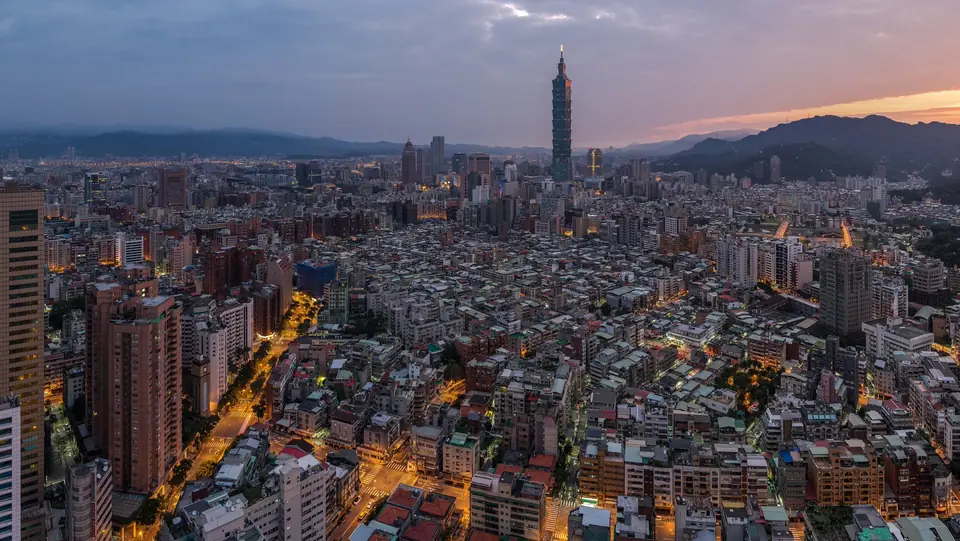
Above Xinyi Road, in Taipei, rises a 508-metre tower that reads like an encoded message: eight blocks of eight storeys, Chinese coins at the base and ruyi ornaments, the talisman associated with clouds, at least 8 metres each on the façade. Taipei 101 was the tallest building in the world from its inauguration, on 31 December 2004, until the Burj Khalifa surpassed it in 2009-2010. Even the curved roof of the adjoining shopping mall culminates in a colossal ruyi that shades pedestrians.
The history of Taipei 101 is made of tussles: with Songshan airport, which almost cut its height; with the earthquake that in 2002 brought down the site cranes; with the typhoons, which a steel ball counters in plain view. In the first second of 2005, hours after the inauguration, the tower launched 35 seconds of fireworks, the first pyrotechnic show fired from a skyscraper, and the show repeats every New Year’s Eve. At dusk, the façade lights up in a different colour each day of the week and, on special dates, shows messages: in August 2022 it welcomed Nancy Pelosi, and Beijing responded with military manoeuvres around the island.
The audio guide, documented and checked against historical sources, covers in four stops what to see at Taipei 101 and the architecture that explains it: from the luck symbols at the base to the workers’ memorial, the damper on the 89th floor and the outdoor terrace on the 91st.
About 2.4 kilometres to the northeast, the Raohe Night Market offers the street-level counterpoint to end the afternoon, and the great monument of the Taipei of the 20th century, the Chiang Kai-shek Memorial Hall, is about four and a half kilometres to the west.
Eight lucky boxes and a floor that does not exist
Taipei 101
Summary of this stop
In front of the Xinyi Road entrance, the tower is told through the eyes: eight stacked segments that open upwards, like the joints of a bamboo stalk or piled money boxes. C. Y. Lee took 8, a homophone of “to prosper” in Chinese, as the module of the whole building. Where the podium joins the tower, four large discs, one on each face, represent Chinese coins with square holes, and above the entrances three gold coins of ancient design form with their holes the figures 1-0-1.
The number has its own history. The project envisaged a 59-storey tower, which Wang Chung-ping later took to 66 storeys and 273 metres; in 1998 the jump to 101 storeys was approved, 89 of main body and 12 of spire. The name TAIPEI 101 arrived on 18 July 2002, months after the crane accident, replacing Taipei International Financial Center, and alludes to the height in storeys and to “going beyond full marks”: 100 + 1.
According to a documented local custom, the tower built around the number of prosperity dodges another: 4, which in Chinese culture is held to be an unlucky number. How the lobby directory manages not to name it, with a floor that changes number and another that gets a letter, is revealed right there.
Seven coloured glass panels for five lives
Workers' glass steles
Summary of this stop
Beside Xinyi Road, seven tangram-inspired steles of coloured glass hold the names of everyone who worked on the tower’s construction. They were designed by C. Y. Lee’s studio in memory of the five workers killed in 2002: they were begun on 28 April 2004, International Workers’ Memorial Day, and installed in the summer of 2005.
On 31 March 2002, at 14:52, a magnitude 6.8 earthquake with its epicentre off Hualien brought down the two tower cranes working on the 56th floor. They fell on cars, motorbikes and part of the shopping mall roof, and killed five people, among them the two crane operators.
That memory hurt again on 25 January 2026, when Alex Honnold climbed the façade without ropes in 1 hour 31 minutes, live on Netflix; Alain Robert had already climbed it with ropes on 25 December 2004, in about four hours, in rain and wind. Honnold’s climb was celebrated as a milestone, but the Association of Victims of Occupational Accidents criticised it by recalling the workers of 2002 and the stele on Xinyi Road; the Taipei government replied that the event followed procedures and that the rope technicians’ equipment was inspected. How the record and the mourning coexist on this same stretch of pavement is heard in front of the glass.
A 660-tonne sphere that dances with the typhoon
Taipei 101 tuned mass damper
Summary of this stop
The ascent is already part of the visit: the observatory’s two elevators, made by Toshiba, go from the 5th to the 89th floor in 37 seconds, at 1,010 metres per minute, about 60.6 km/h. They were the fastest in the world from 2004 until the Shanghai Tower took the record from them in 2016. Up top, the indoor observatory, at 382 metres, opens 360-degree views over the Taipei basin.
In the central shaft, between the 87th/88th and 92nd floors, hangs the tuned mass damper: a sphere 5.5 metres in diameter made of 41 welded circular steel plates, weighing 660 tonnes, which cost 132 million Taiwan dollars. It swings to counter the building’s movement in the wind, and on 8 August 2015 Typhoon Soudelor made it sway 1 metre, the largest displacement recorded. At the tip of the spire, two more dampers of 6 tonnes each work against the wind.
What in almost any other skyscraper would be a hidden machine here has a mascot: the Damper Babies, the ball turned into a round character with arms and legs, in five coloured versions that are among the best-selling souvenirs in the tower’s shops. What theme each of those five babies carries, and how a piece of engineering came to have its own comic and website, is told in front of the sphere.
Almost 390 metres that the planes wanted to cut
91st-floor outdoor terrace
Summary of this stop
The outdoor terrace on the 91st floor, at about 390 metres, lets the wind of the height be felt. That height almost did not exist: in 1999 the Civil Aeronautics Administration warned that the tower interfered with Songshan airport flights, and on 9 August of that year it was agreed to cut it to 391.8 metres. In the end it was Songshan that changed the direction of arrivals and departures so the routes would not pass over the building, which reached 508 metres.
With them it exceeded the Petronas Towers by 57.3 metres and became the first building to pass half a kilometre, a title of tallest building in the world that it held until the arrival of the Burj Khalifa, in 2009-2010.
From this very railing, on the afternoon of 11 December 2007, the Austrian parachutist Felix Baumgartner jumped without permission, with the parachute hidden by his team in the false ceiling of a viewpoint bathroom, and two hours later he was flying to Hong Kong. Taiwan banned him from re-entering the country. His video ended with a taxi escape to the airport; what the taxi driver said afterwards about that scene closes the tour.