Chinese imperial collection
National Palace Museum Audio Guide
A green-tiled palace set against a hillside that could be tunnelled: inside wait the treasures of the Forbidden City that crossed the Taiwan Strait in crates, among them a jade cabbage under twenty centimetres long.
- 120 min of audio
- Treasures of the Forbidden City
The Palace Museum was born in 1925 inside Beijing's Forbidden City, with the property of the imperial family after Puyi's expulsion. Eight years later, with the Japanese advance, its crates set off on a flight that passed through Shanghai, Nanjing, Guizhou and Sichuan and ended on ships bound for Keelung in 1948 and 1949. In Taipei, Huang Baoyu's palace-style building opened on 12 November 1965, the centenary of Sun Yat-sen's birth.
The façade looks like a palace's, but the site was chosen as a refuge: Waishuangxi was the closest point to Taipei where an emergency tunnel could be dug, and behind the building the reinforced-concrete tunnel store of 1974 is still there. Of the collection's 699,119 pieces, only about 1% is on display at any one time.
Highlights
- Jadeite Cabbage — 18.7 cm of white and green jadeite with a locust and a katydid hidden among the leaves
- Mao Gong Ding tripod — 500 characters inscribed inside its belly, the longest known inscription on a Chinese bronze
- Meat-shaped Stone — banded jasper carved like a piece of pork belly, with skin, fat and lean
- “天下為公” paifang arch — Sun Yat-sen's motto at the foot of the avenue of huabiao columns
- Sanxitang tea house — a replica of Emperor Qianlong's study in the Forbidden City
At the foot of the Shilin hills, north of Taipei, a palace of green glazed tiles and yellow ridges holds a collection that was not born here. Between 6 February and 15 May 1933, with the Japanese advance, 13,491 crates of the Palace Museum left Beijing for Shanghai in five convoys. The curator Chuang Yan directed that first transfer and accompanied the collection on its later moves, to Nanjing, Guizhou, Sichuan and, finally, Taiwan. Meanwhile, in Beijing, the director Ma Heng was ordered to fly the select pieces still there to Nanjing, and kept making excuses until not a single crate left.
The history of the National Palace Museum continues in storehouses at the foot of the Beigou hills, in Taichung, where the collection lived from 1950 to 1965 beside a cave 100 metres deep dug for emergencies and used during the Second Taiwan Strait Crisis of 1958. Who owns these pieces today is a matter of political debate: the People’s Republic of China maintains that they left illegally during the civil war, the museum declares itself their legal custodian and lends only to countries whose laws prevent judicial seizure. What to see at the National Palace Museum, and why each object is where it is, is what the audio guide, documented and checked against historical sources, covers in five stops: from the entrance arch to the tea house on the fourth floor.
The great monument of that same Republic of China, installed in Taiwan, is the Chiang Kai-shek Memorial Hall, opened in 1980 in the centre of the city. And to end the day in another Taipei, that of stalls and charcoal smoke, there is the Raohe Night Market.
A republican motto at the gate of the empire
“天下為公” paifang arch
Summary of this stop
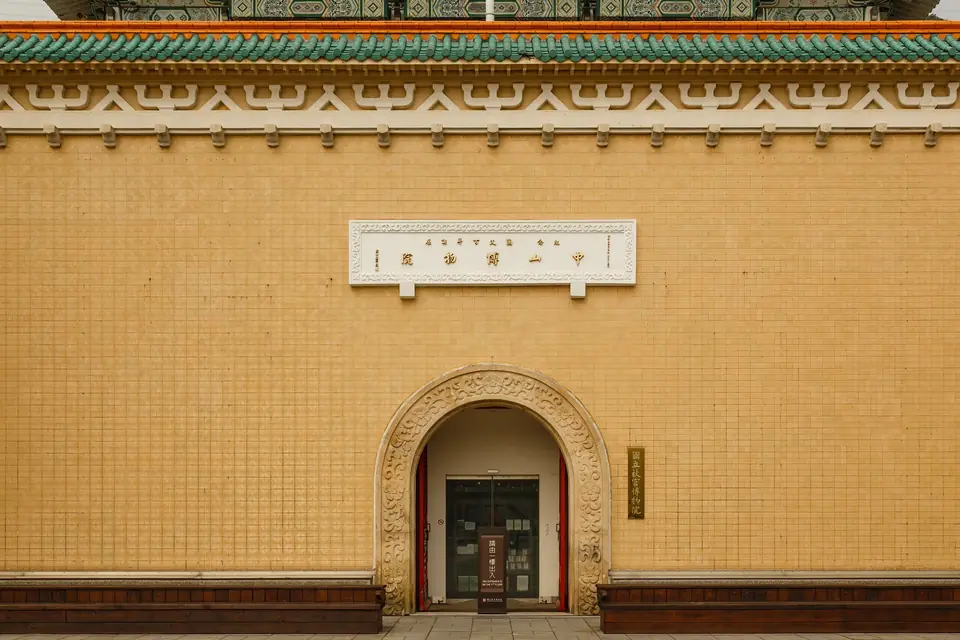
The complex opens with a paifang arch bearing Sun Yat-sen’s motto, “天下為公”, “the world belongs to all”, at the start of an avenue of huabiao columns that climbs towards the building. It is a republican entrance for an imperial collection: the Palace Museum was founded on 10 October 1925 inside Beijing’s Forbidden City, shortly after the expulsion of Puyi, the last emperor, with the property of the former imperial family. In Taipei it opened on 12 November 1965, the centenary of Sun Yat-sen’s birth, under the name Zhongshan Museum; Chiang Kai-shek wrote the calligraphy for the “中山博物院” sign at the entrance and a bronze statue of Sun Yat-sen was placed in the lobby.
The museum’s architecture also has its alternative history. The closed competition of 1961 was won by Wang Da-hong with a modernist design in the manner of Mies van der Rohe, with a roof of inverted umbrellas. Vice President Chen Cheng was not satisfied and the commission passed to Huang Baoyu, who built the present palace-style building, symmetrical in plan, finished in August 1965. Its merit is still disputed: in 2020 Taipei registered it as a historic building, but not as a historic site, amid criticism of a design that repeated the traditional vocabulary and defences from employees and neighbours who asked for the higher rank.
What that modernist glass box would have been like, and what it says about its time that the palace was chosen, is what the narration raises beneath the arch.
Ships loaded with crates and a hill turned bunker
Main building façade
Summary of this stop
From the esplanade the whole façade is visible: cream-coloured tile walls, green roofs and two wings added in 1967 and 1970. But the decisive part is behind, on the wooded slope against which the building leans. For the definitive museum, Waishuangxi was chosen not only for the landscape but because it was the closest point to Taipei where an emergency tunnel could be dug. The pieces arrived from Beigou in October 1965.
That hill is the last stop of a flight by sea. In December 1948 the warship Chung Ting crossed the Taiwan Strait with 772 crates, and Chuang Ling, Chuang Yan’s 10-year-old son, slept on top of one of them; the cargo reached Keelung on 26 December and was stored in a warehouse beside Yangmei station. The third and last shipment, on the ship Kunlun, was meant to carry 2,000 crates, but Navy families boarded first.
Commander Gui Yongqing had to open cabins, deck, mess and sick bay for the crates, and still only 1,248 were loaded, reaching Keelung on 22 February 1949. What was left on the quay that day, and what lies inside the hill today, is told in front of the façade.
A jade cabbage that turned its cracks into leaves
Jadeite Cabbage
Summary of this stop
The museum’s most famous piece fits in a hand. The Jadeite Cabbage, by an unknown sculptor of the Qing period, measures 18.7 by 9.1 centimetres and is 5.07 thick. It was carved from a single piece of jadeite, half white and half green, and its cracks and stains became the veins of the stem and leaves, among which a locust and a katydid hide. Its origin is disputed: one version links it to Consort Jin and her dowry, but no document proving it has been published, and the museum does not class it among its top-ranking pieces but as an important antiquity.
It is usually shown near the Meat-shaped Stone, a banded jasper carved like a piece of Dongpo pork belly, with layers of skin, fat and lean, on a gilded copper stand. The Forbidden City’s 1924 inventory records it as “pork fossil”, and it belonged to Consort Jin, who gave it to Puyi in 1918. The two were exhibited together for the first time in 1928, in the jade room of the Zhaigong in the Forbidden City, although the veteran curator Na Zhiliang did not want to show the stone, which seemed to him “just a stone”.
The pair ended up as a mass attraction, and in Taiwan it earned a popular kitchen nickname that ended up being served for real. Where the “three treasures” everyone comes to see come from is the anecdote the narration reserves for the display case.
Five hundred characters hidden inside a bronze
Mao Gong Ding tripod
Summary of this stop
The Mao Gong Ding tripod is a ritual bronze cauldron from the late Western Zhou, sober on the outside. Its value is inside the belly: a 500-character inscription, the longest known on a Chinese bronze, which can only be seen by leaning over the rim.
Before arriving here it spent the war hidden in Shanghai, in an episode passed down as documented tradition. Its owner, Ye Gongchuo, entrusted it in 1937 to his nephew Ye Gongchao with the order not to sell it, not to pawn it and not to let it leave the country. The Japanese army detained and questioned the nephew, who did not reveal where it was, and to free him the family had a fake tripod made. The genuine one ended up pawned at a bank, and the magnate Chen Yongren redeemed it and donated it to the government in April 1946.
In front of this display case the scale of the museum is also understood: the collection totals 699,119 pieces, of which more than 395,000 are Qing archive documents and more than 216,000 rare books, and the painting and calligraphy rotate every three months. What Chiang Kai-shek noted in his diary about this tripod is one of the details heard right there.
An imperial study turned into a tea house
Sanxitang tea house
Summary of this stop
On the fourth floor of the main building, the Sanxitang tea house, opened in 1984, imitates the study of Emperor Qianlong’s Hall of Mental Cultivation in the Forbidden City. The name refers to the “three rarities” that Qianlong gathered in 1746, headed by the letter Clearing After a Sudden Snowfall, attributed to Wang Xizhi: a sheet of 23 by 14.8 centimetres with 28 characters, preserved in a faithful Tang-period tracing copy.
The emperor adored it to excess: he wrote 71 comments of his own hand on it, drew an enormous “divine” character over it and stamped 108 seals around a few lines. After the fall of the dynasty, Consort Jin secretly sold the other two rarities, but did not dare with this one because it was too well known. That is why the other two are in Beijing today and Wang Xizhi’s letter is here.
The tour closes on the idea that the museum is a selection of a selection. From the Forbidden City, 2,972 crates reached Taiwan, according to the shipping table only 22% of those evacuated in 1933, though chosen from among the best; with the 852 crates of the National Central Museum they add up to the 608,985 objects of the original inventory. The evacuation figures vary between sources, and what that choice means for each piece on display is the reflection with which the audio guide ends.