Monument in debate
Chiang Kai-shek Memorial Hall Audio Guide
White marble, blue tiles and 89 steps, one for each year of the honoree's life: a hall raised under martial law to venerate Chiang Kai-shek, at whose feet the students of 1990 pushed Taiwan towards democracy.
- 60 min of audio
- Taiwan's political memory
Where the Japanese Army had barracks from 1905, and where 50-storey towers were planned in 1971, Chiang Ching-kuo's government decided in July 1975, after his father's death, to build a memorial. The design by Yang Cho-cheng, author of Taipei's Grand Hotel, won the competition in 1976 and the hall opened on 5 April 1980, the fifth anniversary of Chiang's death, in an architectural language reserved in Chinese architecture for palaces and temples.
In March 1990, some 6,000 university students camped on the plaza and mockingly called the building the “Chiang temple”. Since then, signs pulled down by a crane, plaques that come and go, an honour guard that left the hall in 2024 and a statue splashed with red paint have turned the memorial into the place where Taiwan keeps arguing about what to do with its past.
Highlights
- Liberty Square gate — 30 m high and 80 wide, the largest in Taipei
- 89-step staircase — one for each year of Chiang's life, with a ceremonial ramp and the national emblem
- Octagonal blue-tile roof — over a square plan that alludes to his name
- Seated bronze statue — 6.3 m and 21.25 t behind a 16 m door
- Changing of the honour guard — every hour on the hour on Democracy Boulevard
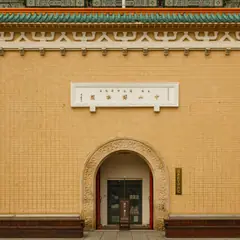
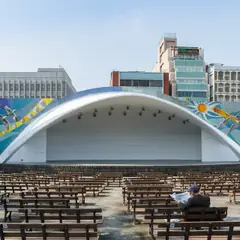
In the centre of Taipei, a white gate with blue tiles opens onto a plaza flanked by two yellow-roofed palaces, the National Theater and the National Concert Hall, and at the far end, above a granite staircase, rises a white hall crowned by a blue octagonal pyramid. This is the Chiang Kai-shek Memorial Hall, 中正紀念堂, built between 1976 and 1980 under martial law to venerate Chiang Kai-shek. The site had an earlier life: a mountain artillery base of the Japanese Army in Taiwan from 1905, the barracks of an infantry regiment in 1944 and, from 1950, the seat of the Army, Combined Logistics and Military Police headquarters.
The history of the Chiang Kai-shek Memorial Hall did not end with its inauguration. Here the students of the Wild Lily movement camped in 1990, here the characters on the gate were taken down in 2007, and here the building changed its name twice in two years. What to see at the Chiang Kai-shek Memorial Hall is, for that reason, also a question about how its honoree is viewed today. The audio guide, documented and checked against historical sources, covers the great axis of the complex in five stops, from the Liberty Square gate to the bronze statue and the ground-floor exhibitions.
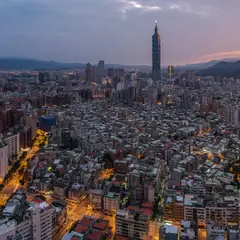
About 800 metres away, the 228 Peace Memorial Park holds the other memory of those decades, that of 1947. The imperial collection that crossed the strait in 1948 and 1949 is displayed in the National Palace Museum, in Shilin, and the Taipei of the 21st century rises to the east in Taipei 101.
Four characters that fell one afternoon in 2007
Liberty Square Main Gate
Summary of this stop
The route begins beneath the gate facing Zhongshan South Road, the largest in Taipei, with “five bays, six pillars and eleven small roofs”, the highest rank in traditional Chinese architecture. Above it, the characters 自由廣場, “Liberty Square”, can be read today from left to right. For almost three decades what hung there was another phrase: 大中至正, “great centrality, perfect uprightness”, taken from Wang Yangming and written in the style of Ouyang Xun, unsigned. Only in 2007 did the calligrapher Yang Jialin reveal that he had traced them with sticks and wire tied with hemp rope dipped in red-earth water.
That same year, Chen Shui-bian’s government renamed the memorial the National Taiwan Democracy Memorial Hall. On 7 December 2007, with the gate surrounded by barbed wire, a crane took six and a half hours to take down the four characters; the last one, 正, fell at 17:26 amid applause and boos. The legality of that change is still disputed: it was done by Ministry of Education regulation, the Pan-Blue bloc considered it illegal and Taipei City Government declared the whole complex a provisional monument.
The new characters were not written by any living calligrapher either: 自由 comes from Wang Xizhi’s Preface to the Orchid Pavilion, 廣 from another of his works and 場, which does not appear in Wang Xizhi, from his descendant, the monk Zhiyong. The originals were never hung again, and their absence is the first thing the narration teaches to see at this point.
Skyscrapers that never came and students who did
Plaza between the National Theater and National Concert Hall
Summary of this stop
In the middle of the plaza, between the two twin palaces, the size of the void can be measured. In 1971 the Council for Economic Planning projected here a “modern business and commerce centre” with towers of 50 and 30 storeys. Chiang’s death in 1975 cancelled the plan, and the business centre moved east, to the future Xinyi district.
From 16 to 22 March 1990, some 6,000 university students sat on this plaza to demand the dissolution of the National Assembly, the abolition of the Temporary Provisions, a National Affairs Conference and a timetable of reforms. It all began with about ten students from National Taiwan University and a white cloth against the “seven hundred emperors”, the lifetime representatives not renewed since 1948. President Lee Teng-hui accepted the conference, and in 1996 Taiwan elected its president by direct vote for the first time. During the sit-in a statue of a wild lily was raised here that gave the movement its name; what happened to it when the students left is one of the dark episodes of this point.
Today, every hour on the hour from 9:00 to 17:00, the honour guard performs its ceremony on Democracy Boulevard, in front of the staircase, except when it rains. Until 14 July 2024 the changings took place inside the hall, before the statue, and lasted 44 years; the last click of the heels, at 17:03 that day, also has its story in the audio guide.
A temple for one man, encoded in stone
Staircase and ceremonial ramp
Summary of this stop
At the foot of the staircase, the architecture of the Chiang Kai-shek Memorial Hall reads like a message. The climb totals 89 steps, one for each year of Chiang’s life: 84 of granite outside and 5 more in the lobby. Down the centre runs a ceremonial ramp with the national emblem, a device that Chinese architecture reserved for palaces and temples. The blue and white reproduce the “blue sky, white sun” of the emblem, the square plan alludes to Zhongzheng, Chiang’s formal name, meaning “centred and upright”, and the façade faces west, towards mainland China.
The octagonal roof has two explanations. According to one, the roof was going to be square, but a wind-tunnel test showed that the wind would tear the tiles off the edges; the official symbolic reading, by contrast, links it to the Temple of Heaven in Beijing and the eight virtues. Both versions coexist.
So much symbolism drew a response. In 1990 the camping students mockingly renamed the building 中正廟 or 蔣廟, the “Zhongzheng temple” or “Chiang temple”, because they saw it as an imperial shrine; the nickname later passed to the movements against the cult of Chiang. Even a Taiwanese pop song ended up singing of this plaza as the forecourt of a great temple, and which song it is is revealed by listening to the narration right here.
A smiling bronze stained with red
Seated statue of Chiang Kai-shek
Summary of this stop
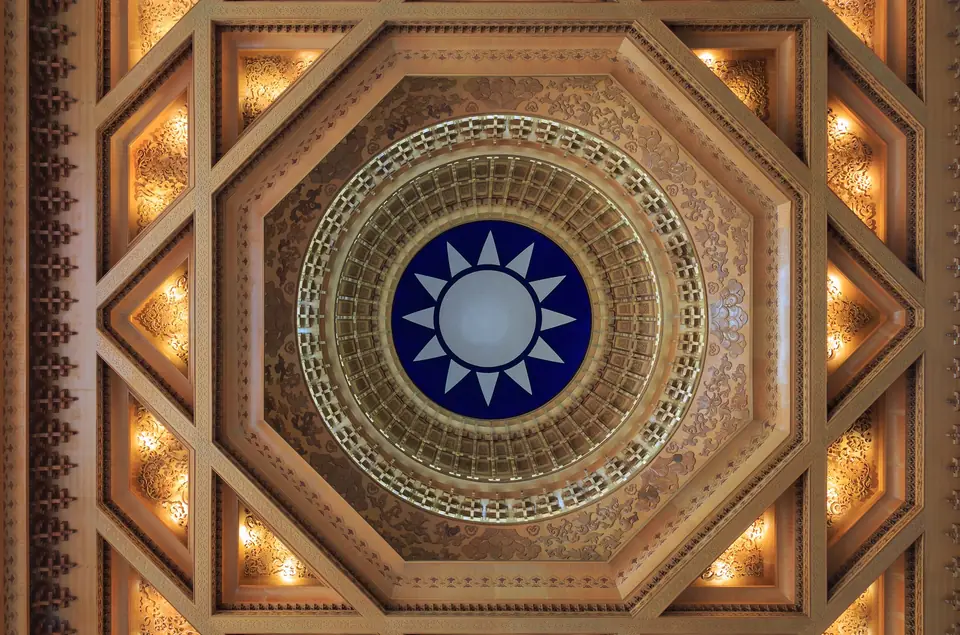
Behind a 16 m bronze door weighing 75 tonnes waits the seated statue of Chiang: 6.3 m and 21.25 tonnes, smiling, in a traditional robe and with his testament engraved on the pedestal (other sources speak of 10 m, probably counting the pedestal). Above it, a coffered ceiling with the twelve-ray sun; at the back, the characters 倫理、民主、科學, “ethics, democracy, science”. In 2008 the statue had cost NT$23 million and the building NT$1.2 billion. Work began on 31 October 1976, the 90th anniversary of Chiang’s birth, and the opening was set for the fifth anniversary of his death: the calendar was also part of the tribute.
The solemnity has cracks. On 20 July 2018, two pro-independence activists threw eggshells filled with red paint at the statue, which according to their group represented the blood of the victims of martial law. The memorial closed and a crew spent the afternoon scrubbing the bronze. It was not the only attack, and in one of them a soldier of the honour guard did something nobody expected of him; the narration tells it in front of the statue.
Two exhibitions that contradict each other
Ground-floor exhibitions
Summary of this stop
On the ground floor, the permanent exhibitions show Chiang’s official car and the recreation of his office, and next to it, “Flowers of Freedom” reviews the democratic struggle in Taiwan since 1945. Two accounts under the same roof.
The building’s name has come and gone. On 20 July 2009, with Ma Ying-jeou’s Kuomintang back in power, some 600 police protected the workers who cut up the “Democracy Hall” plaque and rehung that of 中正紀念堂; the “Liberty Square” of the gate stayed. Since February 2017 the memorial stopped selling Chiang souvenirs and broadcasting the “Chiang Kai-shek Song”, replaced the names of its halls with numbers and closes every 28 February, the anniversary of the 1947 massacre.
The future remains open. In 2021 the Transitional Justice Commission proposed turning the site into a park for reflection on authoritarianism and removing or transforming the statue, while sectors of the Kuomintang oppose it; in April 2026 several groups called for the memorial to be closed. How each piece of this discussion fits together closes the tour.