Sulphur baths
Abanotubani Audio Guide
A district of ground-level brick domes where the hot water that gave Tbilisi its name still wells up. Legendary kings, demanding mothers-in-law, Pushkin and Dumas have all passed through its halls.
- 60 min of audio
- Persian-inspired architecture
Abanotubani is the sulphur-bath district of Tbilisi, spread at the foot of Narikala Fortress. The name of the city itself comes from the old Georgian word “tpili”, warm, after the springs that still feed its public baths today. As early as the 10th century the Arab geographer Ibn Hawqal compared them with those of Tiberias, water that boils without fire. Most of those that survive were built in the 17th and 18th centuries under Iranian architectural influence: square plans, brick domes with skylights and halls sunk into the earth.
What from the square look like simple brick humps are the roofs of underground halls where, in old Tbilisi, neighbours spent whole days between baths, rest and banquets, and where future mothers-in-law inspected the candidates for daughter-in-law. Here Pushkin slipped in on a Tuesday, the women's day, and here Alexandre Dumas left his massage convinced that Paris urgently needed Persian baths.
Highlights
- Brick domes — skylit roofs of bathhouse halls sunk beneath the square
- Chreli Abano — the Orbeliani bath and its mostly blue tiled façade
- Falcon and pheasant — the bronze of King Vakhtang Gorgasali's founding legend
- Pushkin and Dumas — two writers won over by Tbilisi's bath attendants in 1829 and 1858
- Leghvtakhevi waterfall — a 22-metre drop at the end of the bath street
The first thing to greet whoever walks down into Abanotubani is not a view but a smell: the sulphur rising from the subsoil. That smell explains the whole city. Tbilisi owes its name to the old Georgian word “tpili”, warm, after the many hot springs of the area, the same ones that still fill the tubs of the district’s public baths today. The story of Abanotubani is, to a large extent, the story of how a capital grew around water that comes out of the rock hot.
The sources leave a long trail. In the 10th century Ibn Hawqal, in his “Book of Roads and Kingdoms”, describes baths in Tbilisi like those of Tiberias. By the end of the 13th century, according to some sources (others place it earlier), 65 baths were on record, free of charge for Muslim residents; in the 17th century the spring area was called Seidabad, after the sayyids who lived there. What stands today is mostly 17th- and 18th-century architecture of Iranian inspiration, grouped at the start of the slope up to the Botanical Garden. The audio guide’s documented route takes in the square of domes, the bathhouse doorway, the façade of Chreli Abano and the hidden ravine at the end of the street.
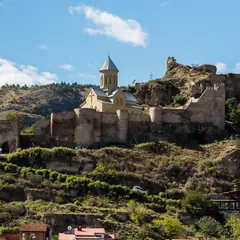
Above the domes rises the wall of Narikala Fortress, and a few minutes’ walk away, beside the same river, stands Sioni Cathedral.
The legend of the falcon, the pheasant and the hot pool
Abanotubani
Summary of this stop
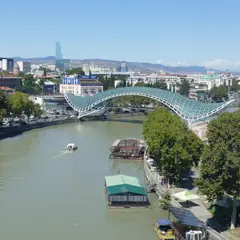
On the square of domes, beside a small pond, a bronze group freezes a hunting scene: a falcon seizing a pheasant. Across the Mtkvari river, on the Metekhi rock, the equestrian statue of King Vakhtang Gorgasali seems to be releasing the bird at that very instant. Between the two sculptures, one on each bank, the founding tradition of Tbilisi is told.
According to that tradition, in the mid-5th century the king was hunting beside the Mtkvari when his falcon brought down a pheasant; crossing the river he found both birds in a pool of hot water, already cooked, and took it as a sign to move his seat here from Mtskheta. But the legend does not agree with itself: in some versions the pheasant is healed in the spring, in others it is the falcon that dies, and in others there are no birds at all, only a wounded deer that is cured in the sulphur water. Archaeology, for its part, points to a settlement long before the hunting king, and the debate over who really founded the city remains open.
Which ending the statues choose, and why the smell that bothers some visitors today is in fact Tbilisi’s birth signature, is something the narration unfolds calmly in front of the bronze pool.
Pushkin, Dumas and the mothers-in-law of the bath
Bathhouse doorway on the square
Summary of this stop
At the doorway of one of the square’s public baths, the skylights peeping out at ground level hint at what lies below: vaulted halls that for centuries served as the city’s social lounge. In old Tbilisi people spent whole days in them bathing, resting and holding banquets, and it was there that future mothers-in-law carefully observed the candidates for daughter-in-law.
In 1829 Alexander Pushkin walked into the baths on a Tuesday, a day reserved for women. The owner, an old Persian, let him in anyway, and more than fifty women carried on undisturbed. His bath attendant, Gassan, a Tatar without a nose, laid him on the hot stone, stretched his joints, pummelled him with his fists and scrubbed him with a woollen mitt. In “A Journey to Arzrum” the poet described a ferruginous-sulphurous spring that fell into a tub carved in the rock and claimed he had seen nothing more luxurious in either Russia or Turkey. Today one of the baths shows a “Pushkin room”, although its text names no particular bath.
Three decades later Alexandre Dumas arrived. His session with two attendants, joints cracking one by one and a finale of hookah and Persian music, is among the funniest episodes of travel literature about Tbilisi, and what the novelist concluded on leaving that hall is one of the moments the audio guide keeps for this doorway.
Chreli Abano: blue tiles over a razed city
Chreli Abano
Summary of this stop
At the end of Abano Street, the façade of the Orbeliani bath breaks the sobriety of brick. It is known as Chreli Abano, the “variegated bath”, for its cladding of mostly blue ceramic tiles with motifs of Islamic tradition, which give it a Central Asian air in the middle of the old town. Sources date it to the 17th century and make it the most photographed image of Abanotubani’s architecture.
Behind the colour there is a wound. The city that once counted 65 baths saw the number collapse: in the 18th century the geographer Vakhushti Bagrationi recorded only six. In 1795 the Persian invasion of Agha Mohammad Khan razed Tbilisi, and the Orbeliani family later drove the rebuilding of the baths in the style of the Persian hammam, although not all sources agree on what was raised before that destruction and what after.
The most ingenious feature of this architecture is not on the façade but under your feet: square halls sunk into the ground and crowned with domes with skylights. The reason for building downwards, and what it says about Tbilisi’s relationship with its water, becomes clear at once when you hear it in front of the tiles.
The Leghvtakhevi waterfall and the fig-tree ravine
Leghvtakhevi waterfall
Summary of this stop
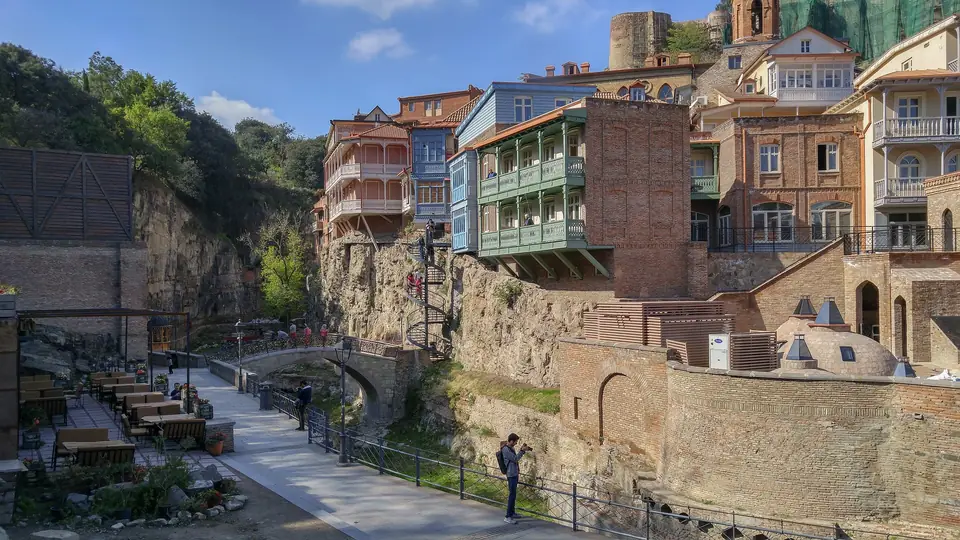
Where the bath street ends, the Leghvtakhevi gorge begins, the “ravine of the fig trees”, first mentioned in 1429. At its far end the Tsavkisistskali river drops in a 22-metre waterfall among little bridges, stairways and balconied houses hung over the rock, a corner of shade and coolness that was restored in 2012 after decades with the river hidden under concrete.
Along the way, the bridge railings are covered with padlocks bearing couples’ names in many languages: closing one is believed to secure a love for ever. The custom, however, arrived from Europe only a few decades ago. What is ancient is something else: for centuries the ravine was where the neighbourhood’s women washed clothes and shared news, and where leather was tanned in sulphur water.
Above, on Botanical Street, the red-brick minaret of the Juma Mosque appears, the only one surviving in the old town, rebuilt in 1895 with funds from the patron Zeynalabdin Taghiyev. How Sunnis and Shiites came to pray together in it, and what once separated them, is the closing note the route keeps for this last viewpoint over the waterfall.