4th-century citadel
Narikala Fortress Audio Guide
It was born in the 4th century so that a Persian governor could keep an eye on the king of Kartli, and Byzantines, Umayyads, Ottomans, Qizilbash and Georgians have taken it and lost it ever since. Every stretch of its walls carries the signature of one of them.
- 60 min of audio
- Medieval citadel
- Viewpoint over Tbilisi
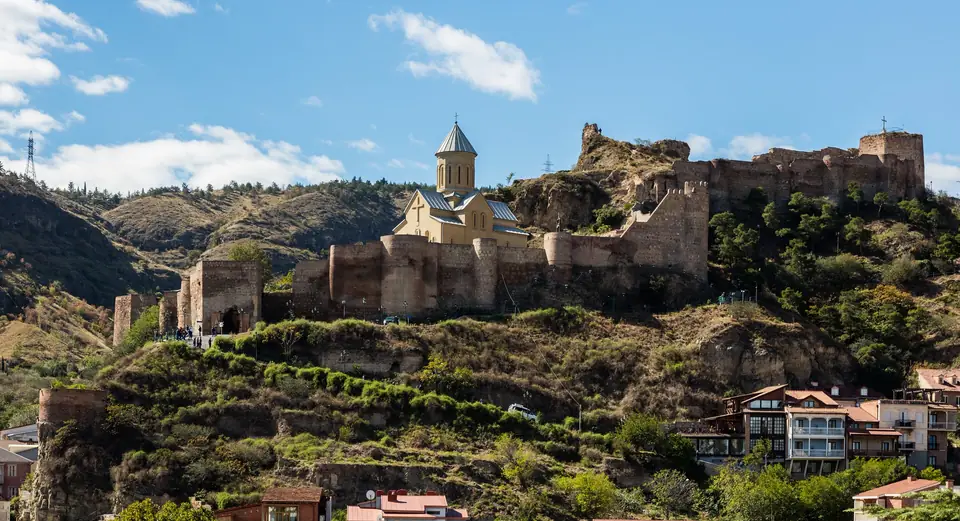
The history of Narikala Fortress begins in the second half of the 4th century, when, according to the Georgian chronicles, the Persian pitiakhsh Khram Khuar Borzard raised it on the crag to watch from here over the king of Kartli, who lived in Mtskheta. What remains today is two enclosures joined along the ridge, one square at 70 × 70 m and one long and narrow at 60 × 20 m, with walls up to 2 m thick and ruins from the 12th–13th and 17th centuries.
St Nicholas Church, the pale dome that appears in every photo of the old town, looks ancient and is not: it was consecrated in 1997 on the foundations of a 13th-century church that a Russian general turned into a powder magazine. The explosion flattened the church and almost the whole citadel, and legend speaks of a lightning bolt that struck right above it.
Highlights
- St Nicholas Church — consecrated in 1997 on the ruins of a powder magazine
- Istanbul Tower — the highest point of the western enclosure
- Patched walls — ashlar, split stone and Georgian brick from a thousand eras
- Two enclosures on the ridge — 70 × 70 m and 60 × 20 m
- Panorama of Tbilisi — the Mtkvari, Abanotubani and Mtatsminda at its feet
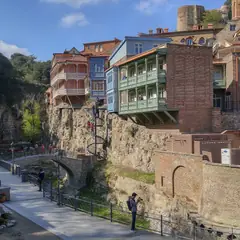
Above the old town of Tbilisi, perched on a crag over the domes of the Abanotubani baths and the Mtkvari river, Narikala Fortress was built not to defend the city but to watch it. The Georgian chronicles place its origin in the year 368, when a governor sent by the king of Persia settled here so as not to lose sight of the king of Kartli. Tradition prefers another founder, King Vakhtang I Gorgasali, and other sources move the date earlier or later: the debate remains open.
What came afterwards explains the look of its walls. Byzantines and Khazars besieged it in 627 and razed it in 628; the Umayyads enlarged it; David IV the Builder recovered it in 1122; Timur took it in 1386; the Ottomans occupied it from 1578 and the Persian Qizilbash for more than a century, until Erekle II drove them out in 1748. The story of Narikala is that of a citadel that changed hands again and again, and that in the 19th century lost almost everything to an explosion and an earthquake. The audio guide walks both enclosures from east to west, from the lower courtyard to the ridge, with documented narration checked against historical sources.
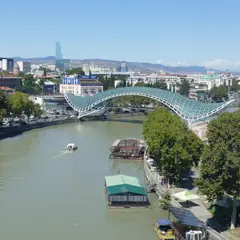
Downhill at its feet, the brick domes of the Abanotubani baths peep out, and heading down towards the river you reach the glass roof of the Bridge of Peace.
The wall signed by all its conquerors
Wall by the great north-eastern gate
Summary of this stop
The entrance is through a crumbling quadrangular tower beside the great north-eastern gate. At its foot survives a piece of the oldest wall, made of large dressed blocks, and from there the rampart turns into a sample book: split stone, Georgian brick, rebuilt stretches. Each band corresponds to a siege, an occupation or a reconquest, from the encirclement by Heraclius and the Khazar khagan Ziebel to the Ottoman garrison that Lala Mustafa Pasha left here in 1578.
The last great chapter of this patched skin was written in 1795. After the defeat at Krtsanisi, the elderly Erekle II fled to the mountains and, according to documented tradition, the fight against Agha Mohammad Khan’s troops carried on through the streets and among these stones until the capital fell and was sacked. The citadel was badly damaged. Who rebuilt it the following year is one of the most unexpected details of the tour, and the narration saves it for when you have those walls in front of you.
St Nicholas, the church that was a powder magazine
St Nicholas Church
Summary of this stop
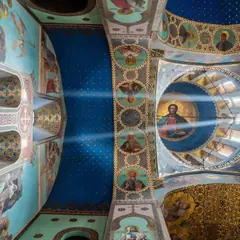
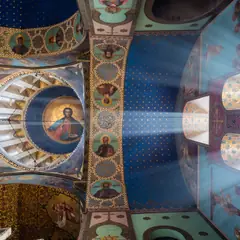
In the lower courtyard stands St Nicholas Church, faced in pale ashlar, with crosses and ornaments on its façades and an interior painted from top to bottom with biblical scenes and scenes from Georgian history. On its west and north sides you can make out fragments of the earlier church, built in the 13th century under King Demetre II the Self-Sacrificer. That medieval church met a brutal end: in 1818 the Russian general Alexey Yermolov turned it into a gunpowder store, and the explosion of the magazine flattened it almost to its foundations along with nearly the whole citadel.
Sources disagree about the date and the cause of that blast. Legend says it was a lightning bolt, and that the people of Tbilisi took it as a punishment from heaven for the desecration of the temple. Excavations in 1966 brought the remains of the medieval church to light, and on top of them construction of the new one began in 1996, with the proportions of the old one, Georgian brick and Bolnisi tuff; Patriarch Ilia II consecrated it on Palm Sunday 1997. Behind that work lies a personal story linking a student in 1966 to the restoration the fortress is undergoing today.
Shuristsikhe, a fortress to watch the king
Viewpoint over Abanotubani and the Mtkvari
Summary of this stop
From the wall-walk that looks over Abanotubani and the Mtkvari you understand why the fortress stands exactly here: the crag commands the valley and the road to Mtskheta, where the king of Kartli resided. One of its old names, Shuristsikhe, comes from that watching role, and it is translated in ways that do not match: fortress of envy, enviable fortress or rival fortress. The popular explanation boasts of impregnability; the old Armenian translation of the Georgian chronicle points instead to a fortress built against the king’s city.
Under King Rostom, between 1632 and 1658, a wall divided the city from the citadel, and from that came the place names lower fortress and upper fortress. Around then the Ottoman traveller Evliya Çelebi passed through and described a small walled village with flat-roofed houses, a palace, a mosque, a caravanserai, a bath, a bazaar and a tower on the river for drawing water during sieges. His figures for towers and battlements were very generous, and what truly fitted inside is part of what the audio guide tells at this point.
Istanbul Tower, still standing after the earthquake
Istanbul Tower
Summary of this stop
At the highest point of the western enclosure rises the Istanbul Tower, square and unlike all the others, the best-preserved part of the citadel even though the 1827 earthquake brought down much of its fabric along with walls and bastions. The popular explanation says it got its name because it served as a prison during the Turkish occupation. From here the architecture of Narikala can be read at a glance: the eastern enclosure, square, and the western one, elongated, stepped along the ridge.
The name Narikala is another enigma. It appears in 17th-century records and, according to the most widespread explanation, comes from the Persian narin qala, inner citadel, a term many Georgian fortresses had and which survived only in Tbilisi; other sources attribute it to the Mongols. Since 2012 the cable car rising from Rike Park has brought thousands of visitors, and in 2020 Europa Nostra listed the fortress among Europe’s most endangered heritage sites, at risk of collapse. The close of the tour explains what is being done to keep it standing.