Contemporary architecture
Bridge of Peace Audio Guide (Mshvidobis Khidi)
A sheet of glass and steel that arrived from Italy on 200 trucks, spans the Mtkvari, lights up at every pedestrian's step and, every hour, spells out in Morse what the human body is made of.
- 20 min of audio
- Glass, steel and light
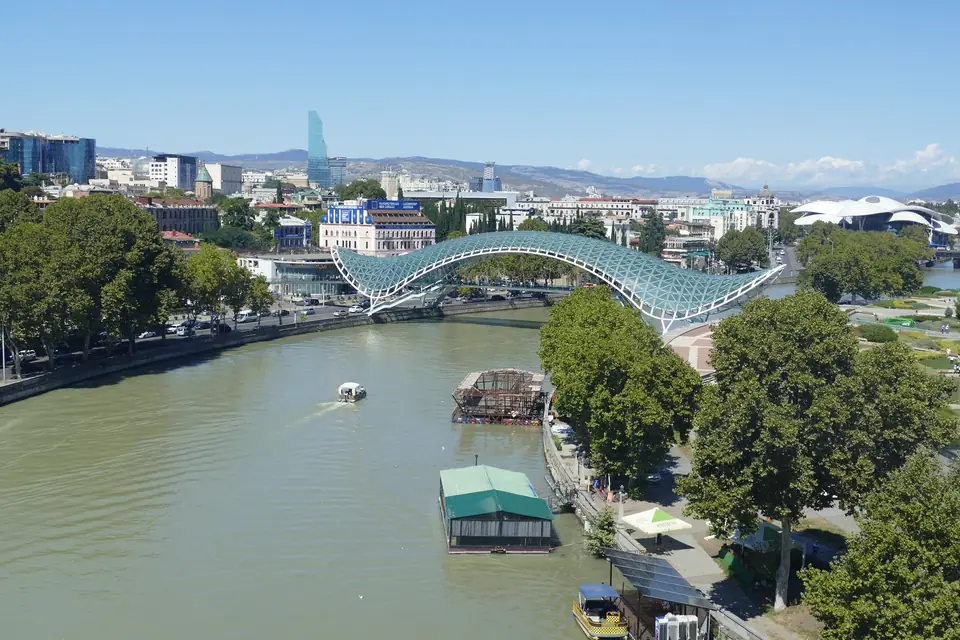
Inaugurated on 6 May 2010, St George's Day, the Bridge of Peace links the old town of Tbilisi with Rike Park. It was designed by the Italian Michele De Lucchi, the same architect as the presidential palace, and was born as an emblem of the glass Georgia that Mikheil Saakashvili wanted to show the world after the 2008 war.
Few works have drawn so much mockery and so much affection at once: architects accused it of breaking with the 19th-century city, and the city christened it with the name of a sanitary pad. Today it is the favourite backdrop for night-time wedding photos and a screen on which the capital dresses in the colours of its joys and its mourning.
Highlights
- Undulating roof — a single membrane of bluish glass and steel on four forked supports
- Smart parapets — thousands of LEDs and motion sensors that accompany the pedestrian
- Morse message — every hour it spells out the chemical elements of the human body
- Made in Italy — it travelled to Tbilisi on 200 trucks and opened in 2010
- Views of Metekhi, Narikala and the glass dome of the presidential palace
In a city of stone churches, sulphur baths and wooden balconies, a footbridge of bluish glass crosses the Mtkvari river as if it had landed from another century. The history of the Bridge of Peace begins in August 2008, after the Russo-Georgian war, when President Mikheil Saakashvili pushed the idea and Tbilisi City Hall placed the order: to link the old town with the new bank at Rike. Works began in 2009 and on 6 May 2010 the bridge opened to the public.
Behind its silhouette there is Italian architecture, precision engineering, a political programme and an encrypted message that very few of those who cross it ever read. What to see on the Bridge of Peace, how it was built and why half the city laughed at it are the three questions the audio guide answers in a stroll from bank to bank, with documented narration checked against historical sources.
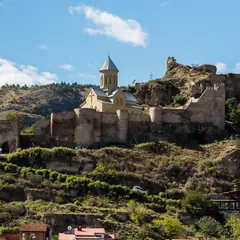
From the bridge you can see Narikala Fortress high on the hill, and on the other bank the golden cross of Holy Trinity Cathedral shines. Its glass dates from the same years as the golden St George on Liberty Square.
A bridge born amid mockery
Old town entrance to the bridge
Summary of this stop
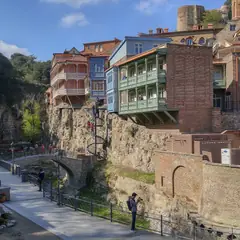
The approach from Erekle II Street is the best place to gauge the clash: on one side, the low houses and carved wooden balconies of the café district; ahead, a roof of glass and steel arching over the river. That contrast is precisely what sparked the controversy. In August 2010, barely inaugurated, several architects denounced the bridge for breaking with the brick and ornament of the 19th-century city, and opponents and urban planners added that it dominated the old town and hid its monuments.
The price did not help either: 12.5 million lari, about 7.5 million dollars, out of the municipal budget. The following year, in the shops of the old town you could hear that only deputies liked it, and the undulating roof already carried a supermarket nickname, “Always Ultra”, for its resemblance to a pad of that brand. In 2018 the British press counted it among Saakashvili’s “trophy buildings”.
In this first stretch, the audio guide reconstructs how such a disputed bridge ended up on all the city’s postcards, and which everyday scene from 2011 sums up Tbilisi’s humour towards its new neighbour better than any report.
A roof that arrived on 200 trucks
Undulating glass and steel roof
Summary of this stop
Under the roof, the architecture of the Bridge of Peace makes sense at once. The design is by Michele De Lucchi, who also designed the presidential palace and the Ministry of Internal Affairs in Tbilisi. The whole structure was made in Italy, travelled on 200 trucks and was assembled by the contractor Permasteelisa, which installed the lighting as it put the pieces together. The result is a single latticed membrane of steel and glass, leaf-shaped, anchored to four forked supports spread between the two banks; from it hangs a walkway 4.80 metres wide.
The triangular panels of bluish glass explain the other name heard around the city, “Shushis jidi”, the Glass Bridge. The opening date was not chance either: 6 May is the anniversary of the execution of St George, patron saint of Georgia.
Over the years, that much-criticised roof has become the newlyweds’ favourite backdrop: the night photo session under the lit glass is now part of the Tbilisi wedding album, and at dusk couples and street musicians arrive. The narration reveals what happens under that roof when the light falls.
Saakashvili’s transparent Georgia
Viewpoint of the presidential palace and Metekhi
Summary of this stop
From the middle of the bridge, looking at Avlabari hill, the landscape reads like a political programme. Over the Rike bank rises the presidential palace with its ovoid glass dome, by the same architect as the bridge. After the Rose Revolution of 2003, glass became the symbol of a transparent Georgia turned towards the future: glazed police stations, the Ministry of Internal Affairs, the palace dome and, over the river, this footbridge. Upstream, on the cliff, the Metekhi church and the equestrian statue of Vakhtang Gorgasali keep watch.
Beside Rike Park, the two great tubes of Massimiliano Fuksas’s Music Theatre and Exhibition Centre, associated with the same legacy, stood unused for years and in 2026 are being demolished by the Georgian Dream government. Depending on how the works progress, you will still see its structure or the gap it leaves.
This same footbridge has also served as a stage. In August 2023, on the eve of Ukraine’s independence day, displaced Ukrainians, activists and local residents unfurled a 32-metre flag along the bridge, one metre for each year of independence. The audio guide tells who organised it and why that gesture, on a bridge born after another war, had so much resonance.
A parapet that spells out the human body
Illuminated glass parapets
Summary of this stop
From the Rike bank, looking back, you discover what the walk was hiding: the glass railings carry thousands of LEDs connected to motion sensors that switch on stretches of light at each pedestrian’s step and accompany them from one bank to the other. The lighting, by the Frenchman Philippe Martinaud with the Dutch engineer Marco de Boer, uses only white light; on the roof, some 1,200 luminaires switch on before sunset and alternate several programmes every hour, from waves crossing the river to star flashes.
The best-kept secret runs along the parapet: every hour, a Morse code sequence spells out the chemical symbols of the elements that make up the human body, from calcium to oxygen, a message its author dedicated to life and to peace between people. It is often described as the complete periodic table, although the technical documentation limits it to those elements.
The roof also dresses in flags at big moments: it was tinted with the colours of France the night after the 2015 Paris attacks and in European blue and gold in December 2023, when Georgia became a candidate for the European Union. The narration shows how to read that luminous thermometer and which other image of the bridge ended up turned into propaganda ammunition.