Historic square
Liberty Square Audio Guide (Tavisuplebis Moedani)
A former firewood market that has changed its name with every regime and whose centre has been occupied, one after another, by a burning theatre, an empty rostrum, an 18.5-metre Lenin and a golden St George.
- 25 min of audio
- Political history
- Freedom Monument
Liberty Square was born in the early 19th century outside the walls of Tbilisi, in the Garetubani suburb, where village carts unloaded firewood. Since then it has been called Erivansky, Teatral, Liberty, Beria and Lenin Square, and around its great rotunda stand the former General Staff of the Caucasus Corps, the seminary where Stalin studied, now the Museum of Art, and the clock tower of the City Assembly, with its pseudo-Moorish façade. Rustaveli Avenue starts here.
Every regime has wanted to leave its mark on the same spot: the centre of the square. There burned in 1874 the theatre that Alexandre Dumas compared to a fairy palace, there a marble rostrum waited for a Lenin who took twenty-two years to arrive, and there, since 2006, rises a granite column with a gilded bronze St George that does not win unanimity even in Georgia.
Highlights
- St George column — 35 metres of granite and a gilded bronze saint of 27 tonnes
- Sakrebulo clock tower — a former police station with a pseudo-Moorish façade and a clock from 1884
- The 1907 robbery — bombs, revolvers and 241,000 roubles stolen from a State Bank stagecoach
- Pushkin Garden — the old firewood market, with the poet's bust and a vanished tomb
- Five names in two centuries — from Erivansky to Lenin and back to Liberty in 1990
Noisy, full of traffic and crowned by a golden saint, Liberty Square in Tbilisi looks at first glance like one more big roundabout. Its history says otherwise. This trapezium of about 110 by 140 metres began as a wasteland outside the walls where firewood was sold and has been, over two centuries, a showcase for every power that passed through Georgia: the tsars gave it the name of a conquering general, the Soviets that of Beria and then of Lenin, and in 1990 it recovered the name Liberty.
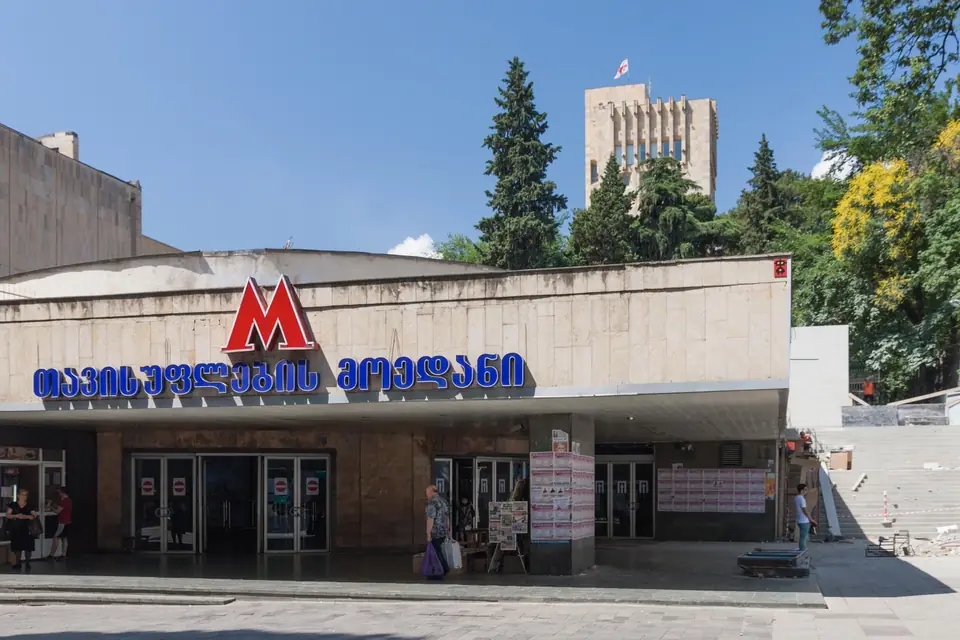
The history of Liberty Square reads best as a palimpsest. In its centre there have followed one another a theatre with a caravanserai opened in 1851, a marble rostrum raised in 1934, a statue of Lenin from 1956 and, since 23 November 2006, Zurab Tsereteli’s Freedom Monument. Around it remain the witnesses: the Classicist building of the former General Staff of the Caucasus Corps, from 1824–1829, the oldest on the square; the seminary where Stalin studied, now the Museum of Art; the Courtyard Marriott hotel, built over the ruins of the 1991–1992 civil war, and beneath the asphalt the Tavisuplebis Moedani metro station, opened in 1967. The EarGuide audio guide walks its pavements in 25 minutes, from the garden to the clock and from the clock to Rustaveli, with documented narration checked against historical sources.
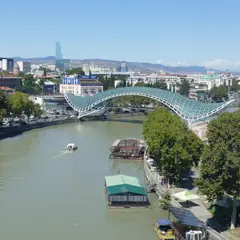
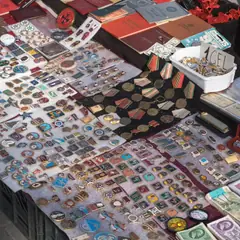
Less than a kilometre to the north, in the Dry Bridge Market, medals and objects with Soviet symbolism are sold today, and heading down towards the river waits the glass of the Bridge of Peace, another emblem of the same era as the golden St George.
From the firewood market to the poet’s garden
Pushkin Square
Summary of this stop
At the northern end, among trees and a fountain, the bronze bust of Alexander Pushkin presides over a quiet little square that hides a much more rustic origin. Until the early 19th century this was Garetubani, a suburb outside the wall, and locals called it “Firewood Square”: the carts coming down from the villages parked here. The remains of that wall, discovered in 2012, still peep out on the pedestrian stretch of Pushkin Street. The Sunday hay and firewood market moved in 1884 to the Vere slope, and the following year the garden was planted.
The first official name came around 1828 and was not exactly neutral: “Paskevich-Erivansky”, in honour of General Ivan Paskevich, made Count of Erivan for taking that fortress. Shortened to Erivansky Square, it accompanied the square throughout the tsarist period. The poet’s bust, paid for decades later with donations from Georgian society, also recalls a visit with the air of an escapade.
Under these same trees there was a tomb that no longer exists. In 1922 a revolutionary was buried here with a monument of his own, and during Stalin’s rule the monument disappeared and his remains were taken elsewhere. Who he was and why his name is tied to the square is the thread that leads, in the audio guide, to the next corner.
The clock tower that saw the robbery of 1907
Sakrebulo clock tower
Summary of this stop
The south side is closed by a building with a pseudo-Moorish façade and a clock tower in the middle. It was born in the 1830s as a police headquarters, with a tower for spotting fires, and between 1878 and 1886 it was transformed into the City House, with plans by Alexander Ozerov and a façade by the German Paul Stern. The clock was installed in 1884 and the wings gained a third storey in 1910–1912. Today it is the seat of the City Assembly, the Sakrebulo.
That clock was already telling the time on 26 June 1907, when a Bolshevik group attacked with bombs and revolvers the stagecoach carrying State Bank money. Most of the attackers waited on the corners dressed as peasants; their leader, Kamo, arrived in a phaeton disguised as a cavalry captain. There were some 40 dead, 50 wounded and a haul of 241,000 roubles, and in the escape Kamo had the nerve to shout at a police carriage that the money was safe.
Documented tradition adds almost novelistic scenes: a tavern across from the square turned into a trap for customers who walked in, a rolled-up newspaper as a signal, a robber who came back in disguise to look at the result and an official death toll far from the one kept in the secret police archives. Stalin’s exact role that day is still debated, and the narration reconstructs the raid from inside one of these façades.
The pedestal that changes tenant
Central rotunda of the square
Summary of this stop
From the west pavement, facing the column, the centre of the square reveals itself as a stage with many premieres. Between 1847 and 1851 a great theatre with a caravanserai was raised there, the work of the Italian architect Giovanni Scudieri, paid for by the merchant Gabriel Tamamshev. Alexandre Dumas, who visited it in 1859, compared its hall to a fairy palace, and for a time the square was called “Teatral”. On 11 October 1874, in the middle of a performance of Bellini’s “Norma”, the theatre burned down; only the caravanserai was rebuilt, and it fell in 1934 with the Soviet remodelling.
In its place that same year a marble rostrum was raised, meant for a statue of Lenin that would look at the clock and turn its back on the garden. The statue did not arrive, and around the 1950s the rostrum was also dismantled. Lenin finally appeared on 21 April 1956: 18.5 metres signed by the sculptor V. Topuridze.
His end was as discreet as his arrival was spectacular: he was taken down at dawn, with the police watching, when he was the last Lenin statue still standing in Georgia. Most sources place it in 1990, although others say 1991. And a legend holds that what remained underground of the old theatre saw the light again much later; the audio guide tells when and why.
A golden saint, a silent grenade
Golden statue of St George
Summary of this stop
At the start of Rustaveli Avenue, the square recovers the sense of its name. After the fall of the tsar it was renamed Liberty; then came the Transcaucasian Federation, Beria and, in 1953, after his execution, a hasty change to the name of Lenin. In 1990, on the initiative of Zviad Gamsakhurdia, it became Liberty Square again.
Above it rises the Freedom Monument: a 35-metre granite column with a gilded bronze St George of 5.6 metres and 27 tonnes, whose gilding consumed 2 kilos of gold. It was inaugurated on 23 November 2006, Giorgoba, the feast of St George, and the third anniversary of the Rose Revolution. A year earlier, on 10 May 2005, some 100,000 people filled the square to hear George W. Bush and Mikheil Saakashvili when a grenade fell 18.6 metres from the lectern. It did not explode, and the reason fits in a handkerchief.
One question remains that the column poses without saying it: where the dragon-slayer comes from. According to a disputed thesis, the scene of the saint spearing the dragon may have been born precisely in the South Caucasus, and its oldest known telling appears in an 11th-century Georgian manuscript. The audio guide closes the tour with that story and with the feast celebrated only in Georgia.