Flea market
Dry Bridge Market Audio Guide (Mshrali Khidi)
A stone bridge that lost its river and now carries on its arch Tbilisi's great souvenir flea market: war medals, samovars, silver and paintings spread on blankets, a few steps from the hotel where Munch's muse died.
- 60 min of audio
- Flea market and 19th-century bridge
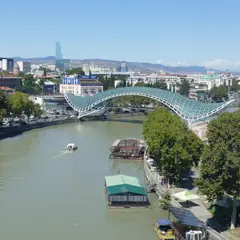
The Dry Bridge was born in the mid-19th century on the orders of Viceroy Mikhail Vorontsov, who wanted a double crossing over the Mtkvari. The Paduan architect Giovanni Scudieri drew a single ashlar arch with a 32-metre span, one of the largest spans in the Russian Empire of its day, and died in 1851 without seeing it finished. The structure keeps its original look almost intact, although no water runs beneath it any more.
Around the 1930s the arm of the river that passed beneath dried up, the island that separated it from the bank disappeared and the bridge was left stranded on dry land. Decades later, when the Soviet Union collapsed, its deck filled with families selling the silver, porcelain and books from their homes before emigrating. Today it is called the market of memories, and not everything that looks old is.
Highlights
- 32-metre stone arch — one of the largest spans in the Russian Empire, over a river that no longer exists
- Giovanni Scudieri plaque — in Georgian and Italian, beside Italy Street
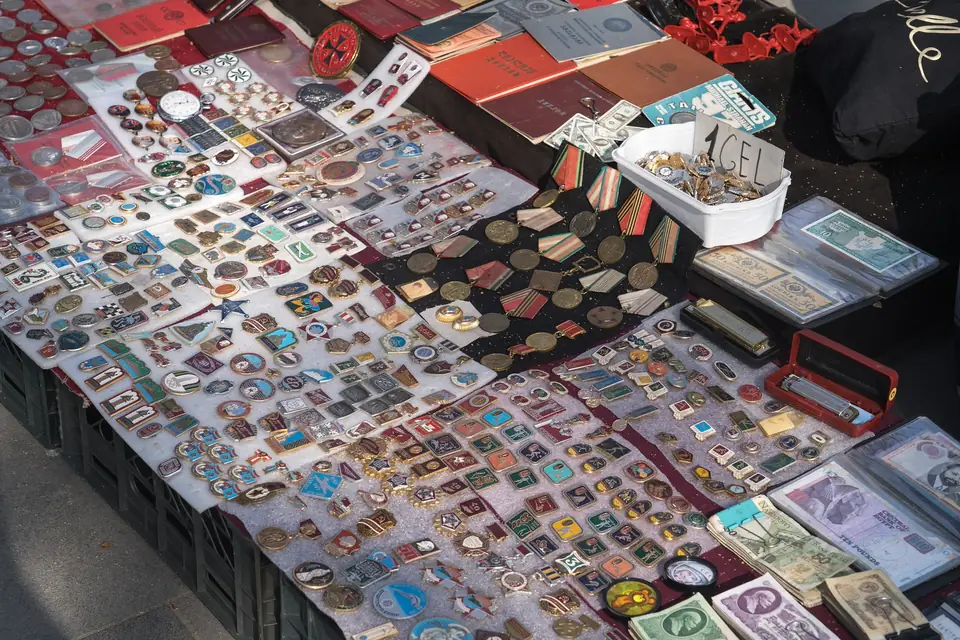
- Flea-market blankets — Second World War medals, Soviet badges, samovars and radios
- Paintings in Dedaena Park — painters who exhibit and sell views of Tbilisi in the open air
- Former Grand Hotel — the scene of Dagny Juel's murder in 1901
Few bridges carry in their name the proof of what they have lost. The Mshrali Khidi, Tbilisi’s Dry Bridge, was finished in 1851 over the right arm of the Mtkvari, and today only cars pass beneath its arch. Above, on the deck, the city’s best-known flea market spreads out every day: Second World War medals, objects with Soviet symbolism, enamels, silver, antique tableware, typewriters and paintings by local artists. Whoever asks what to see at the Dry Bridge Market finds much more than a heap of souvenirs: a piece of Italian engineering, a vanished island, the trace of post-Soviet emigration and one of the darkest tragedies of European bohemia around 1900. The history of the Dry Bridge Market is best understood by walking it from one end to the other, from the parapet that looks over the avenue to the old hotels at its head, with the audio guide, documented and checked against historical sources.
Less than a kilometre to the south, Liberty Square tells in its names the same changes of regime, and following the river you reach the Bridge of Peace.
A bridge stranded on dry land
Dry Bridge parapet above the avenue
Summary of this stop
From the parapet, the surprise is below: under the single ashlar arch, with a 32-metre span and an 11-metre roadway, one of the largest spans in the Russian Empire in its time, a road runs. That asphalt occupies the old bed of an arm of the Mtkvari which, until the 1930s, separated an island from the right bank. Sources do not agree on the exact year it dried up, but they do on the consequence: the bridge was left without water and gained the name it bears.
That island had illustrious owners, first the Orbeliani and then Madatov, and on its site stands the Palace of Justice today. There is also an optical illusion few people notice: the Soviet embankments begun in the late 1930s under Lavrentiy Beria filled in the shallows and raised the ground, so the bridge looks much shorter today than in photographs from the late 19th century. How much of the structure was buried is one of the revelations awaiting at this first point of the tour.
The plaque of the Paduan who died before finishing it
Giovanni Scudieri plaque
Summary of this stop
In the 1840s, Viceroy Mikhail Vorontsov commissioned Giovanni Scudieri, municipal architect of Tbilisi since 1846, to build a double crossing over the river: a large bridge over the main channel and a small one over the right arm. That small one is today’s Dry Bridge, known first as the small Mikhailovsky bridge and later as Nicholas Bridge. Its large neighbour is another bridge, today called Saarbrücken Bridge, and the two should not be confused, although some descriptions merge them into one.
The start was both solemn and fateful. On 26 November 1848, Vorontsov laid the foundations of the piers in a ceremony; the following year, a flood swept away the temporary wooden bridge the sappers were raising. Scudieri, born in Padua in 1816, died in 1851 while building a church, and it was the engineer Blix who completed the work.
On the parapet, a plaque in Georgian and Italian recalls his name, and the short street that joins the bridge with Alexander’s Garden has been called Italy Street since 2006. The city’s debt to that architect has more nuances than fit on a plaque.
An inventory of farewells on the asphalt
Flea-market blankets
Summary of this stop
In the middle of the deck, the blankets and rugs spread on the ground form an improvised museum. More than a hundred sellers set up their stalls every day, while painters exhibit landscapes and views of Tbilisi in Dedaena Park, and down the stairs, in the covered section of the bazaar, the silver, porcelain and most expensive pieces are concentrated. The origin of the market is disputed, but after the dissolution of the USSR in 1991 teachers, doctors and academics came here to turn their belongings into quick cash before emigrating, while the new rich bought antique furniture, Chinese porcelain, Russian silver and 19th-century books.
The market also had its conflict. On 8 August 2007, police expelled unlicensed sellers, some 700 at weekends, after complaints from the traders of the bazaar below, who paid 40 lari a month for their stall; twelve days later, the evicted protested on the steps of City Hall. Today the Dry Bridge also works as a brokers’ exchange, a meeting point for intermediaries who close deals on flats and land.
And it is worth knowing that here “antique” is an elastic word. According to the sellers themselves, a good part of what is on offer is only a few decades old, and some portrait with a centenarian air has been painted to order in a nearby courtyard. The stories hidden behind those blankets, authentic or not, are the heart of this stop.
The Grand Hotel and Munch’s muse
Former Grand Hotel
Summary of this stop
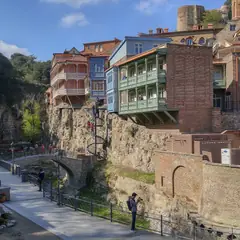
At the head of the bridge two old hotels with wood and iron balconies face each other, the Grand Hotel and the London. On the façade of the first, a plaque recalls what happened in one of its rooms on 5 June 1901: Władysław Emeryk shot the Norwegian writer Dagny Juel, a model of Edvard Munch, in the head, after taking her five-year-old son Zenon out of the room.
The local press of the time and the letters Emeryk left behind sketch a crime planned for a long time, with details that still chill. Some indications, never confirmed, suggest that Dagny’s husband, Stanisław Przybyszewski, may have known of the plan; Emeryk’s authorship is not disputed. From the bustle of haggling to the silence of that façade there are only a few steps, and the end of the tour turns the whole bridge into something else: a place where the city leaves what it can no longer carry.