Historic cathedral
Sioni Cathedral Audio Guide (Sionis Tadzari)
They tore off its dome to set up a throne, burned it and looted it, and still it stands beside the Kura. Inside it keeps St Nino's cross of vine and the tombs of Georgia's patriarchs.
- 30 min of audio
- Medieval Georgian architecture
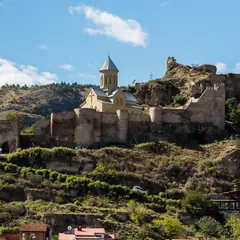
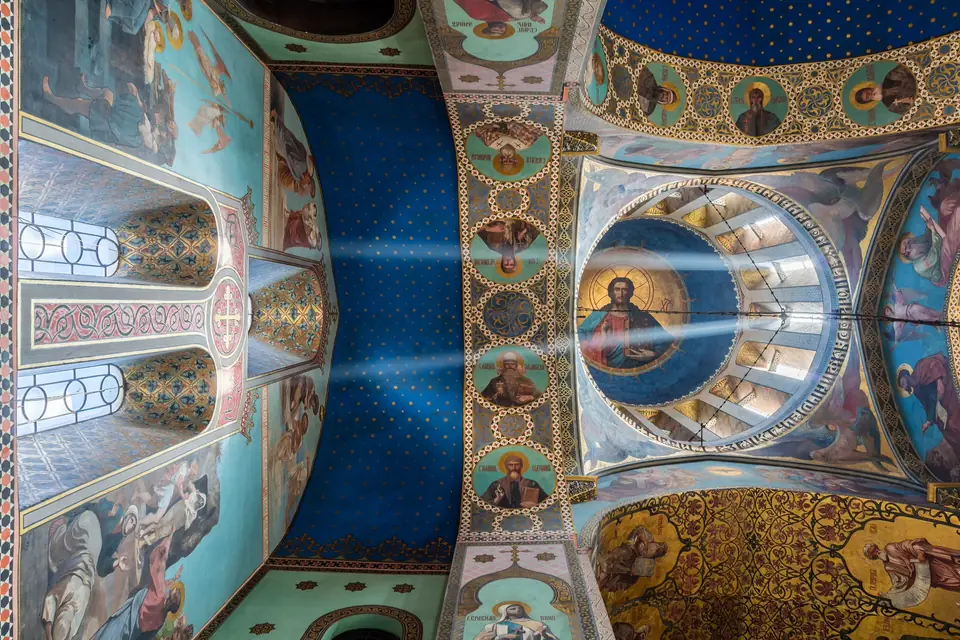
Sioni Cathedral is the old cathedral of Tbilisi: a yellow tuff church pressed against Sioni Street, a step from the river. Its inscribed-cross plan with a dome on two free-standing piers comes from David the Builder's reconstruction in 1112 and has barely changed since. It was Georgia's main cathedral and the seat of the Catholicos-Patriarch until 2004.
Few churches have been so humiliated and so rebuilt. In 1226 a shah of Khwarazm had its dome taken down to install his throne there; in 1795 the fire of the Persian invasion devoured its murals and iconostasis. And yet Georgia still chooses this ground to bury its own: Patriarch Ilia II has rested here since March 2026, at his own wish.
Highlights
- St Nino's cross: the vine relic that returned to Georgia in 1802 after half a century in Russia
- Sixteen-sided drum: the dome rebuilt in 1710 in Bolnisi tuff, where a shah had set up his throne in 1226
- Icon of the Virgin of Sioni: thrown into the Kura, rescued by a shepherd and carried out of the city on a back
- Tombs of the patriarchs: from Kirion II and Ambrose the Confessor to Ilia II, buried in 2026
- 1812 bell tower: one of the first Russian Classicist buildings in Tbilisi, paid for with war booty
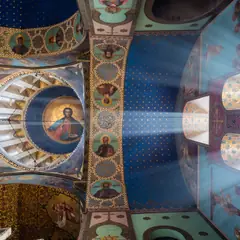
Small, dim and smelling of wax, Sioni Cathedral impresses not by its size but by everything it has endured. The story of Sioni Cathedral begins in the 6th century: around the year 575 Prince Guaram of Iberia began a new church here, on top of a 5th-century one attributed to King Vakhtang Gorgasali, and his successor Adarnase finished it around 639, although the exact dates are still debated. The Georgian chronicle says that half of it was built by the people of Tbilisi and the other half by the eristavis, with the help of a rich widow whose name has been lost.
What you see today is mostly the work of David the Builder, who rebuilt it completely in 1112 after the Arab destruction. Then came the Khwarazmians, Shah Ismail, the Ottomans, the Persians, the tsars and the Soviets, and each left a mark on the yellow stone. Walking it with the audio guide, documented and checked against historical sources, means reading those scars one by one, outside and in.
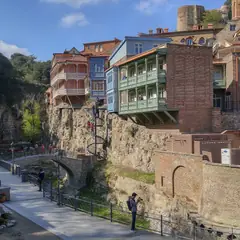
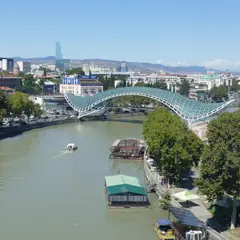
Across the Mtkvari rises Holy Trinity Cathedral, the tallest in Georgia; a few minutes’ walk away lie the baths of Abanotubani, and a little further north, the Dry Bridge Market.
A bell tower paid for with Ganja booty
Neoclassical bell tower of 1812
Summary of this stop
Before going in, the eye goes to the other side of Sioni Street: a tall brick tower with a spire, Neoclassical, with inscriptions in Russian and Georgian naming Tsar Alexander I and Exarch Varlaam. It is the bell tower of 1812, one of the first Russian Classicist buildings in Tbilisi, and its origin has something of a settling of scores: it is linked to the prize money for the capture of Ganja, which Pavel Tsitsianov’s troops are said to have donated in full to Sioni because people from that city had taken part in the destruction of 1795. Another version presents it instead as a memorial of the Russo-Turkish war of 1806–1812.
Its bells have their own story. In 1848 Viceroy Mikhail Vorontsov had old cannons melted down for the great bell, of 650 poods. Under Soviet power they rang for the last time on 27 January 1931, the feast of St Nino, and a few days later were thrown down from the top. What happened to that silent tower, and why this cathedral is considered the work of the people of Tbilisi themselves, is better understood by listening in front of it.
The dome a shah turned into a throne
North façade and dome drum
Summary of this stop
Beneath the north façade, the cathedral shows its most recent head: a sixteen-sided drum with a narrow window with a carved frame on each face, reliefs of an archangel and of a saint with a book, and higher up the inscription of Regent Vakhtang, the future Vakhtang VI, surrounded by a solar symbol and fabulous birds. In 1710 he rebuilt the dome, the cladding and the roof in Bolnisi tuff, and left it written in the stone.
That new dome covers an old wound. In 1226, after taking Tbilisi, the Khwarazmian shah Jalal ad-Din Mangburni ordered Sioni’s dome dismantled and his throne installed on top. From there he watched those who refused to desecrate the icons of the Saviour and the Virgin, taken out of the cathedral and placed on the Metekhi bridge. According to tradition, some 100,000 inhabitants who refused to trample them were beheaded, and the Georgian Church venerates them as the 100,000 martyrs of Tbilisi. What that throne saw from above is one of the moments the narration reserves for this point.
A vine cross tied with hair
Niche of St Nino's cross
Summary of this stop
Inside, to the left of the stone iconostasis, a queue always forms: in a niche of its own, inside a reliquary, is kept the drooping-armed vine cross of St Nino, the most venerated relic in Georgia. Legend says the saint received it from the Virgin Mary, or made it herself on the road to Mtskheta, and that she tied the two vine shoots with her own hair.
The cross also knew exile. It left Georgia in the mid-18th century and spent nearly fifty years with the family of the emigrant Prince Bakar in Moscow and Lyskovo, until in 1801 his grandson Georgy handed it to Tsar Alexander I, who returned it to Georgia with the annexation of 1802. That same year, on 12 April, this nave witnessed a very different scene: General Karl von Knorring gathered the Georgian nobility inside, with the cathedral surrounded by troops, to read the manifesto of annexation to the Russian Empire and make them swear loyalty; those who refused were arrested. How a relic came back the very year the country lost its crown is the twist you discover when you listen to the stop in front of the niche.
Patriarchs under the floor, the Virgin of the river
Tombs of the patriarchs
Summary of this stop
In front of the iconostasis and between the dome piers, the floor is made of gravestones: those of the 20th-century patriarchs of Georgia and, since 22 March 2026, that of Ilia II, who died aged 93 after almost five decades at the head of the Church and was buried here at his own wish, although Sioni had ceased to be the patriarchal seat in 2004. Among those slabs is that of Ambrose, the patriarch who protested at the Genoa Conference against the Soviet occupation, was tried for it and defended himself with a sentence that is still remembered; the Church canonised him in 1995 as St Ambrose the Confessor.
Very close by is venerated the cathedral’s main icon, the Virgin of Sioni, with a silver cover. In 1522 Shah Ismail tore the jewels off the original and threw it into the Kura; a shepherd from Kakheti found it 4.5 km downstream and King Leon I returned it to Sioni. That icon was lost in the river in 1724, and the one seen today is a copy commissioned in Russia in the 1760s, which in 1795, in the middle of Agha Mohammad Khan’s invasion, Archpriest Ioane Oseshvili carried out of Tbilisi on his back. Ambrose’s exact words before the court, and the end of this tour, are left for the moment of standing there, among the slabs.