Orthodox cathedral
Holy Trinity Cathedral Audio Guide (Tsminda Sameba)
It looks ancient and is not: the golden dome that dominates Tbilisi was raised between the post-war years and 2004, on Elia hill and over part of an Armenian cemetery of 90,000 graves.
- 45 min of audio
- Contemporary Orthodox cathedral
- Armenian cemetery
Sameba, Holy Trinity Cathedral, is the tallest Orthodox church in Georgia and, since its consecration in 2004, the main seat of the Georgian Church. The idea was born in 1989, in the midst of the national awakening, from Patriarch Ilia II; the project by architect Archil Mindiashvili won out after an international competition with more than a hundred entries, and its 7.5-metre golden cross now crowns almost every view of the city.
Beneath the hill lies another story. The church occupies at least part of the site of Khojivank, the great Armenian cemetery of Tbilisi, razed on Beria's orders in the 1930s; when the bulldozers opened the cathedral's foundations, the remains of thousands of people came to light. Behind the apse a small pantheon survives with around thirty rescued gravestones.
Highlights
- 7.5-metre golden cross — the crown of a church some 86 metres tall, visible from almost all of Tbilisi
- Khojivank pantheon — what remains of an Armenian cemetery of some 90,000 graves, with the tomb of the novelist Raffi
- Nave of stone from half the world — Georgian limestone, Chinese and Indian granite, Italian, Egyptian and Greek marble
- Nine chapels — five of them in an underground crypt 13 metres high
- Icon of the Virgin painted by Patriarch Ilia II himself, beside the entrance
From almost anywhere in Tbilisi, a golden dome rises above the rooftops of Avlabari. Whoever sees it for the first time tends to think of centuries of history, but Holy Trinity Cathedral — Tsminda Sameba to Georgians — is almost a newcomer: it was designed in 1989, construction began in the mid-1990s and it was consecrated on St George’s Day 2004. In barely two decades it went from building site to Georgia’s ceremonial heart, the place where patriarchs lie in state and their successors are chosen.
The story of Sameba is that of a ruined country that decided to raise its tallest church when its homes barely had electricity, but also that of what lay buried beneath its foundations. Its architecture, its funding and the ground it occupies still give people plenty to talk about, and the audio guide walks through those layers one by one: from the olive walk to the Armenian pantheon, from the marble nave to the icon painted by the patriarch who dreamed it.
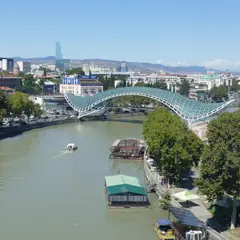
On the other bank, in the old city, Sioni Cathedral keeps the tombs of Georgia’s patriarchs, and downhill towards the river you cross the Bridge of Peace.
A golden cross born in a Georgia without light
Olive walk and stairway
Summary of this stop
The visit starts at the gate on Samreklo Street, where a walk lined with olive trees and stone pillars leads to a cascading stairway that climbs to the west façade. From below, the scale impresses: by the most-quoted measure, the church reaches 86.1 metres to the top of the cross, and the golden cross alone measures 7.5. Add the foundations, which go down more than 14 metres under the hill, and the two underground floors, and the total height is around a hundred metres. Other sources give slightly different figures, and on that measure depends the place it holds among the tallest Orthodox cathedrals in the world.
None of this is medieval. The idea arose in 1989, the year of the national awakening of a still-Soviet Georgia, to celebrate the 1,500 years of autocephaly of the Georgian Church and the 2,000 of the birth of Christ. Civil war and crisis froze it for years: most sources date the first stone to 23 November 1995, St George’s Day, in a city where almost no resident had water or electricity 24 hours a day. Why a country in that state launched into such a project is the question the narration leaves hanging at the foot of the stairway.
Khojivank, the cemetery that was left underneath
Khojivank pantheon
Summary of this stop
Around the church, to the north-east and with a gate of its own, appears a small, silent enclosure: the Armenian pantheon of Khojivank. Some thirty rescued gravestones, the tomb of the novelist Raffi and fragments of gravestones and khachkars set into the walls are what survives of the largest Armenian cemetery in Tbilisi, with some 300 years of history and close to 90,000 graves. Between 1934 and 1937, on the orders of Lavrentiy Beria, most of the graveyard and its 17th-century church of Surb Astvatsatsin were destroyed; its marble gravestones ended up as building material in official buildings and even in Beria’s own house.
Decades later, when the foundations of Sameba were dug, the machines brought the remains of thousands of people back to the surface, and they ended up in trucks alongside rubble and broken gravestones. How much of the old cemetery the cathedral covers exactly remains a matter of debate between the official versions and Armenian sources.
The origin of the place also holds a documented paradox: the land was granted in the 17th century by a Georgian king, Rostom of Kartli, to his Armenian treasurer, Khoja Behbud, at the foot of a Georgian church dedicated to the Prophet Elijah that no longer exists. From that treasurer comes the name Khojivank; from that church, the name of the hill. How that circle closes with the arrival of Sameba is one of the most revealing moments of the tour.
Stone from five countries, paid for in secret
Nave and white stone iconostasis
Summary of this stop
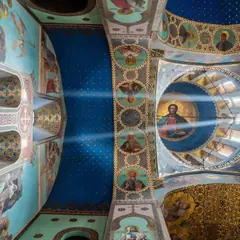
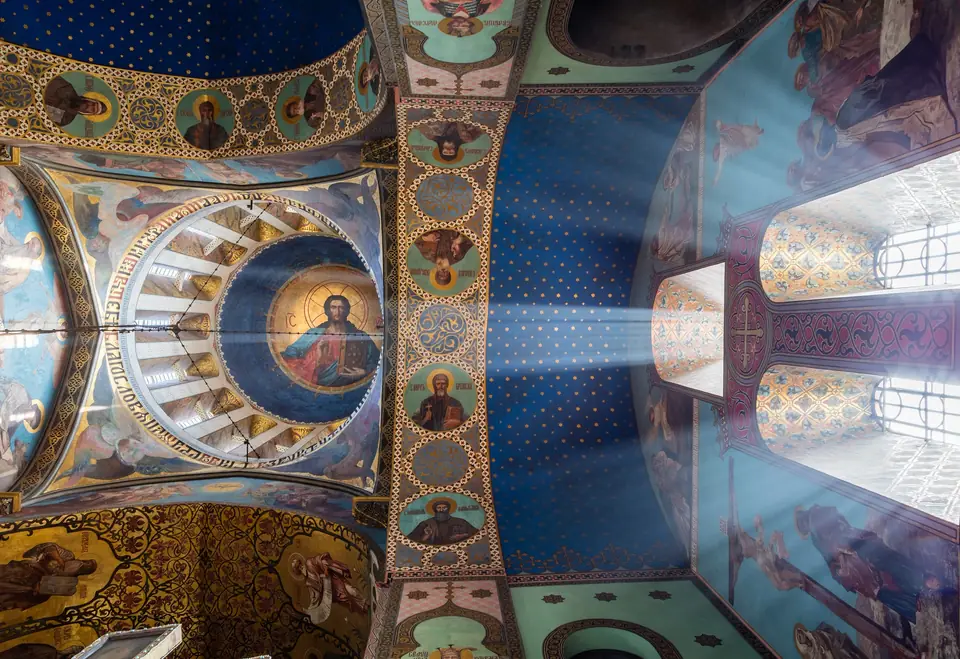
Inside, the nave surprises with its light and its tall free-standing piers, their bases covered in golden icons, the marble and granite floor and a white stone iconostasis. The materials come from half the world: marbled Georgian limestone, Chinese and Indian granite and walls clad in Italian, Egyptian and Greek marble. The frescoes are the work of a team led by the painter Amiran Goglidze.
The bill for all of it, counted in tens of millions of lari, had an invisible protagonist for years. At the consecration, donations were mostly said to be anonymous; it was former president Eduard Shevardnadze who, in his memoirs, named the banker Bidzina Ivanishvili as the main funder, whom he himself had asked for help. And beneath the floor hides another cathedral: the building has nine churches and chapels, five of them in an underground crypt 13 metres high. According to the tradition of the foundation ceremony, stones from Mount Zion and the Jordan and earth from Jerusalem and from the tomb of St George were buried in the foundations, although another version speaks of earth from Georgian shrines.
The cathedral of Ilia II, godfather of a nation
Icon of the Virgin painted by Ilia II
Summary of this stop
Beside the entrance hangs an icon of the Virgin painted by Patriarch Ilia II himself, the man without whom Sameba cannot be understood. He drove the project, celebrated the first liturgy here at Christmas 2002 and consecrated the church on 23 November 2004 before representatives of other Orthodox Churches, replacing the old Sioni Cathedral as the main seat. From 2008 he presided in these naves over mass baptisms in which he became godfather to the third and subsequent children of Orthodox families, a response to the demographic crisis that gave him more than 40,000 godchildren.
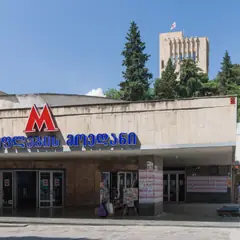
When he died in March 2026, his body arrived here in procession and lay in state day and night, with queues reaching the Avlabari metro; two months later, a council of bishops meeting in this same cathedral chose his successor. Every Orthodox Christmas Eve, on 6 January, Sameba also hosts a liturgy that lasts until dawn, and the next day the Alilo shepherds, with lanterns and sheepskins, climb the stairway singing a hymn heard only on that day. How much of that tradition is ancient and how much Georgia owes to Ilia II is the final twist, saved for hearing it in front of the icon.