The heart of Edo Castle
Imperial Palace East Gardens Audio Guide (Kōkyo Higashi Gyoen)
From here the Tokugawa ruled Japan for 260 years, and today it is a free garden of moats, guardhouses and lawn. At the top waits a granite base from 1658, raised for a tower that never came to exist.
- 60 min of audio
- The Tokugawa castle
The Imperial Palace East Gardens occupy the former heart of Edo Castle, founded in 1457 by Ōta Dōkan, a vassal of the Uesugi of Ōgigayatsu. In 1590 Tokugawa Ieyasu entered it after receiving the Kantō lands from Toyotomi Hideyoshi, and made it the seat of his house: from the Honmaru, Japan was governed for two and a half centuries. A Cabinet decision of 1960 paved the way for the gardens, and on 1 October 1968 they opened to the public, free of charge, covering 210,000 square metres of the Honmaru, the Ninomaru and the Sannomaru.
Edo Castle had three successive keeps, from 1607, 1623 and 1638, and from 1657 it never had another. The last burned in the great Meireki fire through a copper window that had been left open, and the base the Maeda clan built in 1658 for the next one stayed empty. For a time it carried a 30-metre brick tower for watching the sky and measuring the wind; today you climb to its top and there is nothing up there.
Highlights
- Ōtemon — the great gate of 1967 and the shachi head with the date 1657 engraved
- Hyakunin-bansho — the 45 m guardhouse of the four musketeer corps
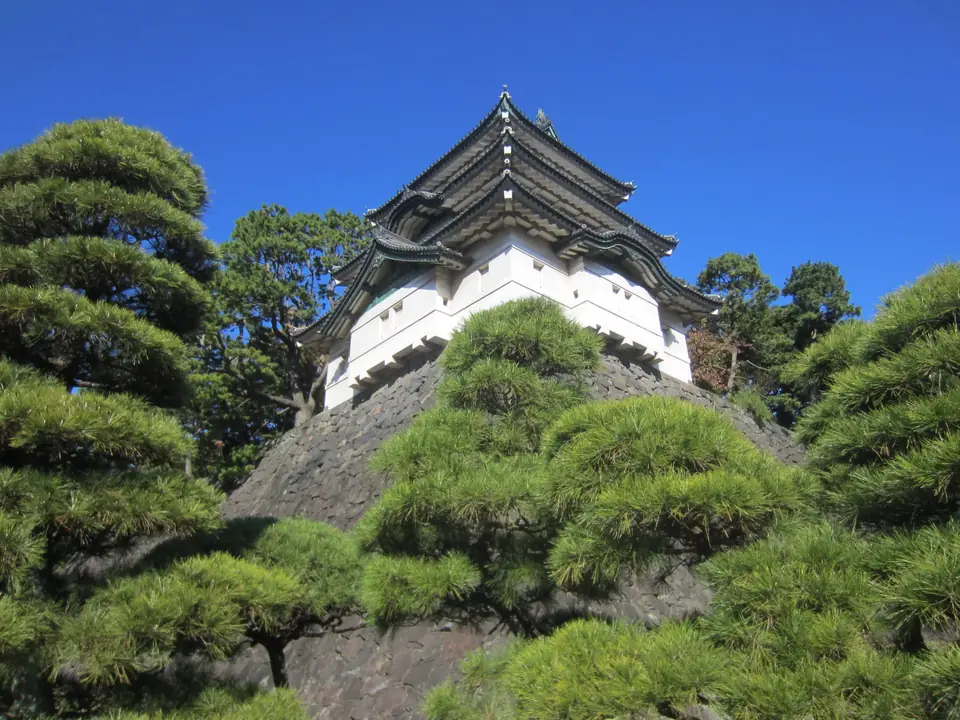
- Fujimi-yagura — the three-storey turret that served as the main tower from 1659
- Tenshudai — a 46 × 42 m granite base for a tower that was never built
- Shiomi-zaka — the slope that looked out on a sea that is now Marunouchi
The history of the Imperial Palace East Gardens is that of a centre of power made of gaps. Where the shōgun’s palace stood, with its official halls, its private rooms and the Ōoku, the women’s quarters, a great lawn now spreads. Where the castle’s tallest tower stood, a granite pedestal remains. And where the sea once reached, at the foot of a slope, the offices of Ōtemachi and Marunouchi now rise. The gardens, opened in 1968, reached 30 million visitors on 27 March 2018.
That emptiness holds episodes of which not a stone remains. In the Honmaru, according to documented tradition, the shōgun had to ring a small bell and wait to be let through to his own women’s quarters, and in 1714 a lady who arrived late after an afternoon at the theatre set off the greatest scandal in the Ōoku; the story of the actor hidden in a chest, the one everybody remembers, is a later legend that appears in no records. On the Bairin-zaka slope, tradition credits the first plum trees to Ōta Dōkan, who is said to have dedicated a shrine to Tenjin there after dreaming of him in 1478.
What to see in the East Gardens, then, is also learning to read what is missing. Among what does still stand are the Edo-period guardhouses, the Fujimi-tamon, the Ninomaru garden with its carp pond and the Suwa no chaya teahouse, and a Musashino woodland recreated solely from rescued soil. The exit through the Hirakawa-mon gate has its own history: it was the one used by the Ōoku’s maidservants and, according to popular belief, criminals caught inside were expelled through it. The audio guide covers the old castle in six stops, from the Ōtemon gate to the Shiomi-zaka slope, with documented narration checked against historical sources.
The 1657 fire that razed the castle also lies at the origin of the district of Tsukiji Outer Market, to the southeast. To the north, Ueno Park holds what is left of Kan’ei-ji, the Tokugawa’s great temple, and to the south Tokyo Tower rose in 1958 over a corner of Zōjō-ji, the temple of their mausoleums.
A gate from 1967 with a fish from 1657
Ōtemon Gate
Summary of this stop
The castle’s main entrance, the one used by the shōgun and the daimyō, is not crossed in a straight line. The Ōtemon encloses, between a small gate and a large one set at right angles, a square courtyard of stone walls designed to slow down anyone who came. The great wooden gate seen today is a reconstruction from 1967: the original was destroyed in a Second World War bombing.
One piece of the original roof survived and is displayed beside the gate’s panel: the head of the shachi, the mythical fish that protected against fire, with a date engraved, 1657. It is the year of the great Meireki fire, and what that coincidence foretells about the rest of the walk is told in the courtyard. From here, the visitor enters the 210,000 square metres that the imperial grounds opened to the public, free of charge, in 1968.
A hundred musketeers and lords stepping down from the palanquin
Hyakunin-bansho
Summary of this stop
The climb to the Honmaru was a succession of checkpoints. Beside the site of the old Ōte-sannomon gate stands the Dōshin-bansho, a low guardhouse whose roof tiles bear the triple hollyhock of the Tokugawa, the imperial chrysanthemum and the mitsudomoe. In front of it was a bridge where every daimyō and official, except those of the three main branches of the Tokugawa, had to get down from the palanquin and continue on foot, while the dōshin watched over the retinues waiting outside.
Further up stretches the Hyakunin-bansho, the “guardhouse of the hundred men”, the largest of the three Edo-period guardhouses that survive: a 45-metre wooden building that controlled the way into the Honmaru. It was guarded day and night by four musketeer corps, the Kōga, Iga, Negoro and Nijūgo-kigumi, each with 100 low-ranking dōshin and 20 yoriki. How that filter worked, and what a great lord felt walking it on foot, is what the narration reconstructs in front of the guardhouse.
The turret that inherited the view of Fuji
Fujimi-yagura
Summary of this stop
At the south corner of the Honmaru, the Fujimi-yagura raises its three white storeys 16 metres above a 15-metre wall. It was rebuilt around 1659, after the Meireki fire, and became the castle’s symbol and its substitute tower when the main one was lost. Its name comes from the view of Mount Fuji, 100 kilometres away.
That view has an older story. The Seishōken, the residence of Ōta Dōkan, the castle’s founder in 1457, is supposed to have stood at this end of the plateau. According to a documented tradition, when the shōgun Ashikaga Yoshimasa asked him in Kyoto what the place was like, Dōkan answered with a poem of pine groves, a nearby sea and the summit of Fuji seen from the eaves. Almost two centuries separate that poem from the turret that inherited its name, and the narration joins both ends in front of the wall.
Two daggers in a palace that no longer exists
Matsu no Ōrōka marker
Summary of this stop
At the edge of the Honmaru’s great lawn, among trees, a small stone stele marks where the Matsu no Ōrōka stood, the palace’s “great pine corridor”, about 55 metres long and 4 wide, with pines painted on its sliding doors. There, in 1701, Asano, lord of Akō, wounded the master of ceremonies Kira. He was sentenced to suicide that same day, and a year later 47 of his masterless samurai killed Kira: it is the episode that gave rise to Chūshingura.
Seventeen years earlier, in the same palace, there was a graver blow, whose motive remains a disputed story. In 1684, near the hall where the shōgun received his counsellors, Inaba Masayasu stabbed his relative Hotta Masatoshi, the grand councillor; those present killed the attacker on the spot. The official version spoke of madness, but suspicions point in several directions. Today that lawn is also the stage of the Daijōsai, the enthronement rite, with the Daijōkyū pavilion raised in 1990 for Akihito and in 2019 for Naruhito. What changed in the palace after the crime of 1684 is told beside the stele.
An open window and the tower that never returned
Tenshudai
Summary of this stop
At the north end of the Honmaru rises the tenshudai, the base of the keep. It was built by the Maeda clan of Kaga, led by Maeda Tsunanori, between May and early October 1658. According to the official sign, the main granite block measures 46 metres north to south, 42 east to west and 10 high (other sources give slightly different figures), and a small adjoining base of Izu andesite served as a ramp. You can climb to the top, where there is no tower at all. A 1:30 scale model of the 1638 tower is displayed in the nearby rest area.
Three towers came before this void, in 1607, 1623 and 1638, each dismantled and rebuilt by the next shōgun; the last, Tokugawa Iemitsu’s, had five roofs outside, six floors inside and about 58 metres including the base, by the most quoted figure. In 1657 it burned down entirely because a copper window on the second level, which should have been shut, had been left open, and the embers of the city blew in through it. Why a fourth was never built is a matter of debate: the official sign attributes it to advice from Hoshina Masayuki, the shōgun’s uncle, while some historians recall that no document of the period explains it. What Hoshina is said, by tradition, to have said can be heard at the top of the base.
The slope that looked out to sea
Shiomizaka
Summary of this stop
From the viewpoint on the Honmaru’s eastern edge, built where a turret burned in 1863, you look over the Hakuchō-bori, the only moat that survives between the Honmaru and the Ninomaru. Beside it runs down Shiomi-zaka, the “slope that looks at the sea”. When the castle was built, the water reached its foot; from 1603 Ieyasu levelled the Kanda hill to fill in the Hibiya inlet, and all the land between the palace, Tokyo Station and the bay is reclaimed from the sea.
Below, in the Ninomaru, there is another reclaimed ground, though of a different kind. Between 1983 and 1985, on the initiative of Emperor Shōwa, a woodland was created with soil brought from the outskirts of Tokyo that were about to be built over. The seeds, roots and insect eggs it contained did the rest, and what grew by itself is the end of the walk.