Tokyo's most photographed crossing
Shibuya Crossing Audio Guide (Shibuya Scramble Crossing)
Five streets empty at once on every green light beneath a ring of giant screens. What looks like spontaneous chaos is a traffic solution from 1973, with one diagonal fewer, built around a bronze dog that attended the unveiling of its own statue.
- 40 min of audio
- Urban crossing and pop culture
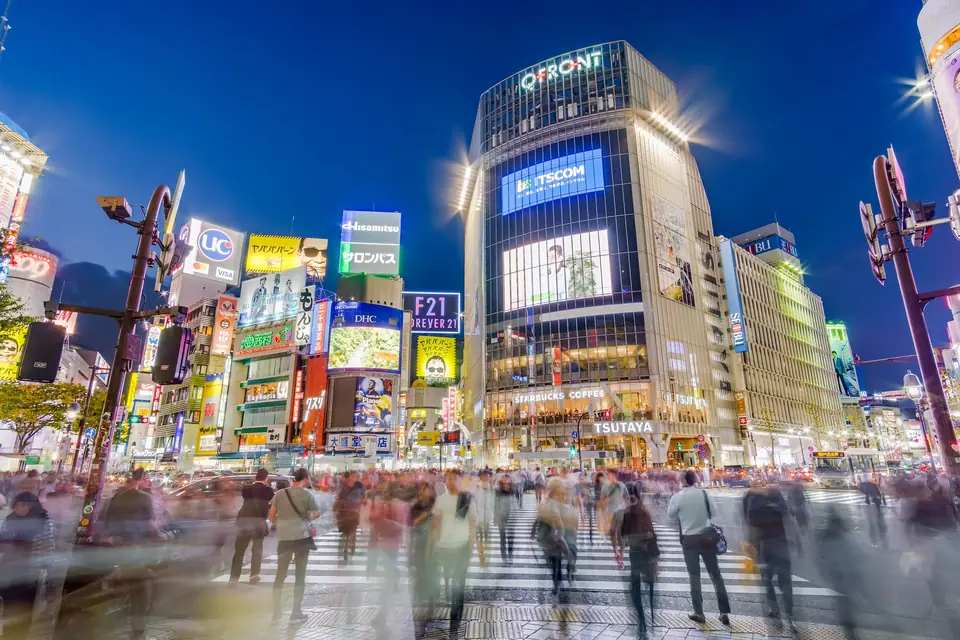
The crossing in front of Shibuya station, whose official name is Shibuya Ekimae Kōsaten, became a “scramble” crossing, with all pedestrian lights green at once, in 1973, the same year Shibuya Parco opened and young people began to fill Center Gai. The station had been turned to face this junction in 1921, and the flood began in 1968 with the Seibu department store: in front of today's QFRONT, the count rose from 22,000 to 74,000 pedestrians on a weekday within a month. A 2014 count estimated some 260,000 a day on weekdays and 390,000 on holidays.
Its fame as an icon is more recent than it seems. In a 1998 survey, the symbols of Shibuya were Shibuya 109, Hachikō and Center Gai, and the crossing was barely recognised as such; worldwide exposure came with Sofia Coppola's “Lost in Translation” in 2003, and with the crowds of the 2002 World Cup, of New Year's Eve and of Halloween. Since then, the city has been rehearsing how to live with them: ordinances against drinking in the street, fences around the statue and screens that switch off before midnight.
Highlights
- Hachikō statue — the 1948 bronze that replaced the one the dog got to see in 1934
- The single diagonal — about 36 m of diagonal crossing, without the second stroke of the X
- QFRONT — the screen facade of the dinosaur in Lost in Translation
- Five streets and ten lanes — up to 3,000 people crossing on a single green
- MAGNET by SHIBUYA109 — the crossing seen almost vertically from the rooftop
The story of Shibuya Crossing begins underground and in a square. In 1921 the station moved almost to its present site and for the first time faced this crossing; the following year the municipal tram was extended to today’s Hachikō square. After the war, the square filled with black-market vendors, and to relocate them Shibuchika, the shopping arcade that runs just beneath the asphalt, opened on 11 December 1957: the first major underground arcade in Japan.
The label of “busiest crossing in the world” always accompanies this place, but the figures vary: some sources speak of 1,000 to 2,000 people per green, others of up to 3,000, and of between 260,000 and 500,000 a day, with no standardised comparative count to back the primacy. What can be measured is its geometry: not four arms but five streets, with 10 traffic lanes and 5 painted crosswalks, in cycles of about two minutes.
What to see at Shibuya Crossing goes beyond the human tide. In the square, from 2006 to 2020, a green train carriage served as a tourist office; on one corner, a roasted-chestnut stall has operated, so it is said, for some 70 years, long before the scramble; and in Ashikaga, in another prefecture, a full-size replica was built in 2019 for filming, with even the chewing-gum stains on the asphalt reproduced. The audio guide covers the crossing in four stops, from the Hachikō statue to the view from above, with documented narration checked against historical sources.
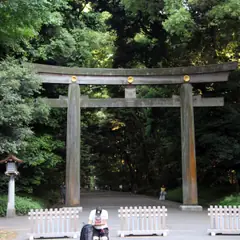
To the north, the forest of Meiji Shrine offers the silent counterpoint to the tide of the crossing, and Tokyo Tower, the other great icon of modern Tokyo, had at its entrance for half a century bronze dogs by the same sculptor as the Hachikō.
The dog that saw his own statue
Hachikō statue
Summary of this stop
Beside the Hachikō exit of the station, the dog’s bronze shines on the front paws and the muzzle from so much rubbing. Hachi, an Akita, went to meet his owner, Professor Ueno Hidesaburō, at Shibuya station for almost ten years after he died on 21 May 1925. On 21 April 1934 his first statue was unveiled, the work of Andō Teru, and Hachi attended in person, almost eleven months before dying on 8 March 1935. Even in his lifetime the rumour circulated that he went to the station for the yakitori stalls; those who knew him denied it, and the debate remains open.
That statue was withdrawn in 1944 for the metal requisition and ended up melted down on 14 August 1945, the eve of the surrender announcement, turned into locomotive parts. The present one was made by Andō Takeshi, son of Andō Teru, who had died in the bombing of 25 May 1945, and was unveiled on 15 August 1948 on the original pedestal. It has changed place several times; since 1989 it faces the station head-on, on a low pedestal that can be touched. Every 8 April, since 1936, Hachikō Day is celebrated here, and why that date matches none of the dates of his life is told before the statue. The material with which the son cast the new bronze has its own story too.
The X that is missing a stroke
Diagonal crosswalk
Summary of this stop
From the kerb, the crossing reveals that disorder has rules. Since 1973 all pedestrian lights turn green at once, in cycles of about two minutes, and at peak moments up to 3,000 people cross on a single green, according to the 2014 count.
You only need to look at the ground to find the anomaly. The crossing has just one painted diagonal, of about 36 metres, between Hachikō square and QFRONT, instead of the usual X. The Tokyo Metropolitan Police have no record of the second ever having been studied, and the neighbouring Dōgenzaka-shita crossing, in front of the 109, does have the full X. What changes in the way of crossing once this is known is what the narration proposes at this point.
QFRONT, the corner of the screen
QFRONT
Summary of this stop
On the northwest corner, the QFRONT building is entirely a glass screen. Before it was QFRONT it was the Minegishi building, and in front of it the effect of Seibu’s opening on 19 April 1968 was measured: on a holiday, the count went from 21,000 to 125,000 pedestrians. To its left begins Center Gai, the pedestrian street to the northwest that makes the crossing an intersection of five streets and through which youth entered Shibuya.
This facade is also a film set. On its screen a dinosaur is seen passing in “Lost in Translation”, the Sofia Coppola film that in 2003 gave the crossing worldwide fame and whose director compared the landscape to “Blade Runner”; the screen was for a time replaced by static advertising and came back into operation in July 2013. Another shoot left a stranger episode here: for “The Fast and the Furious: Tokyo Drift”, in 2006, the crew filmed without permission, and who ended up spending the night in a cell when the police arrived is the story heard on this corner.
The board seen from above
MAGNET by SHIBUYA109
Summary of this stop
From the rooftop of MAGNET by SHIBUYA109, on the northeast corner, the crossing is seen almost vertically, like a board. Around it, six large outdoor screens broadcast adverts and music videos for those waiting for the green.
The height helps to understand the city’s relationship with its crowds. At 1:00 on 28 October 2018, the weekend before Halloween, a crowd overturned a van in Shibuya; in June 2019 the district passed an ordinance against drinking in the street, which since 1 October 2024 applies all year from 18:00 to 5:00. At Halloween 2023 and on New Year’s Eve 2023-2024 the Hachikō statue was fenced off and the screens were switched off at 23:00 on 31 December. Before all that, on the night of 4 June 2013, when Japan qualified for the Brazil World Cup, the police closed this crossing for the first time, and a young officer standing on a van found an unexpected way of calming thousands of fans. How he did it, and the nickname he earned, close the walk.