Shinto shrine in Harajuku
Meiji Shrine Audio Guide (Meiji Jingū)
A dense, silent forest with an air of great age wraps the shrine of the emperor who modernised Japan. It was planted by hand little more than a century ago, almost entirely on wasteland, and since then nobody has added or removed anything from it.
- 60 min of audio
- Shrine and planted forest
Meiji Shrine is dedicated to Emperor Meiji and Empress Shōken, and its grounds have had several lives. From 1640 it was a secondary residence of the Ii lords of the Hikone domain; in 1874 the Meiji government bought it and made it an imperial estate. When work began, of the 70 hectares of the inner precinct only 8 were wooded: 89% was scrub. The shrine was completed on 1 November 1920 with some 100,000 trees donated from all over Japan, according to the official figure, and the work of about 110,000 volunteers directed by the forester Honda Seiroku.
The emperor prayed to here is not buried here. By his own wish, his tomb was built in Kyoto, in Fushimi Momoyama, on the spot where Toyotomi Hideyoshi had raised the keep of his castle; Tokyo asked for the mausoleum, did not get it and ended up building this shrine. Even so, year after year it is the shrine in Japan with the most visitors at hatsumōde, the first visit of the New Year, drawing millions of people every January since its founding.
Highlights
- 70-hectare forest — planted by hand on wasteland and left without human intervention since 1920
- Ōtorii — 12 m high and 17.1 wide, made from a 1,500-year-old Taiwanese cypress
- Sake and Burgundy wine barrels — traditional and Western Japan face to face
- Kiyomasa's Well — the spring that television turned into a lucky phone wallpaper
- South gate — original from 1920, survivor of the 1945 fire
The story of Meiji Shrine begins with a forest that did not exist. A step from Harajuku station, gravel paths sink beneath oaks, camphor trees and fallen trunks left to rot on the ground, and everything seems ancient. It is not: the forest was planted in the years before 1920 on an almost bare estate, and since its creation it has been left without human intervention; today it holds 234 varieties of tree. How many were donated at the start is a matter of debate: the official website speaks of 100,000, other sources of 120,000 or 90,000, and in 2019 some 36,000 remained, fewer but much larger.
The shrine opened with a tragedy and was rebuilt after another. On the day of the enshrinement ceremony, 1 November 1920 according to the shrine (other sources give 3 November, the day of the annual festival), more than 500,000 people came, and the crush left 38 casualties, dead and injured. In the early hours of 14 April 1945, during an air raid, the main shrine burned until dawn; the forest survived. The reconstruction, by public subscription, was finished in October 1958 with a design that opened the courtyard to the public.
The architecture of Meiji Shrine, then, mixes timber from 1920, copper from 1958 and torii from 1975 and 2022. In 2020, a total of 36 buildings in the grounds were designated Important Cultural Properties of Japan. Among them appear documented traditions that bring the walk to life: the Meoto Kusu, two camphor trees planted in 1920 and joined by a sacred rope, where people come to ask for a partner, or the iris field the emperor ordered planted in 1893 for Empress Shōken. The audio guide covers the shrine in five stops, from the first torii to the prayer courtyard, with documented narration checked against historical sources.
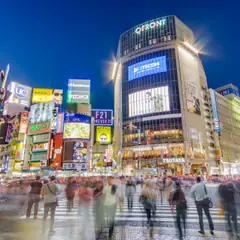
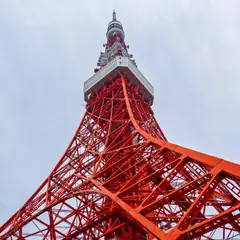
To the south of the forest, Shibuya Crossing shows the busiest face of west Tokyo, and some four and a half kilometres to the east rises Tokyo Tower, another postwar symbol finished in 1958, the same year as the shrine’s reconstruction.
The cedar torii of an invented forest
Jingū Bridge
Summary of this stop
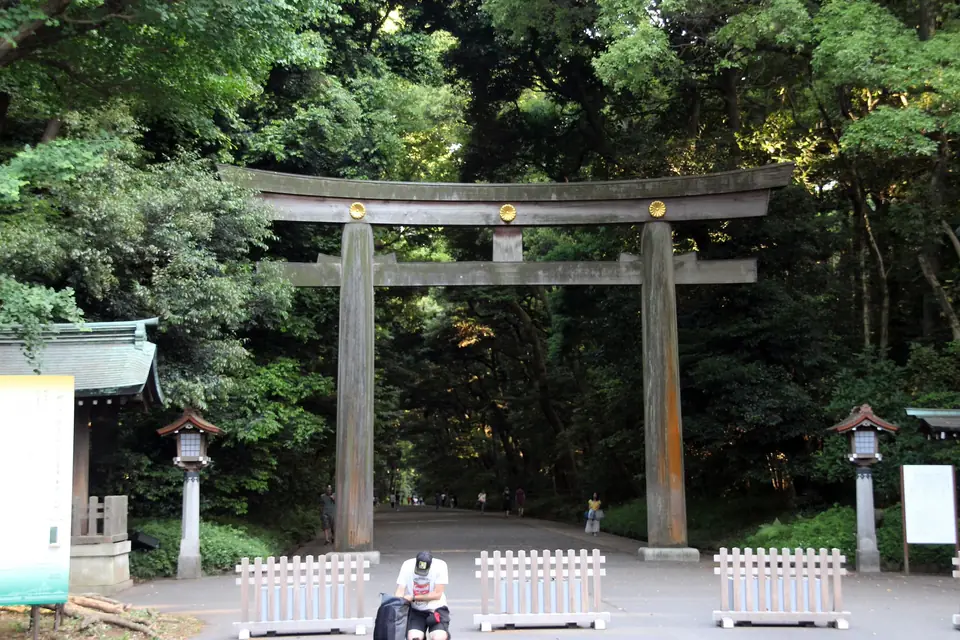
The walk begins beside Harajuku station, before a 10.1-metre torii with pillars of Yoshino cedar from Kawakami (Nara), about 260 and 280 years old. It was installed in 2022 to replace the last of the eight torii remaining from 1920, and it is the first cedar torii of the grounds: felling Taiwanese cypress, the wood of the originals, is prohibited. It keeps the fittings with the imperial chrysanthemum from the previous torii.
Behind it the forest begins, and with it an old argument. Prime Minister Ōkuma Shigenobu wanted a cedar forest like the one at Ise. The forestry team, with Honda Seiroku, Hongō Takanori and Uehara Keiji, persuaded him face to face to plant evergreen broadleaves, kashi and shii oaks and camphor trees, because the soil was dry and the smoke from the neighbouring trains would kill cedars. That the first cedar arrives a century later, and in the form of a gate, is the irony with which the narration opens.
The well that television turned into a charm
Meiji Jingu Gyoen
Summary of this stop
The Gyoen garden, with paid admission, is the oldest layer of the place: it was a daimyō garden of the Ii lords from 1640 and, from 1874, an imperial estate. It has a pond, the Kakuuntei pavilion and an iris field that blooms in June, planted in 1893 on former rice paddies by order of the emperor for Empress Shōken.
In its most secluded corner wells up the Kiyomasa-no-ido, a small spring that, according to tradition, was dug by General Katō Kiyomasa, whose family had a villa here in the early Edo era. It received at most some 20 people a day until 25 December 2009, when television presented it as a “power spot” and a palm reader said that luck had smiled on him after a visit. A popular custom was born: photographing the water and setting it as a phone wallpaper. Waits of several hours became common, and what that says about today’s Tokyo is told beside the well.
Sake, Burgundy wine and a Taiwanese cypress
Sake and Burgundy barrels
Summary of this stop
Along the path, two walls of barrels face each other. On one side, the sake barrels, empty and wrapped in straw, offered every year to the shrine by the national association of sake producers. On the other, the wine barrels that several Burgundy wineries donated in 2006 in memory of Emperor Meiji’s fondness for French wine. Traditional and Western Japan stand face to face, as in the Meiji era itself.
The barrels sum up how the shrine was made: with gifts that came from far away. A few metres further on, the ōtorii makes it physical. The 1920 one was made from a 1,200-year-old cypress from the Alishan range in Taiwan, and lightning destroyed it in 1966. The present one, of the myōjin style, is 12 metres high and 17.1 wide, with pillars 1.2 metres in diameter, and was finished on 23 December 1975 with a 1,500-year-old cypress from Mount Danda. How that tree was found is part of what the narration reveals beneath the crossbeam.
The gate that survived the fire of 1945
South Gate Minami-shinmon
Summary of this stop
The south gate, Minami-shinmon, two-storeyed and covered in copper, is original from 1920. It saw the crush on opening day and still stood in the early hours of 14 April 1945, when the priests carried the sacred object through the forest to the Treasure House and, at 1:40, the main shrine began to burn. After the fire it served as a provisional place of prayer, with its leaves closed to hide the ruins.
The reconstruction had a notable episode. On 11 September 1955, the first timber for the new shrine, felled at Hichisō (Gifu), arrived by train at Shinjuku, and from there worshippers, boy scouts and sumo wrestlers dragged it by hand in the o-kibiki ceremony, a rite almost exclusive to the great shrine of Ise that had never been held in Tokyo. The copper plates of the roof were raised from the public, and the way the last fittings were placed is revealed in front of the gate.
An open courtyard where yokozuna make their debut
Gehaiden courtyard
Summary of this stop
Crossing the gate, the courtyard opens before the prayer halls. The shrine rebuilt in 1958, the work of Sunami Takashi, removed the intermediate gate that separated the public from the main shrine and replaced the cypress-bark roofs with copper. Beside the wall of votive plaques something that abounds at other shrines is missing: here there are no omikuji of good or bad luck. The slip you draw, the Ōmikokoro, carries a waka by the emperor or empress with a commentary, predicts nothing and is taken home.
This courtyard is also a living stage. Each new yokozuna, the highest rank in sumo, appears here in public for the first time with the dohyō-iri, the ceremonial entrance with claps, stamps and a long bend of the knees. The first was Ōnishiki, on 2 November 1922; Kisenosato did it in 2017 before more than 20,000 people, and Hoshōryū in 2025, with his uncle Asashōryū watching from the side. The calendar coincidence that joined uncle and nephew is the last story of the walk.