The hill where Edo lost its war
Ueno Park Audio Guide (Ueno Onshi Kōen)
Cherry trees, museums and a lotus pond cover the hill where the shoguns' temple burned in 1868. In Ueno Park the victor has a statue, the defeated have a tomb and, between them, the buildings that survived everything still stand.
- 75 min of audio
- Historic park of Edo and Meiji
The history of Ueno Park begins with a temple. Kan'ei-ji was founded in 1625 on Ueno hill, to the northeast of the Edo of the Tokugawa, the “demon gate” of the castle, and took the name Tōeizan, “the Hiei of the east”, in imitation of the Enryaku-ji that protected Kyoto. At its height it occupied nearly double the area of today's park and brought together 36 subtemples. The battle of Ueno, on 4 July 1868, reduced it to ashes, and the decree of 15 January 1873 turned the razed hill into one of Japan's first public parks.
Its official name, Ueno Onshi Kōen, means “park of the imperial gift”: in 1924 Emperor Taishō gave it to the city of Tokyo on the occasion of Hirohito's wedding. On the old temple the Tokyo National Museum was later built, on the site of the abbot's residence, and Ueno Zoo, opened in 1882, the oldest in Japan. Shinobazu Pond, which the paths now surround, has been a sacred lake, a horse-racing track and a rice paddy.
Highlights
- Statue of Saigō Takamori — a 1898 bronze in hunting clothes with a dog, which his widow did not recognise
- Shōgitai tomb — a 6.7 m stone for the 266 defeated of 1868, without their names
- Kiyomizu Kannon-dō — a terrace copied from Kyoto and a pine with a branch curved into a circle
- Ueno Tōshōgū — a gilded shrine of 1651 that survived 1868, 1923 and 1945
- Face of the Great Buddha — what remains of a Buddha of 1631, invoked by students
The history of Ueno Park is that of a defeat turned into a stroll. On 4 July 1868, the Shōgitai, loyal to the shogunate, entrenched themselves on the hill; Saigō Takamori’s troops forced the Kuromon gate, the Armstrong artillery of Saga fired over Shinobazu Pond and by about five in the afternoon the resistance had collapsed. The fire destroyed most of Kan’ei-ji, the great temple of the Tokugawa. The Kiyomizu-dō, the Tōshōgū, the five-storey pagoda, the Great Buddha hall and the time bell were saved.
The hill might have ended up as a hospital. In 1870, by the general chronology (other sources give 1871), the Dutch military physician Anthonius Bauduin, invited to inspect the land for building a hospital and medical school there, proposed keeping it as a park; the National Diet Library presents that proposal as something that “is said”, while the Ueno tourist association calls him the park’s creator. In 1877 Japan’s first National Industrial Exhibition was held here, and Meiji Japan began to put itself on show over the ashes of Edo.
What to see in Ueno Park includes, besides the museums and the some 800 cherry trees, the traces of other nights. After the bombing of 10 March 1945, the park appears in the register of provisional burials with 8,386 bodies, and beside the Kiyomizu Kannon-dō a monument from 2005 gathers some thousand people in silence every 9 March. On the Bentendō island, Tokyo guilds have raised steles for fugu, kitchen knives or eyeglasses, and along the Tōshōgū approach stand copper lanterns that were never lit. The audio guide covers the park in five stops, from the Saigō statue to the great fountain, with documented narration checked against historical sources.
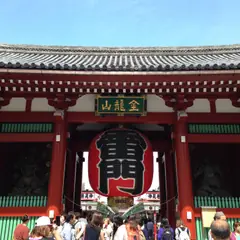
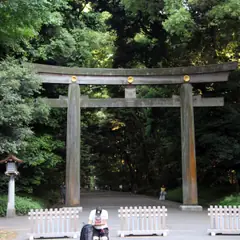
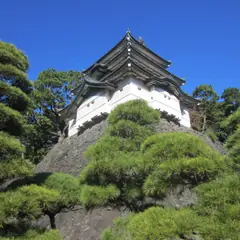
To the east, Asakusa and Senso-ji Temple complete the Tokyo of the shitamachi; to the south, the Imperial Palace East Gardens occupy the heart of the castle of the very Tokugawa whom Kan’ei-ji protected. Across the city, Meiji Shrine honours the emperor in whose name the troops that took the hill in 1868 fought.
The bronze general and the defeated
Saigō Takamori statue
Summary of this stop
At the park’s south entrance, on Sannōdai, from where the Shōgitai fired in 1868, stands the statue of Saigō Takamori. It is the work of Takamura Kōun, with the dog by Gotō Sadayuki, and was unveiled on 18 December 1898, twenty-one years after Saigō died as a rebel, paid for with 500 yen from the Imperial Household and donations from more than 25,000 people. It is 370.1 centimetres tall and wears no uniform but rabbit-hunting clothes, with a straw trap at the belt. The initial project, on horseback and as a general, was discarded, and the change is attributed to the intention of removing the rebel burden from the figure. At the unveiling, his widow Itoko said: “my husband was not like that.”
Behind, a 6.7-metre stone marks the place where the 266 dead Shōgitai were cremated. It says only “tomb of the fallen”, in the calligraphy of Yamaoka Tesshū, without the names of the defeated; at its feet, a 60-centimetre stone that two monks of Kan’ei-ji buried in secret the following year. The date of the large stone varies by source, between 1875 and around 1884. According to a documented tradition, the bodies were left on the hill as a warning until a monk risked his neck to bury them, and who helped him is told at the tomb.
A Kyoto terrace copied in Edo
Kiyomizu Kannon-do
Summary of this stop
The Kiyomizu Kannon-dō, a red hall on wooden stilts leaning out over the slope, dates from 1631 and was moved to its present site in 1694. It copies in miniature the terrace of Kyoto’s Kiyomizu-dera, and it is no isolated whim: the monk Tenkai reproduced in Ueno famous places of Kyoto and Lake Biwa. Shinobazu Pond stands in for Lake Biwa, and the Bentendō island for the island of Chikubushima. The whole hill was designed as a Kyoto of the east to protect the shogun.
Before the terrace grows the “moon pine”, with a branch curved into a circle. The original was lost in the early Meiji and was replanted in 2012; inside the hoop the Bentendō can be made out. That pond has had unexpected lives: in 1884 it was partly filled in to lay out a racecourse, with Emperor Meiji at the first race, and after the war it was drained to grow rice, until in 1949 it was agreed to keep it. What that hoop frames, and why, is what the narration explains on the terrace.
A Buddha who can no longer fall
Ueno Daibutsu
Summary of this stop
At the top of Daibutsu-yama hill, a bronze face set into a wall is all that remains of the Great Buddha of Ueno, raised in 1631 by Hori Naoyori. It lost its head in several earthquakes and fires; after falling again in 1923, in 1940 its metal was requisitioned for the war, except the face. Since 1972 it has been on the wall, and attracts students who pray to pass exams because it “can no longer fall.”
Around it stretch the cherry-lined paths. In 1698, with the completion of the temple’s great hall, the common people of Edo were allowed hanami under the hill’s blossoms, and Matsuo Bashō wrote his “cloud of flowers: is the bell from Ueno or from Asakusa?” Under those same paths, in 1945, thousands of bombing victims were provisionally buried; the exhumations began in 1948 and lasted three years. How that memory coexists with the spring festival is told in front of the Buddha’s face.
The gilded shrine nothing could bring down
Ueno Tōshōgū Shrine
Summary of this stop
Beyond a stone torii of 1633 and an avenue of bronze lanterns, the Ueno Tōshōgū preserves the gilded building that Tokugawa Iemitsu rebuilt in 1651. Founded in 1627 by Tōdō Takatora in honour of Tokugawa Ieyasu, it survived the battle of 1868 despite housing the Shōgitai headquarters, the 1923 earthquake without even its torii falling, and the bombing of 1945, when an incendiary bomb that fell beside the building did not explode. From the path you also see Kan’ei-ji’s five-storey pagoda, another survivor, now inside the zoo grounds.
At the Karamon gate, beside the gilded pillars, four carved dragons are attributed, according to tradition, to Hidari Jingorō, the legendary and perhaps fictional sculptor to whom famous carvings all over Japan are attached. One is called the “ascending dragon” and another the “descending dragon”, although the one looking down is the ascending one. The maxim attributed to Ieyasu that explains that inversion, and where legend says the dragons go every night, are heard at the gate.
The fountain where the great temple stood
Park's great fountain
Summary of this stop
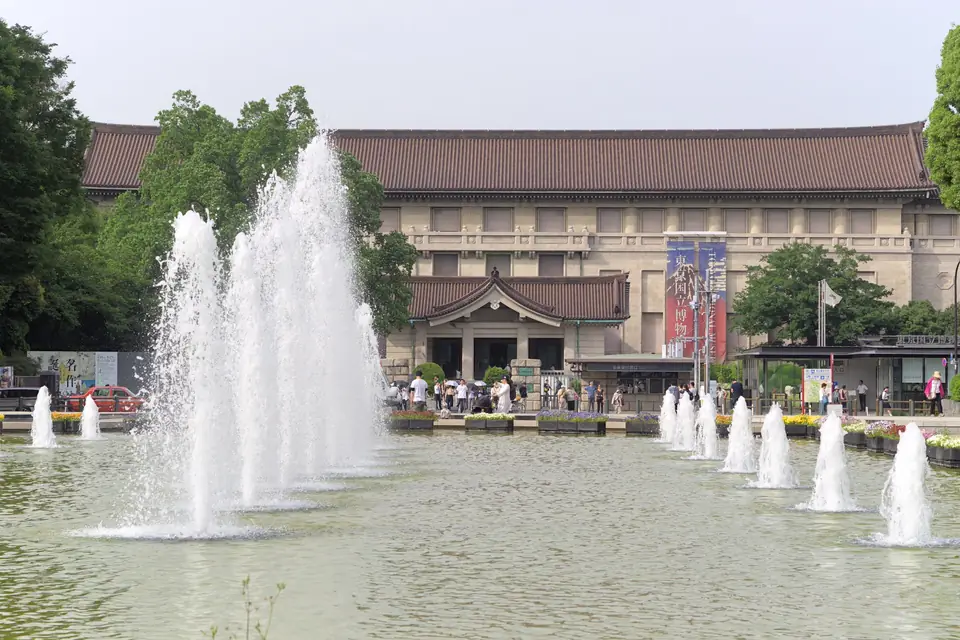
The great fountain in front of the National Museum occupies exactly the place of the Konpon-chūdō, the main hall of Kan’ei-ji, inaugurated in 1698: it measured 45.5 metres across the front, 42 deep and 32 high. It burned in 1868, and no visible trace of it remains; the temple’s present main hall is a building brought in 1879 from the Kita-in of Kawagoe. To the north the Tokyo National Museum closes the perspective, built on the site of the abbot’s residence, where in 1877 the first National Industrial Exhibition was held.
To the west of the square, a bust commemorates Dr Bauduin. The version seen is from 2006, because the original, the work of Mari Andriessen unveiled on 5 October 1973 for the park’s centenary, had the wrong face. Whose face that was, and why it took three decades to correct, is the last story of the walk.