Symbol of postwar reconstruction
Tokyo Tower Audio Guide
A postcard tower of 333 metres that hides an improbable story: it was raised in 1958 on a burned corner of the Zōjō-ji cemetery, by riggers working without harnesses and, in its upper part, with the steel of tanks scrapped after the Korean War.
- 60 min of audio
- Tower and viewpoint from 1958
Tokyo Tower was born of a journey. In early 1956, in San Francisco, the Osaka publisher Maeda Hisakichi imagined a broadcasting tower as “the Golden Gate stood on end”, able to replace the separate towers of NHK, NTV and KRT; in May 1957 he founded Nippon Denpatō to build it. Maeda wanted 380 metres with the antenna, but the calculation by Naitō Tachū and Nikken Sekkei so that the wind would not make the antenna sway several metres gave 333: the triple three came out by chance, and the figure exceeded the 312 metres the Eiffel Tower then had.
It opened on 23 December 1958, with admission at 120 yen, and in 1959 5.13 million visitors went up, far above the annual record of Ueno Zoo. Since May 2013 television has broadcast from Tokyo Skytree, but the tower remains a backup antenna and an FM station, and that same year it was registered as a tangible cultural property of the State, cited as a symbol of postwar reconstruction. Its orange and white, required by aviation law, are repainted by brush, in the small hours, from wooden scaffolds.
Highlights
- View from Zōjō-ji — the tower behind the Tokugawa temple, over its former cemetery
- Arch of the four legs — the lattice assembled by tobi without rope or helmet
- Main Deck (150 m) — a ball found at 306 m and the highest shrine in Tokyo
- Top Deck (250 m) — the construction platform turned into a viewpoint in 1967
- Orange and white stripes — eleven until 1986, seven since
The story of Tokyo Tower begins in a burned cemetery. The foundations started on 29 June 1957, with the design still unfinished, at Momijiyama, a plot of the former Zōjō-ji grounds where the luxurious Kōyōkan restaurant had stood, and to make room for it part of the temple’s cemetery was demolished. The grounds, with the Tokugawa mausoleums, had burned in the wartime bombing, and the tower grew among those empty plots. Shiba-kōen beat Ueno for its elevation of 18 metres above sea level and for having the firm gravel layer at a shallow depth.
The architecture of Tokyo Tower is made of figures that shift. The official one is 333 metres; other sources give 332.9. Its advantage over the Eiffel Tower is counted as 21 metres or as 9, and the cost as some 2.8 or some 3 billion yen. The same goes for the tank steel: one version limits it to the part above the former special observatory, with about 90 tanks; others extend it considerably further. The whole tower weighs some 4,000 tonnes.
What to see at Tokyo Tower also includes its popular life. A popular belief, which everything suggests was born from a manga of the nineties, holds that a couple who watch the midnight light-off together will be happy forever. At its entrance for more than half a century stood the bronze group of the Antarctic dogs, by the same sculptor as the Hachikō of Shibuya, until in 2013 it was moved to Tachikawa; and at the base from 1970 to 2013 operated Japan’s first wax museum, with an unusual room devoted to progressive-rock guitarists. The audio guide covers the tower in four stops, from the neighbouring temple to the Top Deck, with documented narration checked against historical sources.
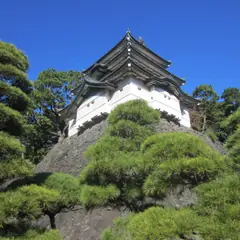
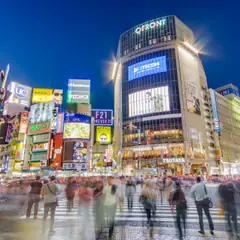
The Tokugawa buried in Zōjō-ji ruled from the castle whose grounds are now occupied by the Imperial Palace East Gardens, to the north. To the west, Shibuya Crossing is another of the icons of modern Tokyo, and some two kilometres to the northeast lies Tsukiji Outer Market.
The tower that peeks out behind the temple
Zōjō-ji
Summary of this stop
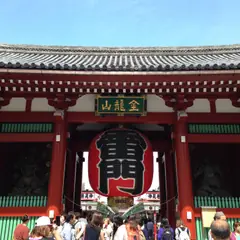
From the courtyard of Zōjō-ji’s great hall, the tower rises behind the roofs and the great vermilion gate: the Tokyo of the Tokugawa and that of the postwar in a single image. It is no visual coincidence. The tower occupies a corner of the temple’s former grounds, turned into a park and divided into 25 plots, and its construction began by demolishing part of its cemetery.
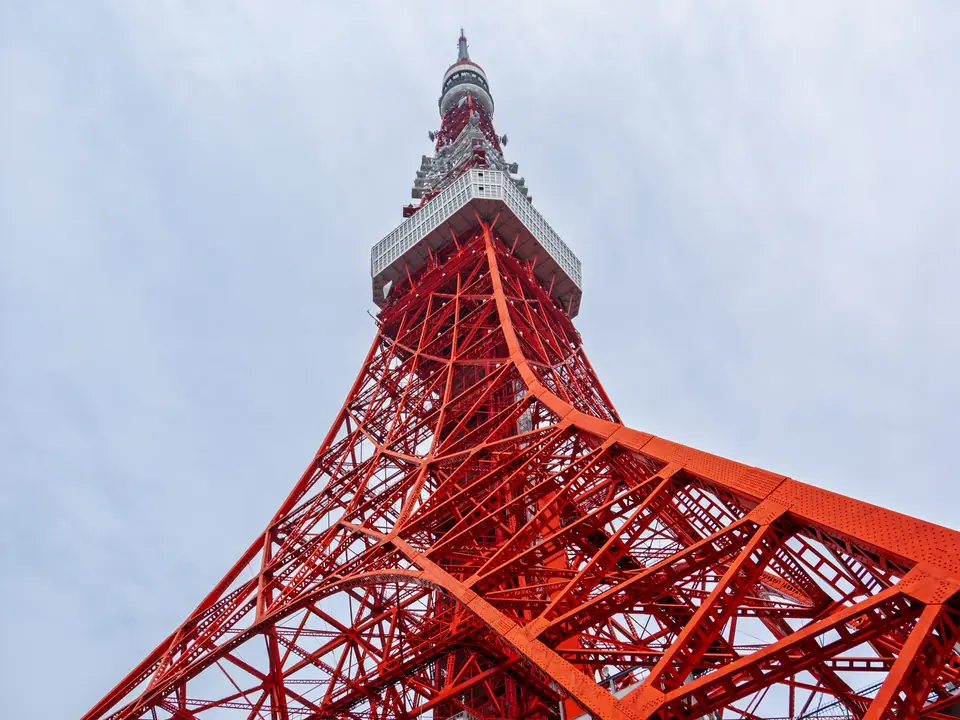
From here its colours are easy to appreciate. Aviation law requires the tower to be painted, above the Main Deck, in alternating stripes of international orange and white: there were 11 until 1986, when they became 7 and the orange turned redder. In 1958, many mistook that orange for the anti-rust primer and thought the paint was half done. Why an Osaka publisher wanted to plant a tower taller than the Eiffel here, and how he imagined it in San Francisco, is what the narration tells from the temple.
Sixty-one metres without a rope
Arch of the four legs
Summary of this stop
Beneath the tower, the four lattice legs join in an arch at about 40 metres’ height; it was closed in December 1957 after correcting a 15-millimetre misalignment in the rivet holes. The total height was no whim: Maeda demanded 380 metres, but at that height the wind made the antenna sway several metres, and the calculation to limit the sway to a few tens of centimetres while still covering all of Kantō gave 333.
It was assembled by the tobi, high-rise riggers who started the work without safety rope or helmet. On 30 June 1958, one of them, aged 31, turned on hearing a colleague; the log he was carrying struck the structure and he fell from 61 metres. His boss, Kurosaki Saburō, saw him off with a funeral in neighbouring Zōjō-ji. The crew chief, Kiryū Gorō, was 25, and what he did the day after the tower was finished is part of what is heard beneath the arch. Today that same structure is climbed on foot by an outside staircase of about 600 steps, and whoever reaches the top receives a numbered certificate.
A ball lost at 306 metres
Main Deck
Summary of this stop
The Main Deck, at 150 metres, is the two-storey white volume of the former “great observatory”, with glass-floored windows. From here you understand the affection the tower aroused from day one: 5,600 guests at the opening, led by Prime Minister Kishi Nobusuke, and millions of visitors the following year, with a fixed stop on school trips. Even the name was thoroughly ordinary: in a contest with 86,269 proposals the winner was “Tōkyō Tawā”, which had received only 223, because the jury president, the narrator Tokugawa Musei, ruled that “the ordinary is the best”.
In a display case a mystery waits. The earthquake of 11 March 2011 bent the antenna at the summit by 2°, and when its hollow mast was cut to be replaced, a soft baseball turned up at its base, at 306 metres, on display here since 22 December 2012. A few steps away is Tower Daijingū, consecrated in 1977 with the spirit of Amaterasu brought from Ise: the highest Shinto shrine in Tokyo’s 23 wards, to which students climb to ask for “higher” grades. How a ball could get up there is the question the narration leaves hanging.
The viewpoint made from tank steel
Top Deck
Summary of this stop
The Top Deck, at 250 metres, is the narrow, higher box on the shaft. It was formerly the special observatory at 223.55 metres, the construction work platform, which was left in place: for about ten years it served as a store for broadcasting equipment and did not open to the public until July 1967.
The steel of this upper part has an unexpected origin: it was made from the scrap of some 90 American tanks scrapped after the Korean War, because in Japan in 1957-1958 quality steel was scarce and the United States found it more worthwhile to sell the old tanks than to repair them. War material turned into a symbol of reconstruction, in a tower that no longer broadcasts the main television and remains the image of Tokyo. That fame made it a favourite target of film monsters, although the first to bring it down was not the one almost everybody thinks. Who it was, and why the screenwriter chose it, closes the walk.