The market that stayed
Tsukiji Outer Market Audio Guide (Tsukiji Jōgai Shijō)
A maze of some 460 food shops, knife stores and shophouses rising over a filled-in sea and over a temple's old cemetery. In 2018 the great wholesale fish market left for Toyosu; the outer market voted to stay.
- 60 min of audio
- Edo market and shrine
The Tsukiji outer market was born without an official plan. After the Kantō earthquake of 1923, which razed the old Nihonbashi fish market and burned the Tsukiji Hongan-ji temple with its 57 subtemples, the plot left by the temple's cemetery filled with fishmongers, kitchenware shops and eateries for the people of the new wholesale market, which opened provisionally in December 1923 and was inaugurated as the central market on 11 February 1935. The very name Tsukiji, “built land”, recalls that all this was once a marsh of the bay, filled in after the great Meireki fire of 1657.
When the wholesale market closed, on 6 October 2018, the outer market's shops did not leave with it. Days earlier, after a public vote, they announced they would keep the name Tsukiji Jōgai Shijō. The move to Toyosu was controversial: planned for 2016, it was postponed over deficiencies in the treatment of the contaminated soil of the new site, and the cost of the delay and the compensation to wholesalers gave rise to much talk. Today, from a rooftop of the market itself, you can see the enormous empty plot left by the old neighbour.
Highlights
- Monzeki-dori — shops on the former street of Tsukiji Hongan-ji's subtemples
- Yamacho's kushi-tama — the sweet omelette on a skewer eaten in front of the stall
- Kaikobashi rooftop — a view over the site of the old wholesale market
- Namiyoke Inari — giant lions over 2 m and mounds to sushi, shrimp and egg
- Iron basins of 1838 — an offering from the stevedores of the Owari domain
The story of Tsukiji market begins in the water. After the great Meireki fire of 1657, Edo’s Hongan-ji temple was rebuilt on a sandy marsh of the bay that had to be filled in, and from that built land came the district’s name. Local sources place the filling of the temple’s land in 1658; one encyclopedia moves it to the 18th century. According to a documented tradition, those who filled it were the fishermen of Tsukudajima, brought to Edo by Tokugawa Ieyasu and faithful of Hongan-ji, the same community that had opened the Nihonbashi fish market.
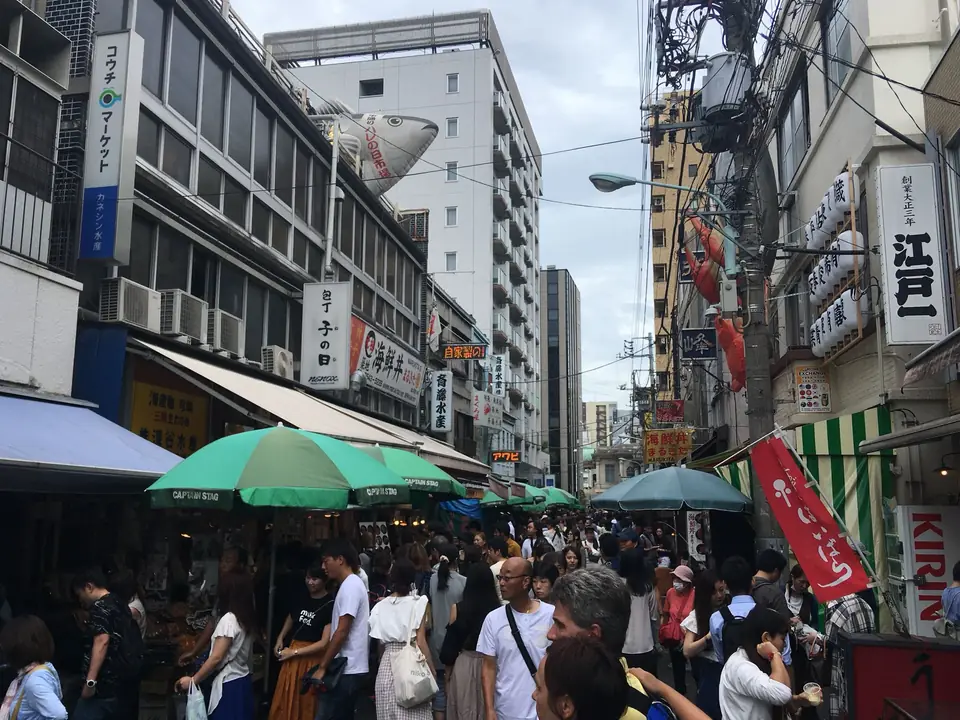
Three centuries later, that market came to Tsukiji. The 1923 earthquake destroyed Nihonbashi and the fish moved to the ground its founders had built up; around it, over the cemetery of the relocated temple, the outer market was born. Today it brings together some 460 shops and restaurants, according to tourist and municipal figures (other sources speak of some 450 or almost 500), in a layout of alleys described as a maze, with buildings more than 80 years old where goods are sold downstairs and people live upstairs.
What to see in Tsukiji therefore goes beyond sushi: the Indian-style facade of Tsukiji Hongan-ji, from 1934, the queues of Namiyoke-dori, the halls of Tsukiji Uogashi and a shrine with giant lions that, according to legend, calmed the sea. There is also a documented festival, the Tsukiji Shishi Matsuri in June, already described by an almanac of 1838, which brings out onto the street a lion’s head weighing a tonne. The audio guide covers the market in four stops, from the temple to the shrine, with documented narration checked against historical sources.
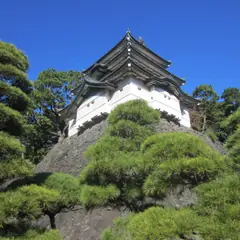
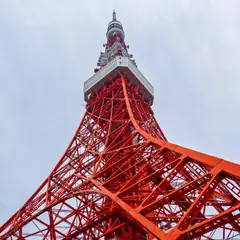
To the northwest, the old Edo Castle survives in the Imperial Palace East Gardens, marked by the same 1657 fire that gave rise to this district; some two kilometres to the southwest stands Tokyo Tower, and further north, in Asakusa, Senso-ji Temple preserves another piece of popular Edo.
A market over the temple’s graves
Monzeki-dori
Summary of this stop
Monzeki-dori is a row of shops and eateries along Shin-Ohashi-dori, facing the grounds of Tsukiji Hongan-ji. Its name comes from “Tsukiji Monzeki”, an old epithet of the temple, and until the Taishō era more than 50 subtemples lined up here. The 1923 earthquake burned them and the cemetery was moved to Wadabori, in today’s Suginami ward. On the plot it left, the first shops of the outer market settled, without an official plan.
The temple also has a famous portrait with a trick. In July 1858, Utagawa Hiroshige published plate 78 of his “One Hundred Famous Views of Edo”, with the enormous roof of Hongan-ji rising over the sea as the landmark that guided sailors toward the port. That roof, however, was not standing when the print was made. What had happened to it, and what Hiroshige really drew, is what the narration reveals in front of the temple.
Shophouses, fire and omelette on a skewer
Inner alleys and shophouses
Summary of this stop
Towards the interior, the passages narrow between low buildings full of knife shops, kitchen utensils, seaweed, tea and dried fish. Part of these shophouses is over 80 years old: the owners use the ground floor as a shop and live on the floors above.
That density has a price. On 3 August 2017, a fire in Monzeki-dori spread to 7 buildings and 935 square metres of the outer market. Nobody was hurt because the premises had already closed, but among what was lost was the popular Inoue ramen.
On the way to Namiyoke-dori, queues appear in front of Yamacho, a tamagoyaki shop founded in 1949 that more than ten years ago invented the kushi-tama, the sweet omelette on a skewer. Today it is the market’s emblematic bite, and it has its little ritual: it is eaten standing in front of the stall, because in Tsukiji eating while walking is forbidden.
The gap of the great fish market
Tsukiji Uogashi
Summary of this stop
Tsukiji Uogashi are two halls in Chuo ward, Odawarabashi and Kaikobashi, joined by a walkway on the third floor, with some 60 wholesale stalls that buy at Toyosu. They opened in a pre-opening on 19 November 2016 and officially on 1 October 2018, to keep activity going when the great market left.
From the Kaikobashi rooftop you look over the site of the old wholesale market, an absence visible since 2018. There stood the central market inaugurated in 1935, heir to the Nihonbashi one that the 1923 earthquake had razed. Below remain the some 460 shops that, days before the closure, decided to keep the name. The story of the fishermen who built up this ground and whose market returned to it three centuries later is heard while looking at that void.
The lion that silenced the sea
Namiyoke Inari Shrine
Summary of this stop
The Namiyoke Inari shrine was founded in 1659, shortly after the temple’s land was filled in, and after the market’s arrival it became the unofficial guardian of merchants and fishmongers. In its courtyard stand two lion heads over 2 metres, the male Tenjo Ojishi and the female Ohaguro Jishi, with blackened teeth, remade in 1990 and 2002. Beside them, the mounds to sushi, shrimp and egg, paid for by market guilds, and a pair of 70-centimetre cast-iron basins offered in September 1838 by the stevedores of the Owari domain’s warehouse.
The shrine’s name, “the one that sets aside the waves”, comes from a legend: while the sea was being filled in, storms swept away the embankments again and again, until one night a shining divine body appeared over the water. The workers raised a shrine to it and the sea calmed. Inside, the only wooden lion head that survived the 1923 earthquake, made in 1848, presides over a scene that the shrine’s tradition explains with a dragon and a tiger, and which can be seen behind a glass door. What the lion does with them is the end of the walk.