Tokyo's oldest temple
Senso-ji Temple Audio Guide
Beyond the gate of the great red lantern, the crowd prays before a Kannon that nobody has seen since the year 645. Everything around it, gates, shops, roofs and smoke, was raised again after the fire of 1945, while she waited buried in a bronze bowl.
- 75 min of audio
- Buddhist temple in Asakusa
Sensō-ji, the temple of Asakusa Kannon, is the oldest in Tokyo. According to the temple's tradition, it was born on 18 March 628, when two fishermen brothers, Hinokuma Hamanari and Takenari, pulled an image of the bodhisattva Kannon from the Sumida river and the local chief turned his house into a temple; the first written mention appears much later, in the Azuma Kagami, regarding 1181. In the Edo period it was a popular sanctuary with shops, shows and fire: in its shadow grew the Nakamise street and the Okuyama stalls, where even the shōgun Tokugawa Yoshimune stopped to watch an acrobatic spinning top.
The architecture of Sensō-ji deceives the eye. The Hondo you see is reinforced concrete, finished in 1958 and paid for by selling the Hyōtan-ike pond; the Kaminarimon is from 1960 and the Hōzōmon from 1964. Their roofs look ceramic and are titanium, much lighter so they do not fall on people in an earthquake. Amid so much reconstruction, pieces from before the war survive: the Nitenmon of 1618 and a ginkgo more than eight centuries old with a charred, hollow trunk, which still puts out leaves.
Highlights
- Kaminarimon — the 3.9 m, 700 kg red lantern that still bears the name Matsushita
- Nakamise-dōri — some 250 m of shops born around 1685 from a cleaning pact
- Hōzōmon — two 4.5 m straw sandals woven in Murayama and titanium roof tiles
- Hondo — the hall of a secret image of Kannon not shown since 645
- Ginkgo over 800 years old — hollowed out by an incendiary bomb in 1945, and alive
The story of Sensō-ji revolves around something nobody has seen. Since 645, when the monk Shōkai decided to hide it, the temple’s main image has been a hibutsu, a secret buddha, kept in a multi-locked shrine that not even the abbots open; what is displayed once a year, on 13 December, is a substitute image. Not even its size is clear: the popular version, born in the Edo period, speaks of a golden Kannon of about 5.5 centimetres, while an official inspection of 1869 described it as a figure of about 20 centimetres, burned and without hands or feet. Since it is never displayed, neither version can be checked.
Around that void, Asakusa has raised its temple again and again. In the Kantō earthquake of 1923 fire razed Nakamise, but the main buildings were saved and some 50,000 people took refuge in the grounds. On 10 March 1945 luck changed: the Hondo of 1649, a former National Treasure, and the five-storey pagoda burned. What is seen today is, for the most part, a postwar neighbourhood reconstruction, with concrete, titanium and donations from businessmen, families and distant towns.
What to see at Sensō-ji, then, also includes what is missing: the site of the old pagoda, the pond that was sold to pay for the Hondo, the gate that spent almost a century without existing. The grounds also hold documented traditions that cross the walk, from the lucky cat, whose first documented origin is a stall of 1852 beside the torii of the Sanja Gongen, to the bell of Bentenyama, usually associated with a Bashō haiku of 1687, five years before the casting of the bell that hangs there today. The audio guide covers the temple in five stops, from the red lantern to the scars of the bombing, with documented narration checked against historical sources.
The same popular Tokyo of the shitamachi stretches west to Ueno Park, the hill of the Tokugawa’s old temple, and some four and a half kilometres to the southwest lie the Imperial Palace East Gardens, on the heart of the old Edo Castle.
A lantern that still says Matsushita
Kaminarimon
Summary of this stop
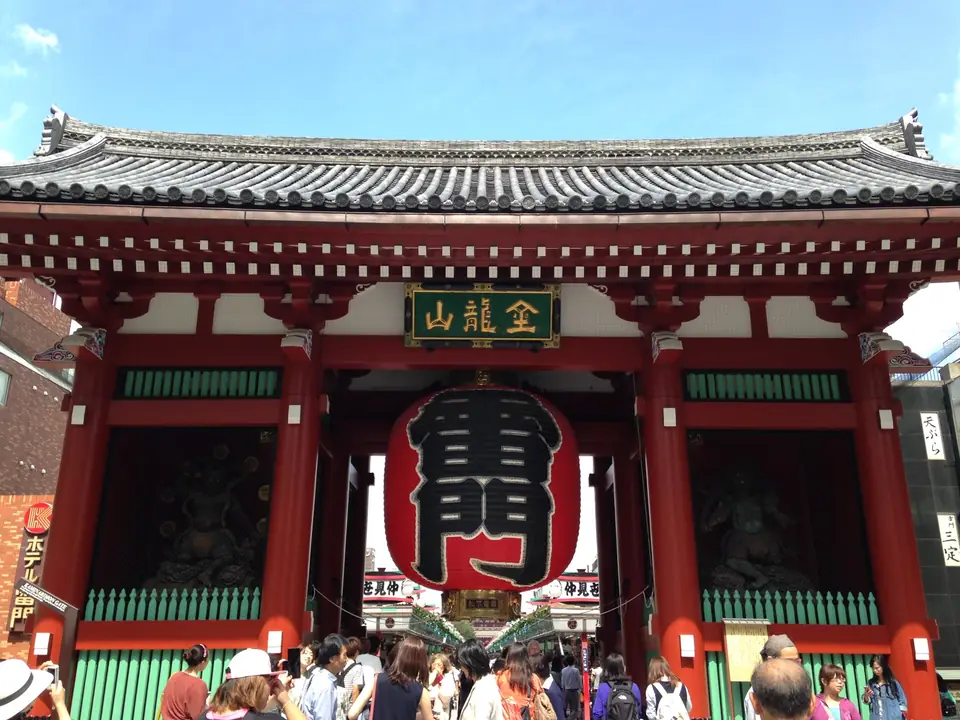
Tokyo’s most photographed gate is younger than it looks. After the fire of 1865, which by the Gregorian calendar falls already in January 1866, the Kaminarimon spent 95 years without a permanent gate. The present one, of reinforced concrete, was inaugurated in 1960, paid for by Matsushita Kōnosuke, founder of today’s Panasonic, after the abbot had prayed for the cure of his neuralgia. At the sides stand guard Fūjin and Raijin, the gods of wind and thunder.
The great red lantern is 3.9 metres high and 3.3 wide and weighs about 700 kilos. On the front it reads 雷門, Kaminarimon; on the back, 風雷神門, Fūraijinmon, its official name. And on the lower ring, beside the carved dragon of the base, a gilded plaque still says 松下電器, Matsushita Denki, although the company has been called Panasonic since 2008.
Nor does it always hang the same way. During the Sanja Matsuri in May, the festival of the neighbouring Asakusa shrine, the lantern is folded so the bearers of the mikoshi, the portable shrines, can pass beneath, and the same happens when a typhoon approaches. Why a symbol of the city shrinks like an accordion before the gods on their litters is what the narration tells beneath the lantern itself.
Shops born from sweeping the temple
Nakamise Street
Summary of this stop
Between the Kaminarimon and the Hōzōmon stretch some 250 metres of vermilion shops: Nakamise-dōri. Its origin is a pact. Around 1685 the temple imposed the cleaning of the grounds on the neighbours as compulsory service and, in exchange, allowed them to open stalls before the subtemples along the approach. The two rows of today, of concrete with the air of temple architecture, were raised in 1925, after the fire of the 1923 earthquake razed the street; that time, a bucket chain led by the district’s fire foremen stopped the flames before they reached the main halls.
Twice a year, the street changes pace. According to the legend that gives the temple its mountain name, Kinryūzan, after the finding of the image a forest of a thousand pines sprang up in one night and a gold-scaled dragon came down from the sky to them. From that was born the Kinryū no mai, the golden dragon dance: every 18 March and 18 October, a dragon some 18 metres long, moved by eight dancers, runs the length of Nakamise chasing a lotus flower that represents Kannon. It looks like a millennial rite, but it has a very precise premiere date, and what it is gets revealed in the middle of the street.
Straw sandals for a giant
Hōzōmon Gate
Summary of this stop
The Hōzōmon, the second gate, reaches 22.7 metres and keeps the temple’s sutras on its upper floor. It was rebuilt in concrete in 1964 with 150 million yen from Ōtani Yonetarō and his wife. On its north face hang two waraji, straw sandals of 4.5 metres, which the town of Murayama, in Yamagata, weaves with 2,500 kilos of straw and renews every ten years: it is the birthplace of Muraoka Kyūsaku, author of the niō guardian on the right.
Above the gate, the tiles that look ceramic are titanium. The Hōzōmon was in 2007 the first customer for this material; the Hondo adopted it in 2010 and the pagoda in 2017.
Beside the gate, a small chapel keeps the most paradoxical custom of the grounds. It is the Kume no Heinai-dō, with the stone statue of a 17th-century swordsman who died in 1683. According to tradition, in his youth he vowed to kill a thousand men; in old age he became a Zen disciple and asked that his figure be buried beside the busiest gate so the whole city would tread on it. How a play on characters turned that penitent into protector of lovers is heard in front of the chapel.
The Kannon nobody sees
Great incense burner before the Hondo
Summary of this stop
Before the steps of the Hondo, the great incense burner is always surrounded by people wafting the smoke toward their bodies. Behind rises the Kannon hall, with its steep roof, finished in 1958. The previous one, from 1649, burned down entirely on 10 March 1945; to pay for the new one, begun in 1951, the temple sold the 2,400 tsubo of the Hyōtan-ike pond.
Inside, a golden shrine holds the image that, according to tradition, the Hinokuma brothers pulled from the river in 628. Nobody beholds it: since 645 it has stayed under lock as a secret buddha, and the crowd that fills the square prays before a closed shrine. The year of the finding and the name of the local chief who founded the temple come from Sensō-ji’s own chronicle and vary according to the versions. What this square says about the faith of Asakusa, and why an invisible image gathers so many people, is the centre of the narration at this point.
A buried bowl and a burned ginkgo
Bronze bowl of the Awashima-dō
Summary of this stop
On the west side of the grounds, beside the Awashima-dō, a large bronze bowl for rainwater, a tensui-bachi, is preserved. During the bombing of 1945 the secret image was inside, buried about 3 metres beneath the Hondo, and so it survived while the hall burned entirely above it.
Very close by stands a sacred ginkgo over 800 years old. An incendiary bomb hit its base: it lost the upper half of its crown and the inside of the trunk was left charred and hollow, but the tree still puts out leaves.
The five-storey pagoda, about 48 metres above a 5-metre base, was rebuilt in 1973 to the west of the Hondo. The one that burned stood on the other side, to the east, where today only a stele inscribed 旧五重塔跡 marks its former site. That shift, and what it reveals about how the temple was remade, closes the walk.