Arctic architecture icon
Arctic Cathedral Audio Guide (Ishavskatedralen)
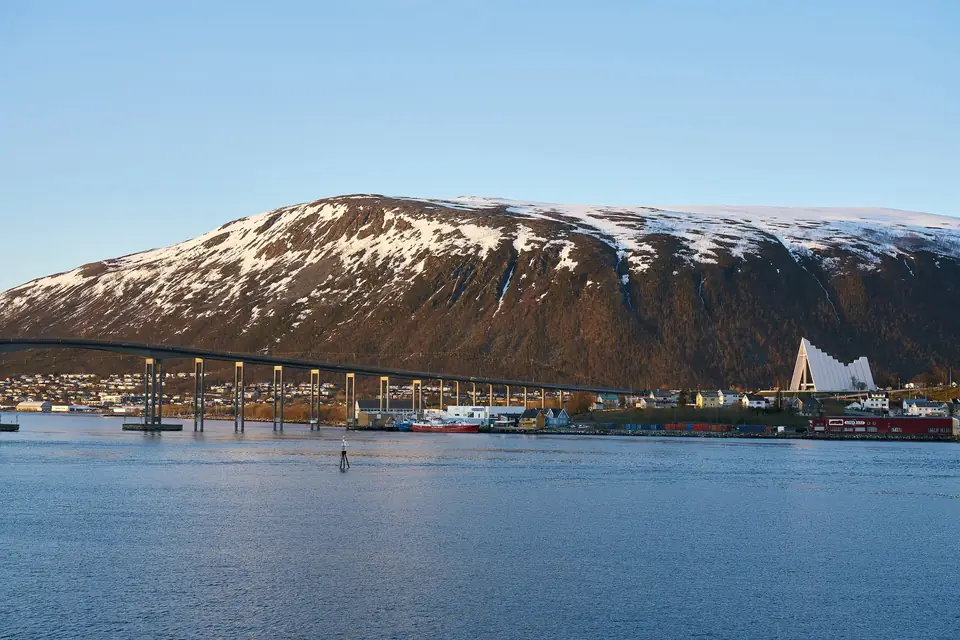
Eleven aluminium-clad concrete panels that gleam like ice facing the Tromsø bridge: a neighbourhood church of 1965 that the city renamed a cathedral the very day it opened and that, in the polar night, glows like a lighthouse.
- 40 min of audio
- Modern architecture
The Arctic Cathedral grew out of forty years of fundraising by a parish association that wanted a church on the mainland shore of the Tromsøysund strait. In 1955 the municipality granted it the Sofiero estate, a knoll beside the water; the architect Jan Inge Hovig drew the first plans in 1957 and building began in April 1964. In 1965 Bishop Monrad Norderval consecrated a building without precedent in the north: eleven concrete panels leaning on one another, with slits of glass through which light enters by day and escapes by night.
Its official name is Tromsdalen Church and it has never been a cathedral: the cathedral of Tromsø is the wooden one in the centre. The nickname, Ishavskatedralen, the Arctic Ocean Cathedral, was given by local residents as soon as it opened. And its skin of ice is the result of a settling of accounts: copper was ordered for the roof, proved too expensive, and Hovig opted for an aluminium that cost half as much.
Highlights
- Eleven stepped panels — concrete clad in pearly aluminium with glass strips that light up at night
- West gable — a 35-metre glass wall with a concrete cross holding up the tallest panel
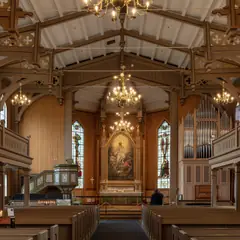
- “Kristi gjenkomst” mosaic by Victor Sparre — 140 m² and 11 tonnes of dalle de verre behind the altar
- 2005 Grönlund organ — 2,940 pipes shaped like icicles and an aurora, and a reindeer-skin bellows
- Midnight sun concerts — they begin shortly before twelve so the audience walks out into the summer light
The story of the Arctic Cathedral is that of a neighbourhood church that ended up as a symbol of Tromsø. For four decades of the 20th century, a parish association in Tromsdalen gathered money to build a church on the mainland shore of the Tromsøysund strait. In 1955 the municipal council set aside the Sofiero estate, on a knoll beside the water; Jan Inge Hovig made the first drawings in 1957, was chosen as architect in 1959, and a royal resolution of 1962 fixed that the church would be built to his plans. When the newspaper Tromsø published his first sketch, on 23 November 1960, it headlined it “Et uvanlig kirkeforslag”: an unusual church proposal. Work began on 1 April 1964 with the contractor Ing. F. Selmer A/S, cost 4,169,815 kroner, and in 1965 Bishop Monrad Norderval consecrated the church (sources differ between 19 November and 19 December). Anyone asking what to see at the Arctic Cathedral finds an architecture designed for northern light, an enormous mosaic behind the altar and an organ that fulfilled the wish of a dead architect. The audio guide walks around the outside and through the nave with a story researched and checked against sources, from the knoll facing the bridge to the organ gallery.
In the centre of the island, Tromsø Cathedral is the city’s other cathedral, wooden and more than a century older, and a kilometre from the church, in the same Tromsdalen, the Fjellheisen cable car climbs to the Storsteinen ledge.
Eleven aluminium panels that look like ice
Ishavskatedralen
Summary of this stop
Seen from the side, the Arctic Cathedral reads as a succession of slabs sloping down to the ground, stepped from one end to the other. They are eleven panels of lightweight concrete poured in situ, leaning on one another over a steel lattice that leaves a slit between each pair. Through those strips of glass daylight comes in and, in the months of polar night, the light from inside spills outwards: hence the lighthouse image the church casts over the strait.
The pearly shine that suggests ice has an unromantic origin. Copper sheets were first ordered for the roof, but they proved too expensive, and Hovig chose an aluminium at half the price. Nor is the name what it seems: the church is officially the parish church of Tromsdalen, in the Tromsøysund parish, and the cathedral label was a neighbourhood nickname that stuck for good.
Among visitors another reading of those panels circulates. Popular belief has it that the eleven on each side stand for the apostles who remained after Judas’s betrayal, with the twelfth deliberately absent. Hovig never explained it that way, and the audio guide tells beside the wall what the architect really said about its shape.
The cross that holds up the cathedral
Glass west gable with the great cross
Summary of this stop
The entrance facade is a 35-metre triangle, all of glass, with a concrete cross that fills its whole height. It is not merely a symbol: it is a structural piece that stabilises the eleventh panel, the tallest in the building. On either side, two identical doors; in front, the flight of steps from which the Tromsøysund strait, the arc of the bridge and the city centre on the island open out.
That view explains much of the architecture of the Arctic Cathedral. Hovig said the bridge inspired a counter-form: the concave line that drops towards the centre of the church and rises again at the gables answers the arch before it. He wanted, he said, a church that would act as a sculpture, and he spoke of the aurora, of the island of Håja and of the three months of polar night. Other popular explanations, such as a boat shed, a fish-drying rack, an iceberg or a Sami tent, rest little on his words, and he himself gave different versions on different occasions.
Above the entrance hang two bells from different eras. The small one, of 1965, weighs 570 kilos and carries a dove with an olive branch; the other original had to be replaced, and in 1996 one of 1,050 kilos arrived, almost twice as heavy, decorated with an open Bible. The audio guide pauses on the steps to join bridge, cross and bells into a single story.
The mosaic that hid the mountain
Victor Sparre's “Kristi gjenkomst” mosaic
Summary of this stop
Inside, the whole east gable, behind the altar, is taken up by “Kristi gjenkomst”, The Return of Christ, the mosaic by Victor Sparre that almost every source dates to 1972. It measures some 23 metres high and 140 m², and has no lead: its 11 tonnes of dalle de verre, in slabs 3 centimetres thick, are set in concrete and iron. At the centre, the hand of God casts three rays of light, one towards the risen Jesus, another towards a woman and another towards a man, while Adam and Eve appear as two grey concrete figures against the colour of the glass. The whole serves as an altarpiece.
That wall was not in Hovig’s plans. The east gable was to be clear glass, so that from the bridge the silhouette of Mount Tromsdalstinden could be seen through the church. The mosaic closed off that view and was installed against the architect’s wishes; today the mountain is hidden behind the building.
The thickness of the pieces makes the wall change with the calendar: on sunny mornings it turns almost transparent, with the midnight sun coming in from the west its colours intensify, and in the dark months it is dim from inside, though still visible from outside. In front of the altar, the audio guide tells how each season reads in the glass.
An organ of icicles that Hovig never heard
Grönlund organ in the upper gallery
Summary of this stop
In the upper gallery, against the western glass wall, rises the pipe facade of the Grönlund organ, with forms that recall icicles and the northern lights; the fan-shaped console is one floor below. Inaugurated on 17 December 2005, on the church’s 40th anniversary, it has 42 stops, three keyboards and 2,940 pipes from 5 millimetres to 32 feet, and its bellows is made of reindeer skin. It replaced the original organ of 1965, with 22 stops, which stopped working when several of its pipes bent under their own weight.
Those ice forms were a wish of Hovig’s, who never got to hear them. In June 1977 he married Ingrid Espelid, a cook and well-known face of Norwegian television, and a week later, on 4 July, he died of a heart attack in Oslo. The organ that fulfilled his idea came almost thirty years afterwards.
It was paid for partly with donations and partly with tourist tickets and the midnight sun concerts, which in summer begin shortly before midnight so the audience walks out into the light. Concerts are held all year round, often with the parish’s five choirs, and on New Year’s Eve the organ sees out the year in the middle of the polar night. Beneath the gallery, the audio guide closes the route with the story of that wish fulfilled too late.