Wooden cathedral
Tromsø Cathedral Audio Guide (Tromsø domkirke)
The only Protestant wooden cathedral in Norway: a yellow neo-Gothic church of interlocked logs, raised in 1861 at the limit of what timber could bear, in a park that was the city's medieval cemetery.
- 30 min of audio
- Neo-Gothic architecture
Tromsø Cathedral was consecrated on 1 December 1861, when it had neither exterior cladding nor paint. It is the work of Christian Heinrich Grosch, one of the last of his nearly 80 churches: a neo-Gothic longitudinal nave of logs joined in laft and clad in boards. It was promoted by Johannes Steen, mayor of the city and later prime minister of Norway, and built by the master builder Ditlev Gunerius Evjen with timber brought from Målselv.
The promoters demanded a long wooden church without columns, and the building paid for it. By 1956 the roof had the shape of a saddle and the walls visibly bowed; in the 1980s new deviations caused great alarm, and today iron ties cross the nave from wall to wall to hold roof and walls in place.
Highlights
- Kirkeparken — the city's first official park, laid out over the medieval cemetery, with gravestones still in view
- West tower — raised in 1862 on the site of the choir of the church where the 1814 vote was held
- Columnless nave — crossed by iron ties that hold up roof and walls
- Resurrection altarpiece — an 1884 copy of Adolph Tidemand's work, beside Per Vigeland's stained glass of 1961
- Claus Jensen organ — 23 stops from 1863, one of the most valuable 19th-century organs in Norway
The story of Tromsø Cathedral begins long before its logs. Around 1250 King Håkon Håkonsson ordered the first church built here, a royal chapel that belonged to the king and not to the Church. Centuries later, on 5 April 1860, the municipal council unanimously approved a new church; the foundation stone was laid on 24 April before a great crowd and by autumn the building was already under a roof. The result is the only Protestant cathedral in Norway built of wood, a neo-Gothic church with ochre walls by Christian Heinrich Grosch, in the middle of Kirkeparken. Guidebooks often present it as the northernmost Protestant cathedral in the world, though other sources give it only as probable. It should not be confused with the Arctic Cathedral, the white triangular church across the bridge: this is the yellow church of the centre. Anyone asking what to see at Tromsø Cathedral finds an architecture pushed to the limit and a story of votes, war and music. The audio guide walks around it outside and in, with a story researched and checked against sources.
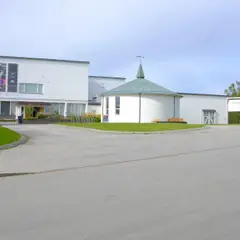
Across the bridge, the Arctic Cathedral is the city’s other cathedral, from 1965 and of concrete and aluminium, and 400 metres away Ølhallen, the oldest pub in Tromsø, keeps the memory of the Arctic trappers.
A park sown over graves
Old graves in Kirkeparken
Summary of this stop
The route starts on the northeast side of Kirkeparken, where gravestones of the old cemetery are still in view. The park around the cathedral, Tromsø’s first official park since 1861, occupies the former medieval burial ground, in use until 1839. When it was remodelled in 2017 and 2018, 65 burials and a gravestone turned up: beneath the quiet lawn the city of the dead remains.
From here the skin of the building can be read. The ochre walls imitate the tone of wood because they are wood: logs joined in laft and clad in boards, the traditional Norwegian technique stretched to the size of a cathedral. Grey pilasters divide the long walls and the window frames are white. It was not always so: for a long time the church was painted entirely white, and it was in the 1980s that it regained its original colours, though sources do not fully agree on the dates of that return. The audio guide tells, in front of the graves, how a cemetery ended up as the city’s garden.
The tower planted on the old choir
Tromsø domkirke
Summary of this stop
Before the west tower, stepped from the porch to the spire and topped by a dated weathervane, an esplanade opens towards Storgata. There stood the earlier church, a cruciform log church painted red and finished in 1803, and the base of the present tower occupies the exact site of its choir. In 1860 the two stood wall to wall: the new one rose beside the old, still standing. The tower came in 1862 and the bells, cast in Hamburg, rang from it for the first time on 6 June 1864.
That red church holds a founding episode. According to documented tradition, in 1814 the first round of the elections to the Constituent Assembly of Eidsvoll, Norway’s first national elections, was held inside it. And the building was not lost: it was dismantled in 1861, reconsecrated in 1863 south of the centre as Tromsøysund kirke and in 1975 reopened, moved again, as Elverhøy kirke. Where it stands today and why it figures among the surviving election churches of 1814 is one of the surprises the narration keeps for this point.
A columnless nave that almost gave way
Iron ties of the nave
Summary of this stop
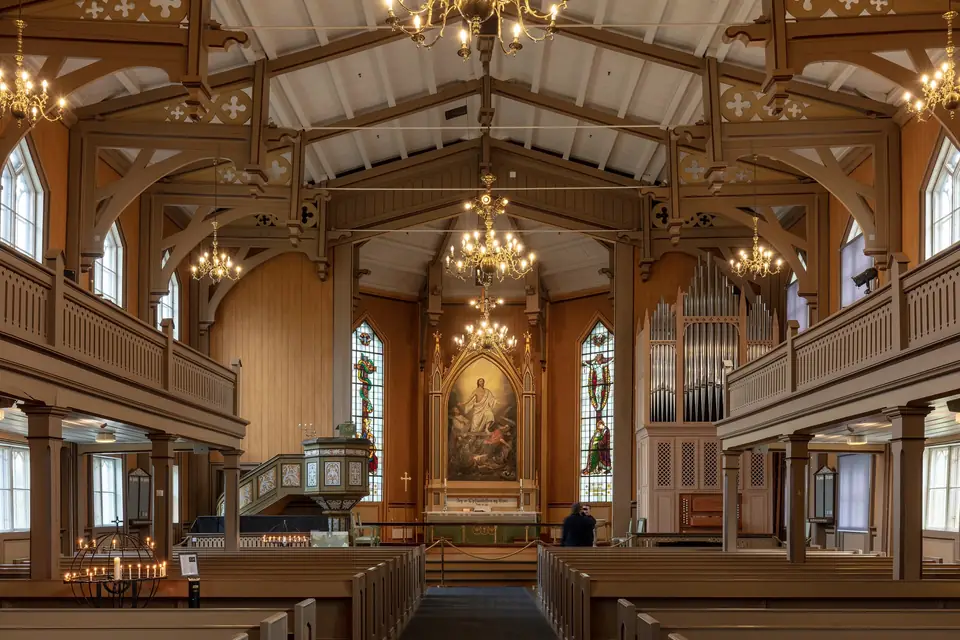
Inside, the nave opens without a single column, crossed by iron bars from wall to wall. The broad grey pilasters outside conceal tension rods that hold the logs of the walls. Grosch had drawn in 1859 transverse walls that projected a little over a metre into the nave, and everything suggests the promoters, set on a long church without columns, did not accept them. When large deviations were detected in the 1980s, some blamed the architect for overestimating the structure; others consider it more likely that pressure from the promoters was excessive. Today all the trusses are reinforced with iron ties.
The nave also bore the weight of war. In the winter of 1944 to 1945 the cathedral housed the forced evacuees from Finnmark: the pews were joined in pairs and each family’s address was the number of its pew, with a Norwegian guard and a German one at the door. Earlier, in 1940, Bishop Wollert Krohn-Hansen had been consecrated here with the city already occupied, and in 1942 he left his post in protest against the Nazi regime. How the city answered the dean imposed by Quisling’s party, in the quietest way possible, is told beneath the ties.
From the altarpiece of 1884 to the organ of 1863
Resurrection altarpiece
Summary of this stop
At the far end, the polygonal chancel, lower and narrower than the nave, frames a neo-Gothic altarpiece of the portal type. Its painting, put in place in 1884 and largely paid for by the city’s merchants, is a copy by Christen Brun of Adolph Tidemand’s “The Resurrection”, whose original is in Drammen; beneath it one reads “Jeg er Opstandelsen og Livet”. On either side, Per Vigeland’s stained glass, installed in 1961 and paid for by a collection, shows Moses’s bronze serpent and Jesus’s farewell to his disciples.
The sound comes from behind. In the gallery over the entrance stands the Claus Jensen organ, installed for Easter 1863, with 23 stops: the third largest by its maker and one of the most valuable organs of the 19th century in Norway, restored to its original state in 2013 and 2014. Since 2017, a second organ from the German firm Mühleisen, beside the choir, can be played from Jensen’s console. And for more than two decades, at eleven at night, the cathedral has hosted the midnight concerts, half an hour of psalms, traditional music from northern Norway and Sami song. The audio guide closes here, with what this wooden church has gone on sounding.